By Austin Weber, Senior Editor// webera@bnpmedia.com
Battery Testing Is Vital to Producing Affordable, Reliable EVs
INDUSTRY INSIGHT
A new facility near Detroit specializes in heavy-duty metal structures.
Modular systems enable engineers to develop better products.
New EV battery cells feature higher power and lower resistance. Photo courtesy BMW AG
Whether they roll, float or fly, electric vehicles require powerful, safe and robust rechargeable battery packs. That’s why traditional suppliers and start-up companies around the world are scrambling to come up with a “Model T moment”—a battery that is cheap, reliable and easy to mass-produce.
Traditionally, scaling up from lab-based prototypes to full-scale production lines can be a daunting task. Testing plays a critical behind-the-scenes role in the process.
Unfortunately, new systems typically require pages of code to make them behave like a battery. And, not all high-voltage test systems use CAN bus, forcing engineers to write more code to control tests.
Ametek Programmable Power Inc., a leading manufacturer of battery test systems, including programmable AC and DC power supplies, electronic loads and power subsystems, has addressed the challenge. At the recent Battery Show in Detroit, the company showcased its Mi-BEAM and i-BEAM products that are designed to simulate real-world conditions and accelerate validation cycles of batteries, inverters and power train systems.
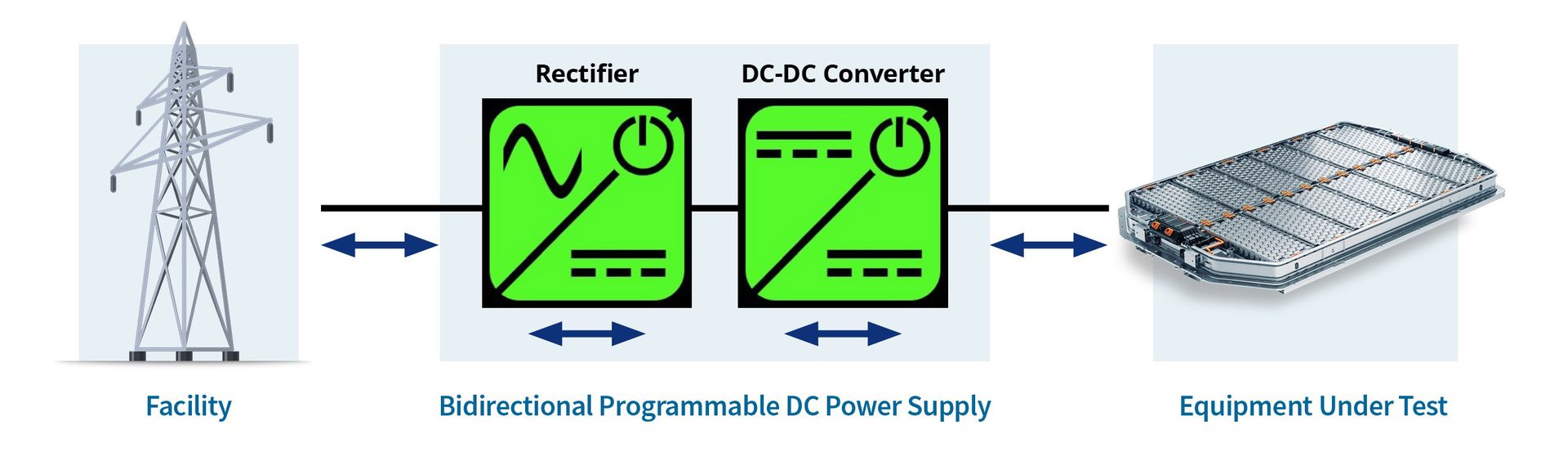
A battery test system made with bidirectional power supplies can draw power from an EV battery and return it to the grid, lowering facility energy costs. Illustration courtesy Ametek Programmable Power Inc.
“The Modular Intelligent-Bidirectional Energy AMplified (Mi-BEAM) allows users to scale with a modular approach,” says Ben Jackson, director of product line management at Ametek Programmable Power. “It includes built-in features to allow for future test needs without having to buy an entirely new system. As users need more power, they just add a new power supply.
“Increased voltage allows for future expansion past the current 1,000- to 1,500-volt EV battery requirements via stackable 37.5-kilowatt-hour building blocks,” explains Jackson. “Mi-BEAM’s modular, regenerative design enables precise control and efficient performance, helping [engineers] accelerate development, while improving safety and sustainability.”
The system also has numerous features to ensure safe testing, such as islanding detection, output isolation, over-voltage protection, over-temperature protection, output current limit protection, reverse polarity detection, and both hardware and software limit controls.
Autonomous & Electric Mobility recently asked Jackson to explain the latest trends and issues affecting EV battery testing.
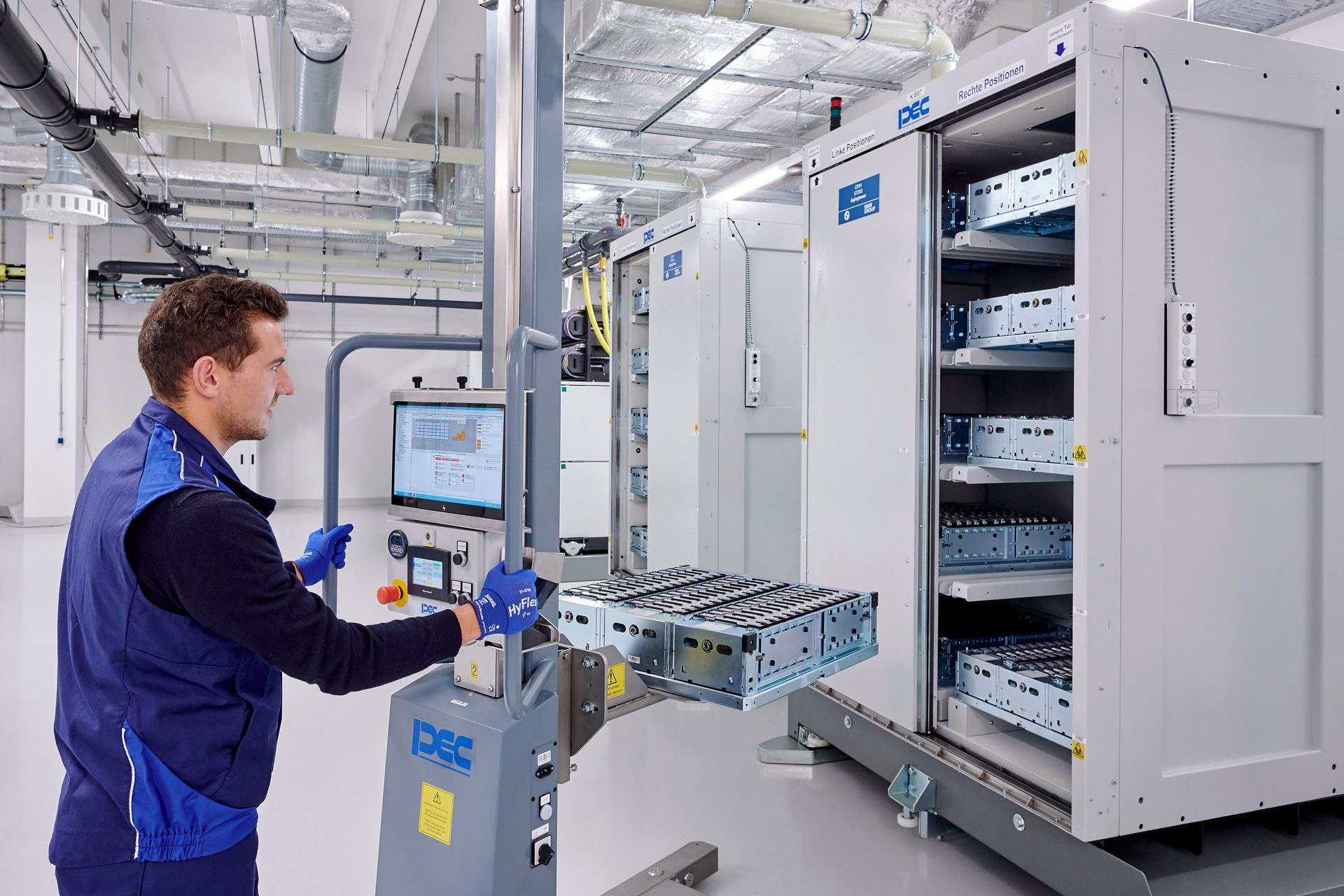
Battery testing systems that are easy to use and easy to scale enable manufacturers to develop better products. Photo courtesy BMW AG
AEM: What is the latest development in EV battery technology?
Jackson: There’s so much research focused on lowering cost, shortening charging time and extending EV driving ranges. Thanks to new chemistries and advancements in construction, cells are emerging with higher power and lower resistance. At the pack and module level, higher voltages enable lower currents, which translate into smaller, lighter wiring and connections. This, in turn, reduces vehicle cost. Battery makers are packing more energy into new devices and in the next few years, more than 500 miles of battery life will become realistic. Also, new chemistries are working toward 80 percent charge in 10 to 15 minutes.
The industry is at a point where costs can come down to spur adoption. Battery manufacturers are reducing the content of high-cost materials, such as cobalt and nickel, and moving to lower-cost, more abundant manganese and sodium-ion chemistries. Lithium-iron phosphate batteries, a lower-cost lithium technology, will become more prevalent. Ford Motor Co., for instance, recently announced that it will use the technology to produce EVs that are competitively priced with internal combustion engine vehicles.
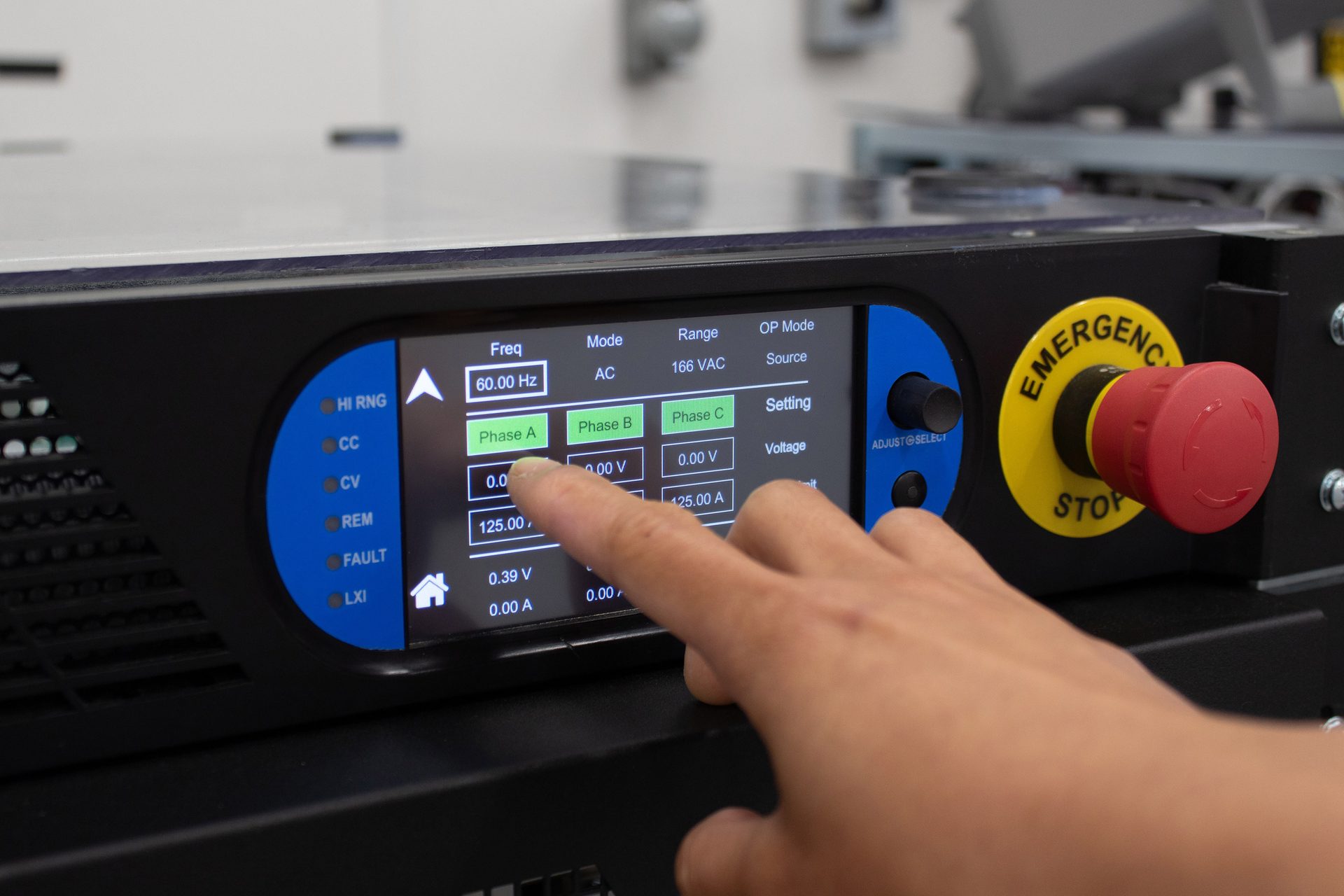
Scalable, future-proof systems enable manufacturers to grow with the same battery testing equipment. Photo courtesy Ametek Programmable Power Inc.
AEM: How has EV battery manufacturing changed in the last few years?
Jackson: As the industry matures, battery manufacturers are striving to reduce costs by standardizing modules, improving yields and utilizing materials more carefully. One barrier has been battery test equipment that is difficult to scale and use. For example, some test systems are not modular, preventing economic or efficient ability to scale with development. Safety has been another concern. Fortunately, EV battery test systems are emerging that are more foolproof. They feature additional isolation and monitoring capabilities that are easy to use and easy to scale by adding modules.
AEM: Because of recent tariffs, are you seeing a renewed interest in domestic battery production?
Jackson: U.S.-based battery manufacturers, such as EOS Energy Enterprises, have seen a large increase in interest and business compared to industry giants based in China and Korea. The cost and risk of relying on offshore supply chains are growing. Tariffs increase the incentive for battery manufacturers to localize production in the U.S. so they can avoid import duties, improve supply chain security, and capture tax credits or incentives linked to domestic content. The U.S. government is supporting domestic battery manufacturing through programs such as the “45X Advanced Manufacturing Production” tax credit, which rewards domestic production of battery cells, modules, components and materials.

AEM: What’s new in battery test and inspection systems?
Jackson: Battery testing requires a bidirectional test system with source-and-sink capability. Such systems have been available for years, but now we see more power-dense and scalable systems. Factory floor space is important. The size of test systems has grown to match the increased power of modern batteries with power-dense test systems consuming less floor space. The systems have also become modular, so the equipment can easily scale with production volume and battery capacity. In addition to power, test systems must now support greater than 1,000 volts.
At these higher voltages, creating a more efficient test becomes increasingly important not only to reduce R&D costs, but to allow for expanded facility capabilities within the existing electrical footprint. Battery test systems capable of returning power to the grid (bidirectional), rather than dissipating absorbed energy as heat, allow for this by lowering facility energy costs, avoiding the need for additional HVAC infrastructure, and improving space requirements.
AEM: What type of testing equipment are battery manufacturers looking for today?
Jackson: Scalable, future-proof systems that allow manufacturers to grow with the same test equipment. Having a product that can start small and scale with [demand] is crucial to providing a seamless capability for expansion with minimal impacts to introducing new variables.
AEM: Why has it been challenging to scale test systems from the prototype stage to full-scale production?
Jackson: In the past, you would buy what you needed for specific tests, and if those requirements changed, you would need to change the entire system. This added time and cost, which hindered growth for manufacturers. High-powered instrumentation was generally not modular in the past, but is now available.

DECEMBER 2025 | ASSEMBLYMAG.com