Toyota Ramps Up Battery Production in North Carolina
NEWS
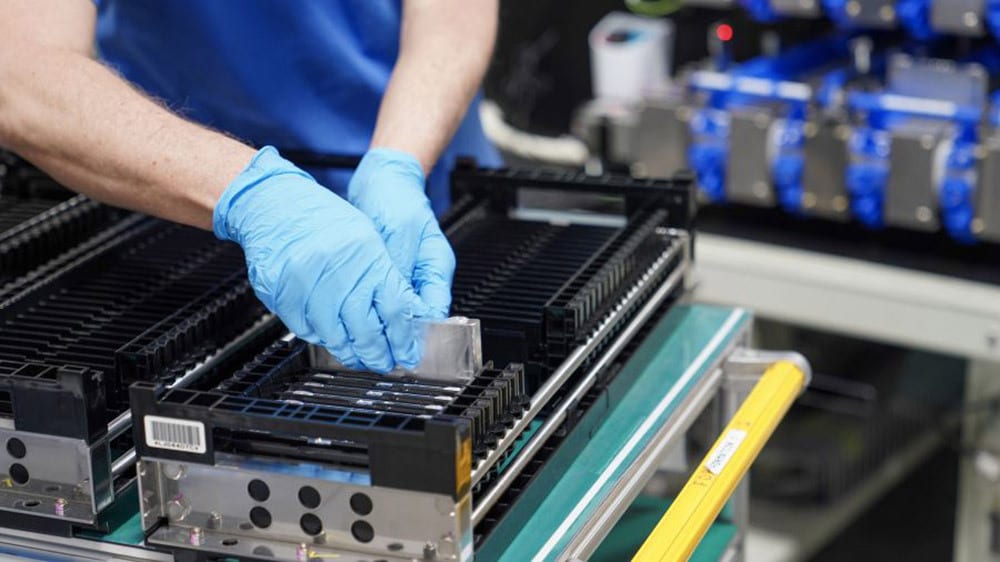
Toyota’s new factory in North Carolina will produce lithium-ion batteries for electric and hybrid vehicles. Photo courtesy Toyota Motor Corp.
LIBERTY, NC—Toyota Motor Corp. has ramped up production at its new lithium-ion battery plant here. The $14 billion facility is the automaker’s 11th U.S. plant, and its first and only battery factory outside of Japan.
The 1,850-acre site can produce 30-gigawatt-hours annually at full capacity. The state-of-the-art plant will house 14 battery production lines to support Toyota’s growing portfolio of hybrid electric vehicles (HEVs), battery electric vehicles and plug-in hybrid electric vehicles.
Batteries assembled at Toyota North Carolina will power vehicles such as the Camry HEV, Corolla Cross HEV and RAV4 HEV that are assembled at plants in Georgetown, KY and Greenbrier, AL. Additional production lines at Toyota North Carolina are expected to ramp up by 2030.
“Today’s launch of [our] first U.S. battery plant…marks a pivotal moment in our company’s history,” says Ted Ogawa, president and chief executive officer of Toyota Motor North America. “Toyota is a pioneer in electrified vehicles, and the company’s significant manufacturing investment in the U.S. and North Carolina further solidifies our commitment to team members, customers, dealers, communities and suppliers.”
“We’re excited to see this innovative facility come to life and to provide cutting-edge careers for more than 5,000 North Carolinians,” adds Don Stewart, president of Toyota North Carolina. “Today’s celebration would not be complete without thanking our team members. Their dedication, commitment and resolve have truly led us to this historic moment.”
During the dedication ceremony, Toyota announced that it also plans to invest up to $10 billion in the U.S. over the next five years to support future mobility efforts. And, the automaker is donating $2.7 million to Driving Possibilities in Guilford County Schools and the Asheboro City School District. Driving Possibilities is a national STEM education initiative that brings together community, education leaders, local and national nonprofits, and industry partners to co-create programs that strengthen communities and prepare young people for future careers in manufacturing.
EV Training Center Supports New Hyundai Plant
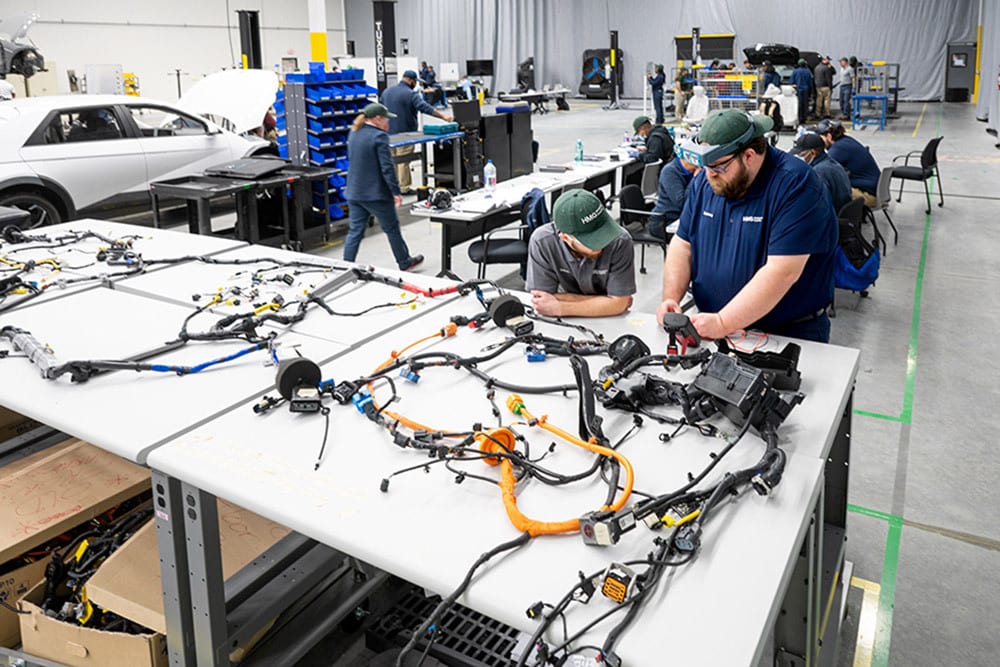
Assemblers learn how to install high-voltage wiring harnesses at the Hyundai Mobility Training Center. Photo courtesy Georgia Quick Start
ELLABELL, GA—The new Hyundai Mobility Training Center here will support the automaker’s assembly plant. The 89,000-square-foot facility will teach workers how to build next-generation electric vehicles.
The state-of-the-art center is operated by the state’s workforce development program and is part of the Technical College System of Georgia. At full capacity, it will be able to train up to 824 individuals at a time.
The facility features a 5,764-square-foot multipurpose “momentum room,” six flexible classrooms, a robotics lab, a welding lab and a paint lab. It is designed to ensure that Hyundai assemblers learn the skills they need on the plant floor. Georgia Quick Start has simulated production processes in a safe, hands-on training environment.
“Quick Start’s training professionals collaborated with [us] to design and build world-class infrastructure that closely mirrors the processes trainees will encounter [in the factory],” says Tony Heo, president and CEO of Hyundai Motor Group Metaplant America.
The facility includes a STEP (Safe Transition for Efficient Production) assembly line that enables new employes to build timing, awareness and coordination skills in a controlled, digital environment. In addition, an IMPACT (Immersive Manufacturing Process and Conveyor Training) assembly line features a full-length, moving production line with 53 integrated assembly activities and a built-in quality check system that replicates real-world EV production.
Other hands-on learning will take place in a high-voltage battery and safety lab; a VR experience lab; and an automation and mechatronics lab featuring programmable logic controllers (PLCs), sensors, motion systems and industrial automation.
All-Climate Battery Addresses Extreme Temperature Challenges
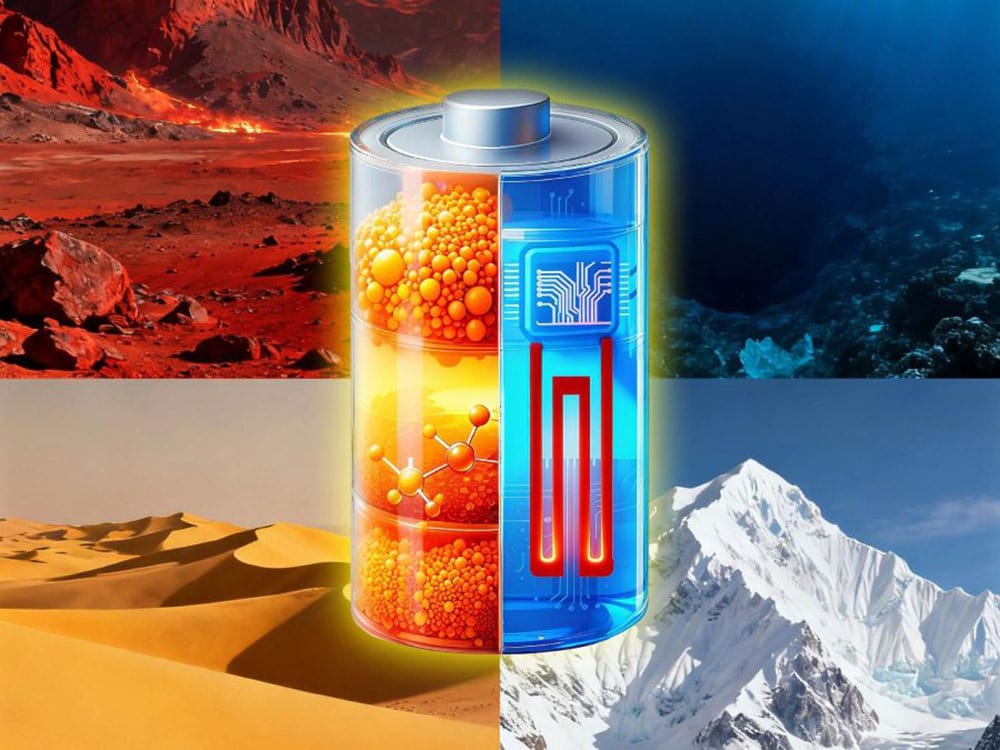
A new all-climate battery can operate safely in hot environments, while supporting operation in cold environments. Illustration courtesy Chao-Yang Wang/Wen-Ke Zhang/Pennsylvania State University
UNIVERSITY PARK, PA—Lithium-ion batteries don’t like cold weather. Unfortunately, that can create a winter driving headache for electric vehicles owners in many parts of Asia, Europe and North America.
Engineers at Pennsylvania State University have developed a battery that addresses those challenges and can operate in many extreme climate conditions. The all-climate battery (ACB) features an internal heating element that optimizes materials for high stability and safety in hot environments, while supporting operation in cold environments. It avoids compromising stability and safety in one climate to improve performance in another.
According to Chao-Yang Wang, Ph.D., a professor of mechanical engineering who is heading up the R&D project, previous approaches have proven incapable of simultaneously improving efficiency at lower temperatures and increasing stability at higher temperatures. “There has always been a tradeoff and a fundamental design flaw,” he points out.
“Although external heating or cooling mechanisms are used to help keep batteries operational today, these bulky, power-intensive systems are inefficient and require frequent maintenance,” says Wang. “Even with external temperature management, lithium-ion batteries lose performance at cold temperatures and experience reduced capacity and stability at high temperatures. Maintaining reliable operation at external temperatures ranging from -30 to 45 C severely limits their [use] in extreme environments.
“This is the key aspect of our research,” notes Wang. “By optimizing the materials used for hot temperatures and implementing an internal heater to warm the battery, in turn improving performance at low temperatures, [we] address this thermal roadblock.”
Wang and his colleagues adjust the material makeup of the electrodes and electrolytes in the ACB to better handle hot environments. Their internal heating structure is composed of a thin film of nickel foil that is only about 10 microns thick. This structure, which is powered entirely by the battery, allows the system to self-regulate temperature, while adding virtually no weight or volume.
This increases the number of environments batteries can reliably operate in, widening their operational temperature range from -50 to 75 C. In addition to improved versatility, removing external thermal management systems offers performance benefits.
“By incorporating thermal management into the battery itself, we significantly cut down the space the batteries take up, as well as other variables associated with external heating or cooling,” explains Wang. “The cost, power consumption and need for maintenance are significantly reduced.”
Wang claims that ACBs could be further optimized to operate at temperatures as high as 70 to 85 C with proper development and testing, which will be necessary to support the growing scale of systems that rely on batteries for power storage.
“Our society is only growing more power-dependent, and shows no sign of slowing down,” says Wang. “As we continue to develop technology like data centers, advanced drones and electric vehicles that require tons of power, we will have to continue improving the batteries that power them.”
Joby Begins Producing Air Taxi Propeller Blades in Ohio
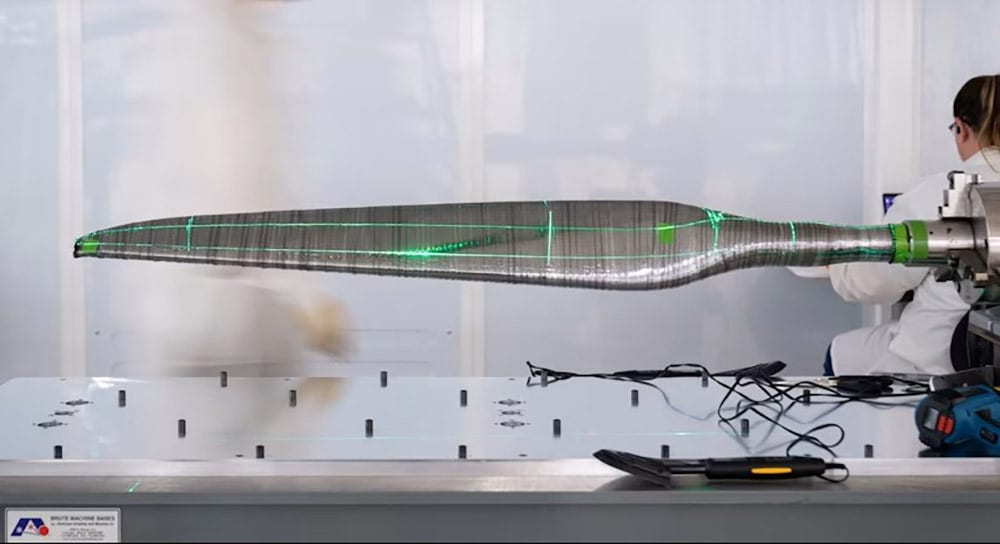
Joby is producing propellor blades for its air taxi at a factory in Dayton, OH. Photo courtesy Joby Aviation Inc.
DAYTON, OH—Joby Aviation Inc. has begun to manufacture propellor blades at its factory here. The company’s Midnight air taxi uses five blades per propeller and 30 per aircraft.
“This milestone expands in-house manufacturing of a critical conforming component and builds on the work already underway in Ohio, including testing, underscoring Dayton’s historic role in aircraft production ahead of commercial launch,” says Eric Allison, chief product officer at Joby.
“Dayton gives us the resources, talent and speed to scale one of the most technically demanding parts of our aircraft,” explains Allison. “[Our] propeller blades are a key part of what makes our aircraft special—central to its low acoustic profile and the result of a decade of complex engineering.
“Designed for quiet flight and built with extreme precision, the propeller blades require complex carbon manufacturing processes and a highly skilled workforce, both available in Dayton,” Allison points out. “Production could [someday] reach up to 15,000 blades a year.”
Eventually, Allison says the Dayton facility will be able to support the assembly of up to 500 aircraft a year, making it a strategic site for the mass-production of its aircraft components.

DECEMBER 2025 | ASSEMBLYMAG.com