Ford to Build Mass-Market EV Using a New Assembly Process
NEWS
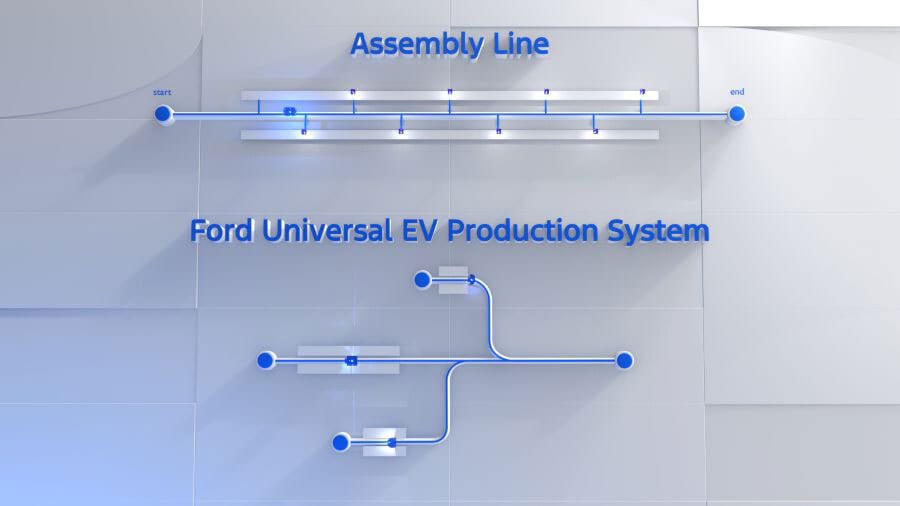
Ford’s Universal EV Production System will use subassembly lines to reduce assembly time and complexity. Illustration courtesy Ford Motor Co.
LOUISVILLE—Ford Motor Co. plans to build a midsized electric pick-up truck at its assembly plant here. The company says the $30,000 vehicle represents a “Model T Moment” that will make EVs available to more people, just like the Model T did when it was launched in 1908.
Ford claims that the new EV will be built much faster than existing production methods by using an “assembly tree” process instead of a traditional linear line. As part of a $5 billion investment, the 70-year-old Louisville Assembly Plant will be retooled to mass-produce vehicles using the automaker’s Universal EV Platform, which features production processes pioneered by Tesla and other start-ups, such as a structural battery pack, gigacasting and a zonal wiring architecture.
“We took a radical approach to a very hard challenge: Create affordable vehicles that delight customers in every way that matters—design, innovation, flexibility, space, driving pleasure and cost of ownership, and do it with American workers,” says Jim Farley, president and CEO of Ford Motor Co. “We have all lived through far too many ‘good college tries’ by Detroit automakers to make affordable vehicles that end up with idled plants, layoffs and uncertainty.
"So, this had to be a strong, sustainable and profitable business,” notes Farley. “From Day 1, we knew there was no incremental path to success. We empowered a tiny skunkworks team three time zones away from Detroit. We tore up the moving assembly line concept and designed a better one. And we found a path to be the first automaker to make prismatic lithium iron phosphate (LFP) batteries in the U.S.”
The Louisville plant currently builds the Ford Escape and Lincoln Corsair on traditional transfer lines that move vehicles from workstation to workstation. Ford’s new Universal EV Production System will consist of three parallel subassembly lines where operators will assemble the front structure, the rear structure, and the battery pack and interior. Seats and other interior components will be attached on top of a structural battery pack located in the floor of the vehicle.
"Instead of one long conveyor, three subassemblies run down their own lines simultaneously and then join together," explains Farley. "Large single-piece aluminum unicastings replace dozens of smaller parts, enabling the front and rear of the vehicle to be assembled separately.
"The front and rear are then combined with the third subassembly, the structural battery, which is independently assembled with seats, consoles and carpeting, to form the vehicle," Farley points out. "Parts travel down the assembly tree to operators in a kit. Within that kit, all fasteners, scanners and power tools required for the job are included, and in the correct orientation for use. The Ford Universal EV Production System dramatically improves ergonomics for employees by reducing twisting, reaching and bending, allowing them to focus on the job at hand."
According to Farley, the new production system reduces parts by 20 percent vs. a typical vehicle, with 25 percent fewer fasteners, 40 percent fewer workstations dock-to-dock in the plant and 15 percent faster assembly time. Wiring harnesses will be more than 4,000 feet shorter and 10 kilograms lighter than the ones used in Ford's first-generation EVs.
"LFP prismatic batteries also enable space and weight savings, while delivering cost reduction and durability for customers," claims Farley. "The platform’s cobalt-free and nickel-free LFP battery pack is a structural subassembly that also serves as the vehicle’s floor. This low center of gravity improves handling, creates a quiet cabin and provides a surprising amount of interior space."
“We took inspiration from the Model T, the universal car that changed the world,” adds Doug Field, chief EV, digital and design officer at Ford. “We assembled a really brilliant collection of minds across Ford and unleashed them to find new solutions to old problems. We applied first‑principles engineering, pushing the limits of physics to make it fun to drive and compete on affordability. Our new zonal electric architecture unlocks capabilities the industry has never seen. This isn’t a stripped‑down, old‑school vehicle.”
BMW Ramps Up E-Motor Production
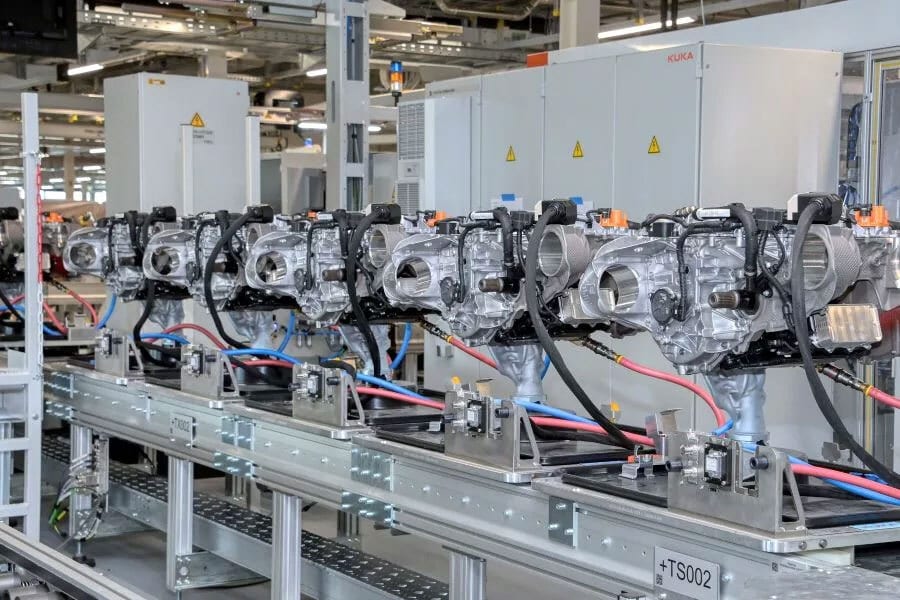
BMW’s sixth-generation e-motor will be used in Neue Klasse EVs. Photo courtesy BMW AG
STEYR, Austria—BMW AG has ramped up production of electric traction motors at its assembly plant here. The e-motor will be used in Neue Klasse EVs.
The next-generation motor features a rotor, stator and inverter designed for a new 800-volt architecture that maximizes performance and efficiency. The efficient design of the power train together with the high energy content of the high-voltage battery, will enable a range of up to 800 kilometers in the BMW iX3 50 xDrive, the first model of the Neue Klasse series.
“Overall, the intelligent use of new technologies in the e-drive and systematic further development of existing systems produce remarkable results,” says Martin Kaufmann, senior vice president of global power train development at BMW. “[Compared to its predecessor], energy loss is reduced by 40 percent, costs by 20 percent and weight by 10 percent. All this makes a significant contribution to the approximately 20 percent increase in overall vehicle efficiency.”
E-drive components will be assembled on two new lines at the Steyr plant, which will also continue to mass-produce traditional internal combustion engines.
“The overall production concept for the Gen6 e-drive follows the principle of a modular system, making it possible to produce different highly flexible electric drivetrain derivatives for the entire range of Neue Klasse models,” explains Klaus von Moltke, plant manager and senior vice president of engine production at BMW. “The modular concept generates positive economies of scale and cost savings in both development and production. It also improves the scalability of production volumes and keeps production, supply networks and procurement highly flexible.”
Lucid, Nuro and Uber Partner on Robotaxi Project

Thousands of Lucid Gravity sport utility vehicles equipped with Nuro Driver autonomous technology will be deployed in multiple markets by Uber over the next six years. Photo courtesy Lucid Group Inc.
SAN FRANCISCO— Lucid Group Inc., Nuro Inc. and Uber Technologies Inc. have formed a strategic partnership that will create a robotaxi ride-hailing system. Thousands of Lucid Gravity sport utility vehicles equipped with Nuro Driver autonomous technology will be deployed in multiple markets by Uber over the next six years. The first launch in a major U.S. city will occur later next year.
Autonomous technology will be seamlessly integrated into the EVs at Lucid’s assembly plant in Casa Grande, AZ. Nuro Driver is a Level 4 self-driving system that combines automotive-grade hardware and AI-powered software designed for reliability and cost-efficiency.
As part of the deal, Uber plans to invest hundreds of millions of dollars in both Lucid and Nuro. The first robotaxi prototype is currently operating autonomously on a closed circuit at Nuro’s Las Vegas proving grounds.
“Autonomous vehicles have enormous potential to transform our cities for the better,” says Dara Khosrowshahi, CEO of Uber. “We’re thrilled to partner with Nuro and Lucid on this new robotaxi program, purpose-built just for the Uber platform, to safely bring the magic of autonomous driving to more people across the world.”
“This investment from Uber further validates [our] fully redundant zonal architecture and highly capable platform as ideal for autonomous vehicles, and our industry-leading range and spacious well-appointed interiors, as ideal for ridesharing,” adds Marc Winterhoff, CEO of Lucid. “This is the start of our path to extend our innovation and technology leadership into this multi-trillion-dollar market.”
“We believe this partnership will demonstrate what’s possible when proven AV technology meets real-world scale,” notes Jiajun Zhu, CEO of Nuro. “[We have] spent nearly a decade building an AI-first autonomy system that’s safe, scalable and vehicle-agnostic, proven through five years of driverless deployments across multiple U.S. cities and states.
“By combining our self-driving technology with Lucid’s advanced vehicle architecture and Uber’s global platform, we’re proud to enable a robotaxi service designed to reach millions of people around the world,” says Zhu.
New Process Uses Ultrasound Technology to Test EV Batteries
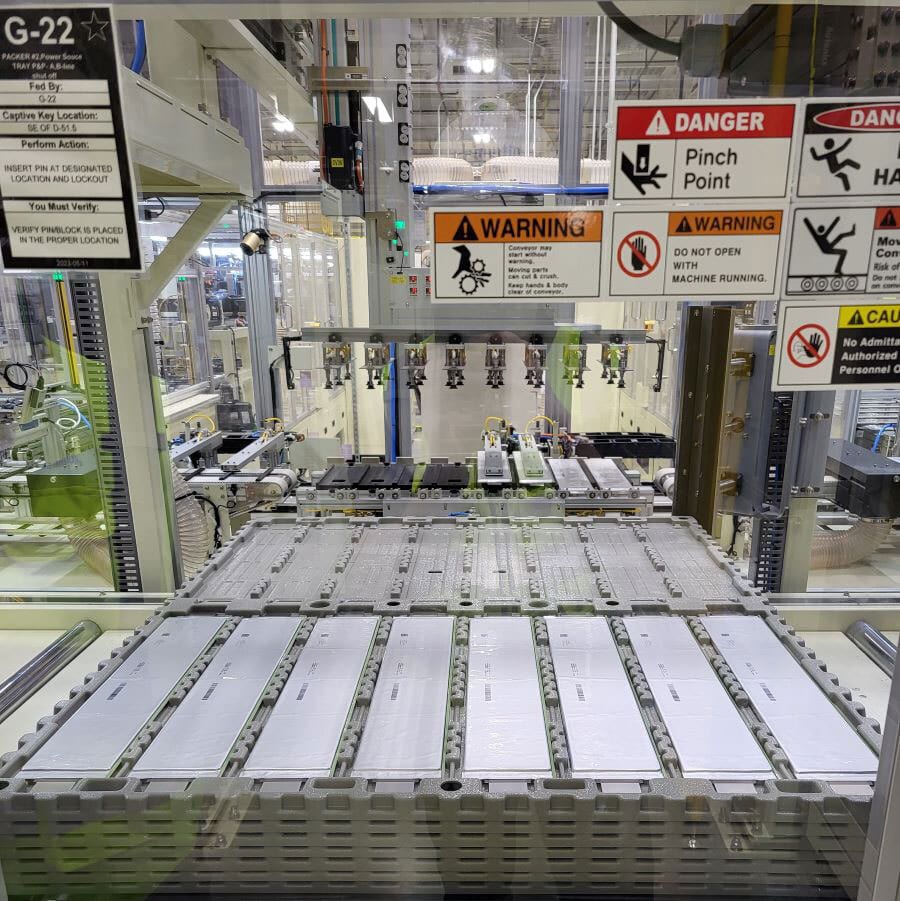
A new benchtop tool uses ultrasound technology to reveal any damage or flaws that could lead to overheating or thermal runaway in EV batteries. Photo courtesy Ultium Cells LLC
PHILADELPHIA—Engineers at Drexel University have developed a benchtop tool that enables automakers and suppliers to get a better look at the electrochemical and mechanical functions of EV batteries. It uses ultrasound technology to reveal any damage or flaws that could lead to overheating or thermal runaway.
“While lithium-ion batteries have been studied for nearly half a century and commercialized for over 30 years, we have only recently developed tools that can see inside with high resolution,” explains Wes Chang, Ph.D., an assistant professor of mechanical engineering and primary investigator at Drexel’s Battery Dynamics Lab.
“In particular, ultrasound has been adapted from other fields, such as geophysics and biomedical sciences, for battery diagnostics only in the past decade,” Chang points out. “Because it is such a new technique in the EV industry, there is a need to teach battery engineers how it works and why it is useful.
“While the vast majority of lithium-ion batteries today are high performing and safe, defects are bound to exist when thousands of cells are used within electric vehicles and there are millions of electric vehicles being produced every year,” says Chang.

According to Chang, current safety and quality control processes rely heavily on visual inspection and performance testing of select battery cells after they come off the production line. Batteries may also be X-rayed to generate a high-resolution interior image, but this is slow and expensive.
“Manufacturers are required to follow these inspection and testing protocols, but with the scale at which batteries are being used, even a small design or manufacturing flaw that is missed can lead to a massive batch of defective batteries making their way into market,” warns Chang.
Chang claims that acoustic imaging—ultrasound—is faster and less expensive than X-rays and can easily provide complementary information about the mechanical properties of a battery. “The sensitivity of ultrasound makes it useful not just for detecting defects in manufacturing, but also for gauging how new battery chemistries fail in research and development labs,” he explains.
The Drexel engineers used scanning acoustic microscopy technology to send low-energy sound waves through a commercial pouch cell battery.
Without affecting its internal operations or affecting its performance, the speed of the waves was altered as they passed through the various materials inside a battery. This allowed Chang and his colleagues to get a quick, detailed look at the chemical changes within the materials as the battery was being used.
“By observing how the sound wave has changed upon interacting with the sample, we can deduce a number of structural and mechanical features,” notes Chang. “The process can help to detect structural defects or damage that could cause an electrical short and material deficiencies or imbalances that could hamper performance, as well as indications that problems are likely to occur.
“One substance the scan is particularly good at detecting is gas, which is important because the presence of [it] inside a battery is an indication of dry areas that could cause the cell to fail while it is being used,” claims Chang.
As part of the R&D project, Chang worked with engineers at SES AI, a lithium metal battery start-up. “We hope that by lowering the barrier to entry, ultrasonic testing can become a routine part of battery research and development,” he points out. “This adds to the existing collection of tools that [engineers] have on hand for measuring and diagnosing next-generation battery performance.”
Chang and his colleagues plan to continue improving the technology so that it can more easily scan battery electrodes, as well as cells, and produce more detailed three-dimensional images to better detect defects.
september 2025 | ASSEMBLYMAG.com