MONTH 2023

ASSEMBLY LINES
Sensor System Automatically Monitors Human-Machine Interaction
ITZEHOE, Germany—Engineers at the Fraunhofer Institute for Silicon Technology (ISIT) recently developed a system that enables close collaboration between humans and robots. NeurOSmart combines several technologies, including a lidar system that continuously monitors shared workspaces; AI-supported chips that evaluate signals directly in the sensor system; and neuromorphic chip technology that functions like a human brain.
“Collaboration with the machine is risk-free for humans,” says Shanshan Gu-Stoppel, Ph.D., head of optical systems at Fraunhofer ISIT. “The sensor system monitors the area in which humans and robots move from a bird’s eye view.”
Movable microelectromechanical system mirrors project the laser across the entire work area and generate a high-resolution 3D image. A key feature of NeurOSmart is the direct integration of data processing into the sensor system.
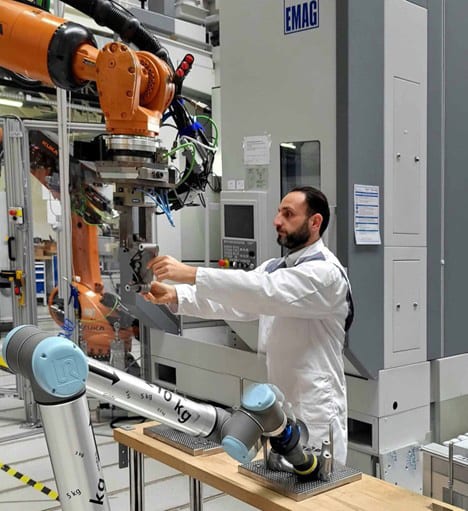
The NeurOSmart technology platform combines sensor technology with AI-supported data processing and energy-efficient chips that mimic the way the human brain works. Photo courtesy Fraunhofer Institute for Silicon Technology
AI-based algorithms bundle the incoming signals and identify areas of special interest in the scene. The sensor can then be precisely aligned for subsequent analyses, saving power and reducing the data rate. The next step, comprising actual evaluation of the data that serves as the basis for controlling the robot, is also performed directly in the sensor system.
The Fraunhofer engineers are focusing on the concept of neuromorphic computing and have developed a special accelerator chip. The processor consists of many small computing units that are interconnected on a wafer in a matrix. Each chip acts as a thinking cell and makes its own decisions. This technology is based on the way the human brain works.
Only a few milliseconds elapse between signal reception, evaluation and the mechanical response of the robot arm. This enables safe collaboration, even with heavy-duty robots, which the AI slows down or stops when a person comes too close to it. By simulating the entire robot cell, the engineers were able to simulate hazardous situations for training purposes that cannot be replicated in real life.
3D-Printing Platform Rapidly Produces Electric Motors
CAMBRIDGE, MA—Engineers at the Massachusetts Institute of Technology (MIT) have developed a multimaterial additive manufacturing platform that can be used to print electric machines in a single step. It can process multiple functional materials, including electrically conductive and magnetic materials, using four extrusion tools.
The printer switches between extruders, which deposit material by squeezing it through a nozzle as it fabricates a device one layer at a time.
The engineers recently used the system to print an electric linear motor in just a few hours using five materials. They only needed to perform one post-processing step for the motor to be fully functional.
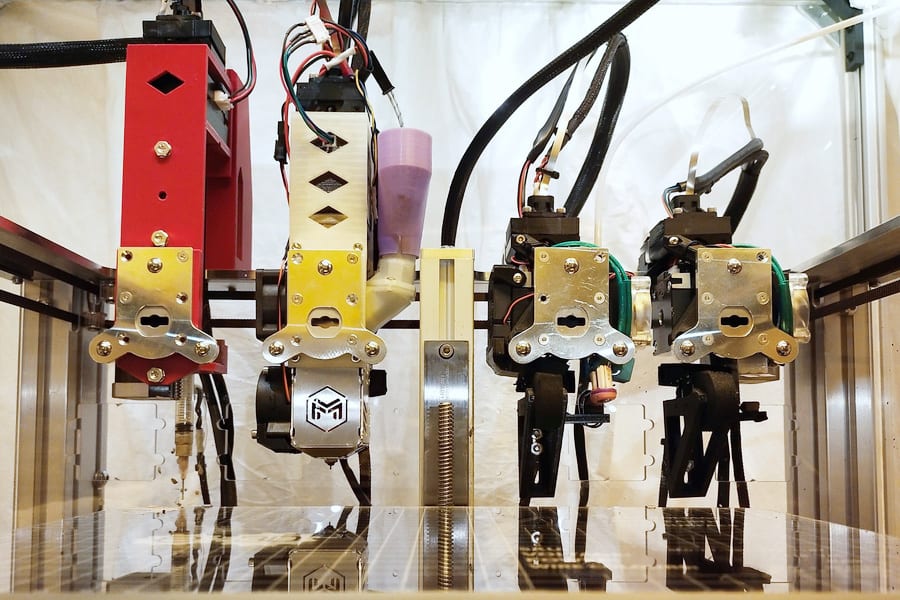
A new multimaterial additive manufacturing platform can be used to fully print electric machines in a single step. Photo courtesy Massachusetts Institute of Technology
“A broken motor in an automated machine can bring production on a busy factory floor to a halt,” says Luis Fernando Velásquez-García, Ph.D., a principal research scientist in MIT’s Microsystems Technology Laboratories who worked on the R&D project. “If engineers can’t find a replacement part, they may have to order one from a distributor hundreds of miles away, leading to costly production delays.
“It would be easier, faster and cheaper to make a new motor onsite, but fabricating electric machines typically requires specialized equipment and complicated processes, which restricts production to a few manufacturing centers,” explains Velásquez-García.
“In the long run, this 3D printing platform could be used to rapidly fabricate customizable electronic components for robots, vehicles or medical equipment with much less waste,” claims Velásquez-García.
The MIT engineers focused on extrusion printing, a tried-and-true additive manufacturing method that involves squirting material through a nozzle to fabricate an object one layer at a time.
To fabricate an electrical device, they needed to be able to switch between multiple materials that offer different functionalities. For instance, the device needed an electrically conductive material to carry electric current and hard magnetic materials to generate magnetic fields for efficient energy conversion.
Velásquez-García and his colleagues carefully designed each extruder to balance the requirements and limitations of the material. “There were significant engineering challenges,” he points out. “We had to figure out how to marry together many different expressions of the same printing method—extrusion—seamlessly into one platform.”
The engineers used strategically placed sensors and a novel control framework so each tool is picked up and put down consistently by the platform’s robotic arms. Each nozzle moves precisely and predictably, which ensures that each layer of material lines up properly.
The linear motor was fabricated in 3 hours. The researchers only needed to magnetize the hard magnetic materials after printing to enable full functionality. According to Velásquez-García, it performed “as well or better than similar motors that require more complex fabrication methods or additional post-processing steps.”
In the future, the engineers plan to integrate the magnetization step into the multimaterial extrusion process and print a rotary electrical motor, in addition to more complex electronic devices.
Humanoid Robot Market to Grow Quickly Over the Next Decade
CAMBRIDGE, England—The humanoid robot industry is entering an early commercialization phase, with adoption expected to scale first in industrial environments before expanding into broader commercial and consumer markets.
According to a new report by IDTechEx, the global market for humanoids will reach $30 billion by 2036, driven by increasing deployments in automotive manufacturing and logistics, alongside ongoing progress in component scaling and platform reliability.
“Humanoid robots are increasingly viewed less as futuristic prototypes and more as a practical route to bring artificial intelligence into human-designed environments,” says Shihao Fu, technology analyst at IDTechEx. “Over the last 12 months, market activity has shifted from trade show demonstrations toward structured pilot deployments on production sites, supported by larger and more deliberate investment from both start-ups and established OEMs.
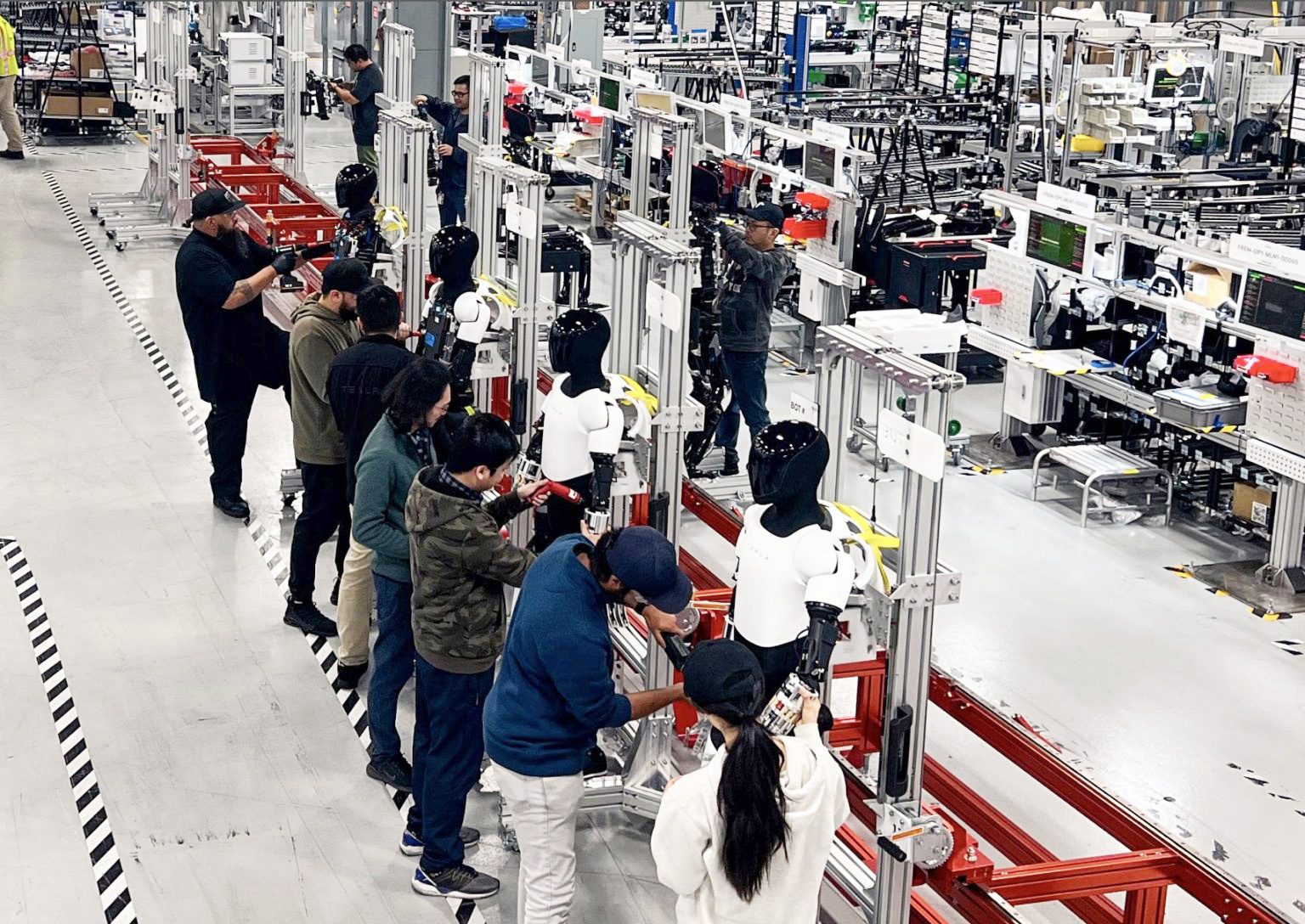
The global market for humanoid robots is predicted to reach $30 billion by 2036. Photo courtesy Tesla Inc.
“With component supply chains gradually stabilizing and early cost reductions emerging, [companies] are now using real-world deployment data to define which humanoid use cases are commercially viable in the near term, and which remain longer-term opportunities,” explains Fu.
According to Fu, automotive manufacturing will be the first commercial sector where humanoid robots scale in meaningful volumes. Indeed, automakers such as BMW, Hyundai, Mercedes-Benz and Tesla have already deployed bipedal machines in their factories.
“Compared with open-world environments, automotive plants offer controlled operating conditions, structured workflow and clearer ROI justification for repetitive labor-intensive tasks,” says Fu. “Early deployments are focused on relatively simple, but scalable tasks such as material handling, inspection support, intra-factory transport and basic assembly assistance.
“As the market transitions beyond proof-of-concept demonstrations, commercialization is increasingly being defined less by ‘general-purpose capability’ and more by reliability, safety validation, maintainability and predictable uptime,” Fu points out.

A key reason why automotive manufacturing is emerging as the first scalable deployment market is that many of the most active investors and strategic backers are automotive OEMs themselves. Unlike traditional industrial automation buyers, they have both the capital base and long-term incentive to accelerate humanoid development, particularly as they face rising labor costs, tightening workforce availability and increasing pressure to improve manufacturing flexibility.
“OEM-backed investment also provides immediate access to controlled production environments, engineering validation resources and real operational datasets that are difficult for start-ups to obtain independently,” notes Fu. “In practice, this allows humanoid platforms to iterate faster through reliability testing, safety validation workflows and maintainability optimization.
“OEM involvement also increases the likelihood of scaled procurement once a platform meets minimum performance thresholds, reducing go-to-market uncertainty and accelerating supply chain readiness,” adds Fu.
Logistics and warehousing applications are expected to become the second big market for humanoids. However, growth in this segment will be affected by competition from existing automation technologies such as autonomous mobile robots, automated guided vehicles, cobots and traditional six-axis robots.
“Despite this, humanoid robots are increasingly positioned as a flexible automation alternative where mixed and unpredictable tasks must be completed in facilities designed around human workers,” says Fu. “As hardware cost declines and task performance improves, humanoids may become commercially attractive for workflows such as pick-and-place, parcel handling and repetitive sorting operations, particularly in environments where deploying fixed automation would require high capital investment and major infrastructure redesign.”
But, humanoid robots still face major engineering and manufacturing constraints, such as component-level bottlenecks.
“Battery energy density and thermal management remain major limitations, restricting operating time and increasing downtime,” warns Fu. “At the same time, scaling high-precision components, such as screws, bearings and high-performance actuators, remains challenging, as supply chains are not yet optimized for high-volume humanoid production.
“Dexterous hands and tactile sensing also remain critical hurdles for expanding humanoid task capability beyond basic industrial operations,” claims Fu. “In many current deployments, humanoids remain best suited to tasks that do not require advanced manipulation, fine grip control or human-level perception of contact forces.”
Ford Explorer Travels From Chicago Assembly Line to the Vatican
CHICAGO—Ford Motor Co.’s historic Chicago Assembly Plant has produced millions of vehicles over the last 102 years, including everything from Model T’s to station wagons and armored military vehicles to pickup trucks. But, a one-of-a-kind Explorer tops them all. That’s because it’s a gift for Pope Leo XIV, who grew up just a few miles from the factory.
The SUV was customized with a V6 hybrid power train and a 10-speed hybrid transmission, as well as an antenna that’s compatible with the European broadcast radio system. Vanity license plates read “DA POPE” and “LEO XIV.”
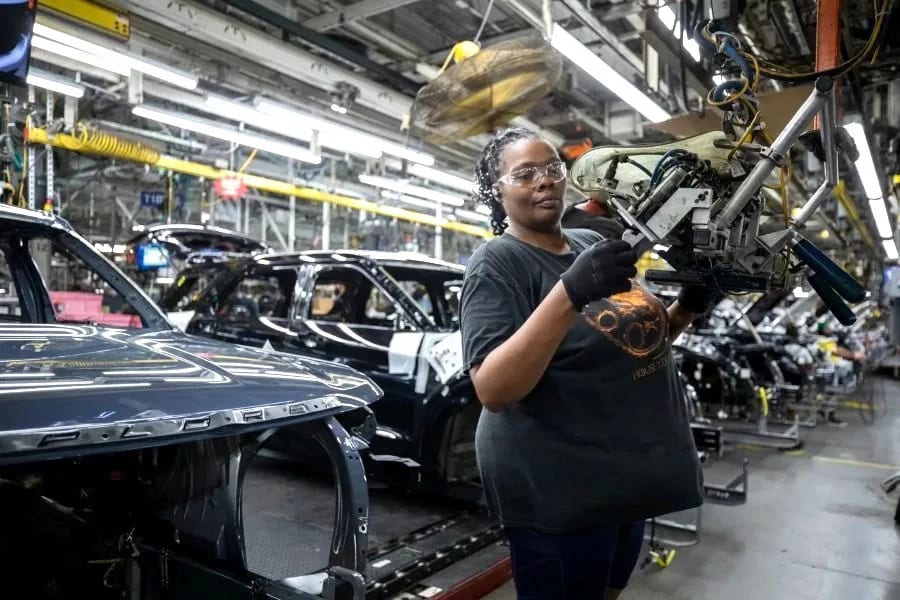
A Ford Explorer made in Chicago was recently presented to Pope Leo XIV. Photo courtesy Ford Motor Co.
On the inside, custom features include seat tags emblazoned with the Chicago flag and a center console with an outline of the Windy City’s world-famous skyline stitched into it. In addition, engravings of the Chicago skyline and St. Peter’s Basilica adorn the scuff plates, representing Pope Leo XIV’s journey.
Ford CEO Jim Farley recently delivered the unique vehicle to the Pope during a private audience at the Vatican. “He noticed and appreciated all the personal touches,” says Farley. “We even took a quick drive, and I can confirm the Holy Father enjoys driving a sporty ride.”
According to Farley, what really stuck out from the conversation was the feeling of pride in the shared Chicago connection. He brought a photo of the Chicago Assembly Plant team and handwritten letters from people who worked on the car. In return, the Pope blessed several rosaries to bring back to the staff.
The assembly plant is located on the South Side of Chicago along the banks of the Calumet River. It is Ford’s oldest continuously operating production facility. An extensive article about the factory appeared in the June 2024 issue of ASSEMBLY Magazine.