MONTH 2023

Manufacturing History
Labor shortages are driving new demand for automation.
Options for Screwfeeding
In this mid-1950s scene, an XP-500 experimental car poses beside the lake at the General Motors Technical Center. Photo courtesy General Motors
The trendsetting R&D campus was hailed as an ‘Industrial Versailles’ when it opened in 1956
GM Tech Center
70 Years of Innovation
Austin Weber // Senior Editor // webera@bnpmedia.com
In the mid-1950s, General Motors was at its zenith. The company controlled 50 percent of the U.S. auto industry at a time when the post-war economy was booming. Its assembly plants were pumping out chrome-plated coupes, sedans and station wagons inspired by jets and rockets.
GM also was a major producer of buses and heavy-duty trucks, and it dabbled in everything from construction equipment (Euclid) and locomotives (Electro-Motive) to refrigerators (Frigidaire) and spark plugs (AC).
General Motors represented the epicenter of American manufacturing. Its power and influence in business and politics was unprecedented. So naturally, GM attracted worldwide attention with a new state-of-the-art research and development campus 17 miles north of its headquarters in downtown Detroit.
When the Tech Center in Warren, MI, opened on May 16, 1956, it featured futuristic buildings and Space Age interiors designed to reflect GM’s role as a forward-looking company.
An elaborate opening ceremony featured CBS news broadcaster Walter Cronkite serving as the emcee. President Dwight D. Eisenhower delivered a keynote address via closed-circuit television from the White House. Several days later, NBC aired a 90-minute television show about the Tech Center entitled “Promise for America.”
More than 179,000 people attended an open house at the Tech Center where GM showed off a variety of modern marvels, including a 137-foot-long semiautomatic assembly machine that put together 75 parts of a cylinder head.
As part of the nationwide celebration, GM factories around the U.S. also staged open houses, inviting the public to visit their facilities.
Life magazine dubbed the Tech Center complex an “Industrial Versailles,” while Architectural Record (a “sister” publication of ASSEMBLY) gushed about the exterior and interior design of the cutting-edge buildings on the sprawling campus.
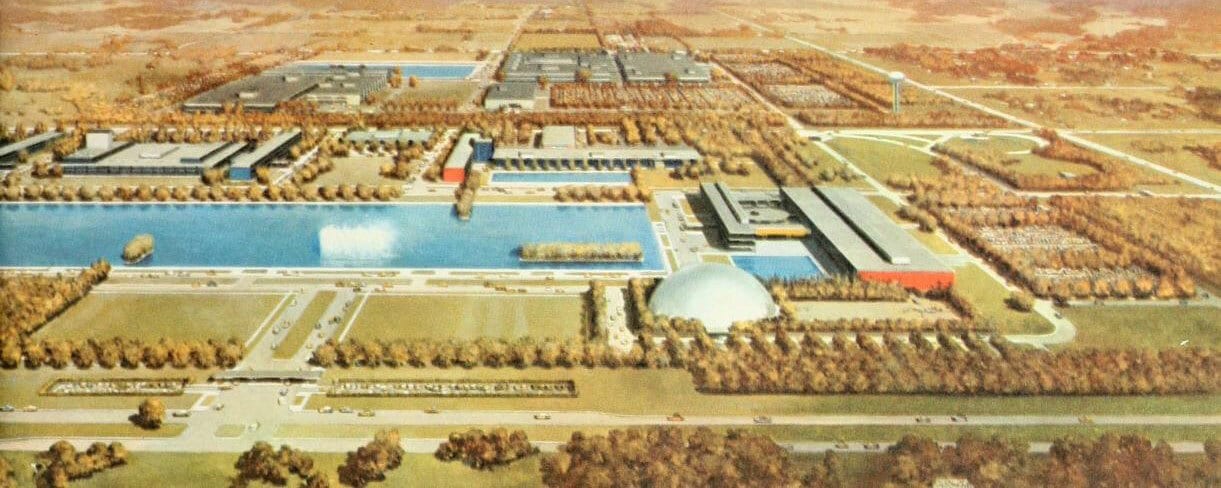
The main buildings on the GM Tech Center were strategically positioned on a landscaped campus. This view looking east shows the distinctive design dome in the foreground. Illustration courtesy General Motors
Where Today Meets Tomorrow
To mark the historic occasion, General Motors published a 40-page booklet entitled Where Today Meets Tomorrow. The company’s president, Harlowe Curtice, wrote the following introduction:
“More than half of the 20th century is behind us—nearly half ahead of us. From the past 50 years have come miracles—the automobile, the airplane, motion pictures, radio and television, and the splitting of the atom. But this is history, and all of us should be interested in the future because…there’s where we are going to spend the rest of our lives.
“Today, the world is undergoing a technical upsurge unequaled in the history of man. You can see it all around us—atomic energy is being harnessed, jets sweep the sky at almost twice the speed of sound and electronic computers perform years of calculations in a few minutes. Scientific man is on the move.
“These things are a challenge to American industry—a challenge not only to keep pace but to forge ahead—a challenge to bring new scientific discoveries down to earth and to apply the principles to creating more and better things for everyone. We must and can dream bigger; we must and can accelerate our pace from year to year.
“We in General Motors accept this challenge. Since our birth nearly 50 years ago, we have pioneered in creating the new and useful, in filling the needs and desires of millions of people. We intend to continue this policy in the next half century. We are meeting this technical challenge by applying the best talent, the best equipment and the best facilities available to molding tomorrow.
“And most representative of this thinking is the new Technical Center.
“There is good reason to believe that nowhere in this country, or even the world, is there concentrated within an area of a square mile such a collection of technical knowledge, experience, skills and facilities. The overall combination of technical people plus unmatched facilities, we believe, is unequaled in abilities to create, develop and produce the conveniences and necessities of tomorrow.
“What will be the shape of that tomorrow, we do not know, but if we use the past half century as a guide, we know that science and engineering in the years to come will unveil the keys to an entirely new way of life. Things undreamed of today will become a part of our daily lives to make them richer, more convenient, healthier and more enjoyable. With this in mind, we in General Motors dedicate the Technical Center to tomorrow.”
“While the architecture of the General Motors Technical Center intends to reflect tomorrow’s industrial environment where surroundings would be beautiful as well as functional, to more than 4,000 men and women it is a place where their inquiring minds can explore the future,” added an article in the May-June 1956 issue of the General Motors Engineering Journal.
“The Technical Center occupies the central 320 acres of a General Motors-owned area of some 900 acres. It includes four central staff organizations—research, engineering, styling and process development.
“Grouped around a 22-acre lake are 25 buildings ranging from gatehouses to large laboratory, office and shop buildings. Floor space totals 2,250,000 square feet. Connected by over a mile of underground tunnels, the buildings contain some 380 miles of electrical wiring, over 12 miles of duct work and 56 miles of fluorescent tubing. There are 11 miles of roads and parking space for 3,000 cars.”
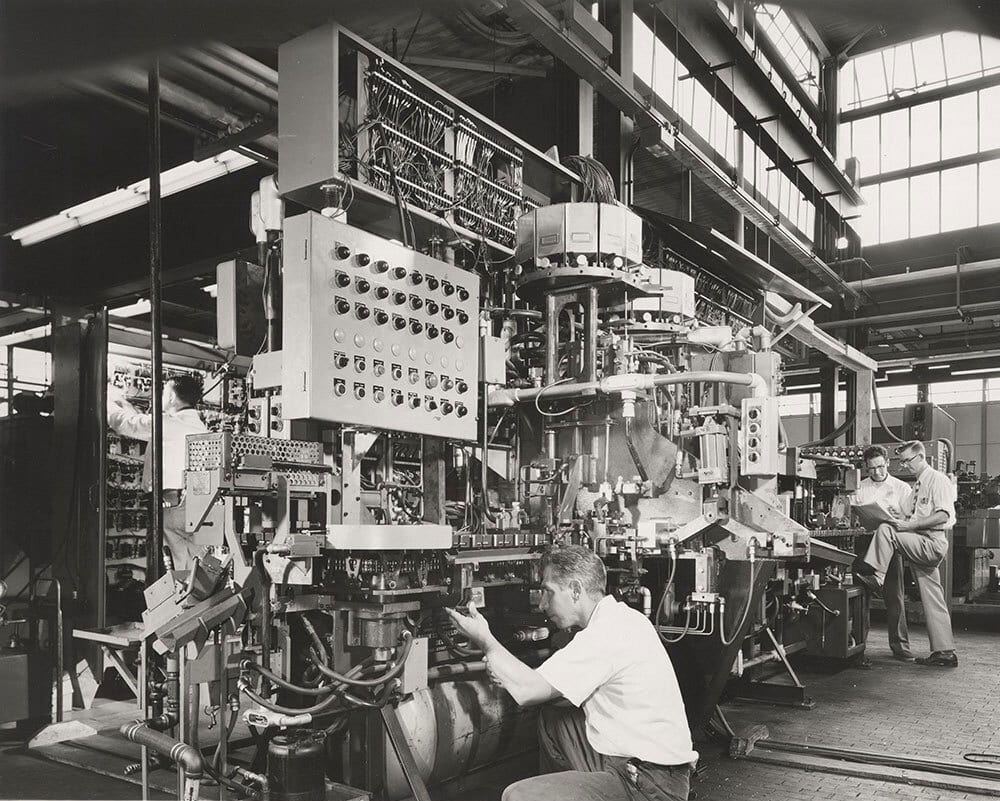
GM process development engineers put the finishing touches on a new semiautomatic assembly machine at the Tech Center. Photo courtesy AACA Library & Research Center
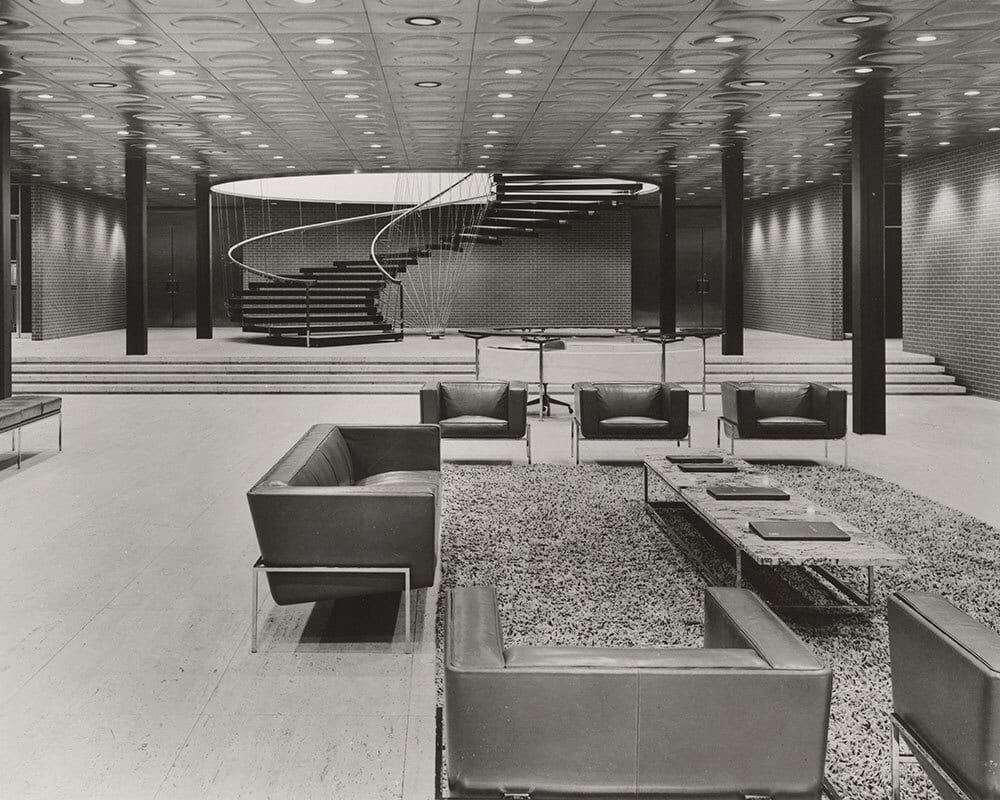
The lobby of the main research building features a circular “floating” staircase. Photo courtesy Library of Congress
A Bold Vision
The concept behind the national historic landmark dates back to March 1944, when Charles Kettering, the head of GM’s research department, and Alfred Sloan, GM’s legendary CEO, first discussed the idea of building a world-class R&D facility.
Several years later, Finnish-American architect Eero Saarinen received his first solo commission for the project. He envisioned a sprawling, self-contained collection of buildings designed in a modern style that evoked the technological advancements taking place within GM.
Later in his career, Saarinen designed other architectural landmarks such as the Gateway Arch in St. Louis; Bells Labs in Holmdel, NJ; John Deere’s corporate headquarters in Moline, IL; and the TWA terminal in New York City.
The Tech Center project was put off for several years, due to a crippling strike by the United Auto Workers union. But, things picked up again in the early 1950s as GM purchased hundreds of acres of farmland north of Detroit and embarked on a massive construction project.
At the time, GM engineers were spread among multiple buildings and sites. For instance, part of the design and styling department was housed in the corner of an old Cadillac factory on the West Side of Detroit.
In sharp contrast, the new Tech Center featured low buildings with glass-curtain walls, dramatic lobbies and colorful glazed brick walls. It was laid out like a college campus, with various disciplines housed in distinct buildings.
According to the Michigan Architecture Foundation, “Saarinen deftly coordinated the work of architects, landscape architects, furniture designers and artists, integrating a high level of design sensitivity into even the most mundane detail.
“The large man-made lake on the site acts as the primary organizing element of the complex and is bounded on three sides by the site’s most iconic research and design-focused structures, emphasizing the importance of design as a key corporate value.
“The remaining side of the reflecting pond is specifically reserved for the automobile, similarly elevating the importance of the car, as one would expect from a corporation devoted to the design and production of the automobile.”
Many experts consider the Tech Center to be the pinnacle of American architecture and design.
“It is easy to see the Technical Center today with nostalgia for the postwar period, when American manufacturing still dominated the global market,” says Emily Cooperman, Ph.D., an architectural historian and historic preservation consultant. “But, while we tend to see this groundbreaking suburban corporate campus inevitably as a thing of the past, to its makers it was intended to project an image of, and more importantly, shape the future.”
Saarinen used the automotive industry for inspiration. “General Motors is a metal-working industry; it is a precision industry; it is a mass-production industry,” he explained. “All these things should in a sense be expressed in the architecture of the Technical Center. Thus, the design is based on steel—the metal of the automobile.
“Like the automobile itself, the buildings are essentially put together, as on an assembly line, out of mass-produced units,” Saarinen pointed out. “And, down to the smallest detail, we tried to give the architecture the precise, well-made look which is a proud characteristic of industrial America.”
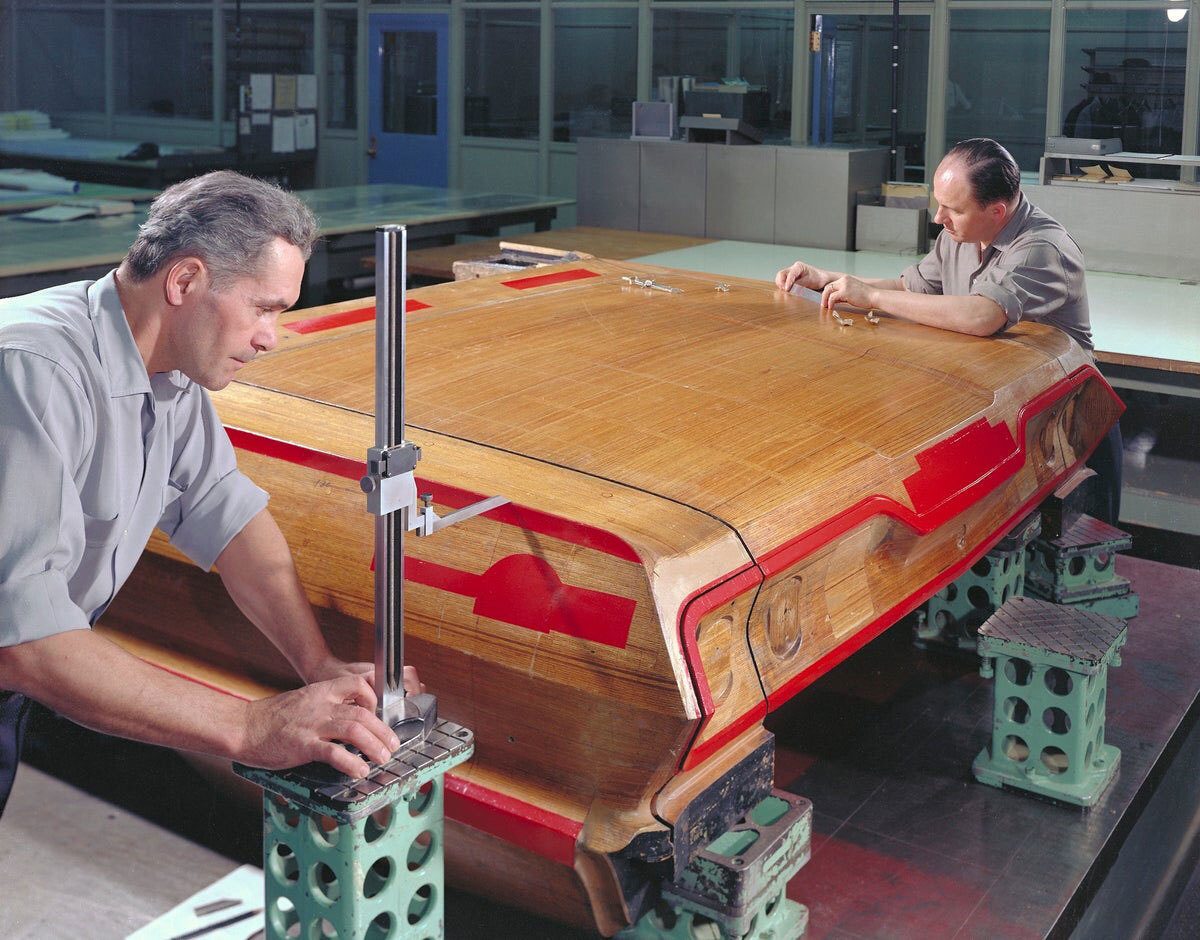
Craftsmen at the Tech Center produce a full-scale wooden mock-up of the rear end of a Chevy Impala sedan in the early 1960s. Photo courtesy General Motors
Magical Mystery Tour
Mid-century architectural critics gushed about the groundbreaking design of the Tech Center’s buildings. In fact, many people had never seen anything quite like it.
“The General Motors Technical Center is a magnificent architectural statement of the power and glory of American industry—far more impressive than any skyscraper set down by itself in an urban jungle,” raved the July 1956 issue of Architectural Record. “Here in a vast controlled environment created out of flat and empty farmland, precisely and beautifully interrelated buildings are served by appropriate routes for motor and pedestrian traffic, and linked to outdoor spaces for pools, gardens, parking and service areas.
“The General Motors Technical Center is the first and best complete collaboration of industry, architects and landscape architects. It is a truly American melding of the best from Europe, with native American feeling; a much-needed demonstration that these sources can be improved for our consumption. Withal it is a magnificent example of architecture which will be a yardstick for future work of this type.
“This overall integration successfully extends, indoors and out to structure, materials, furniture, landscaping, equipment that is sculpture and sculpture that is equipment. As such, it is a milestone to be recognized and remembered.”
“The buildings themselves, planned by renowned architects, are functionally designed to contribute in every way possible to the creative type of investigations being carried on within,” explained Where Today Meets Tomorrow. “None higher than three stories, these buildings have the clean, functional lines of contemporary architecture, utilizing colorful, glazed masonry and walls, and structural steel framing that emphasizes large glass areas for natural lighting.
“On the experimental side, these buildings contain a collection of unique and diversified equipment unequaled in the world today. There is a 100-mile-per-hour wind tunnel, a radioactive tracer laboratory, electronic computers, a metallurgical building housing an experimental foundry, dozens of engine testing laboratories, 80-foot design studios and a huge room where a section of an experimental production line can be put into operation.”
The four core buildings at the Tech Center were dedicated to research, styling, engineering and manufacturing development.
“Located at the north end of the central lake is the largest group of Technical Center buildings, the home of the research staff,” Where Today Meets Tomorrow pointed out. “Here in the main building are the basic science departments, where men who rank as authorities seek new fundamental information in the fields of physics and chemistry—new knowledge of the process of combustion; an insight of the mechanism of electroplating; a better understanding of the effect of crystalline structure on a material’s properties.
“In adjacent buildings, engineers work to gain a better understanding of why metals seem to ‘grow tired’ or fatigue; to learn more about the basic nature of friction; to test new engines and formulate theories as to why one design is better than another, and then apply these theories to new designs
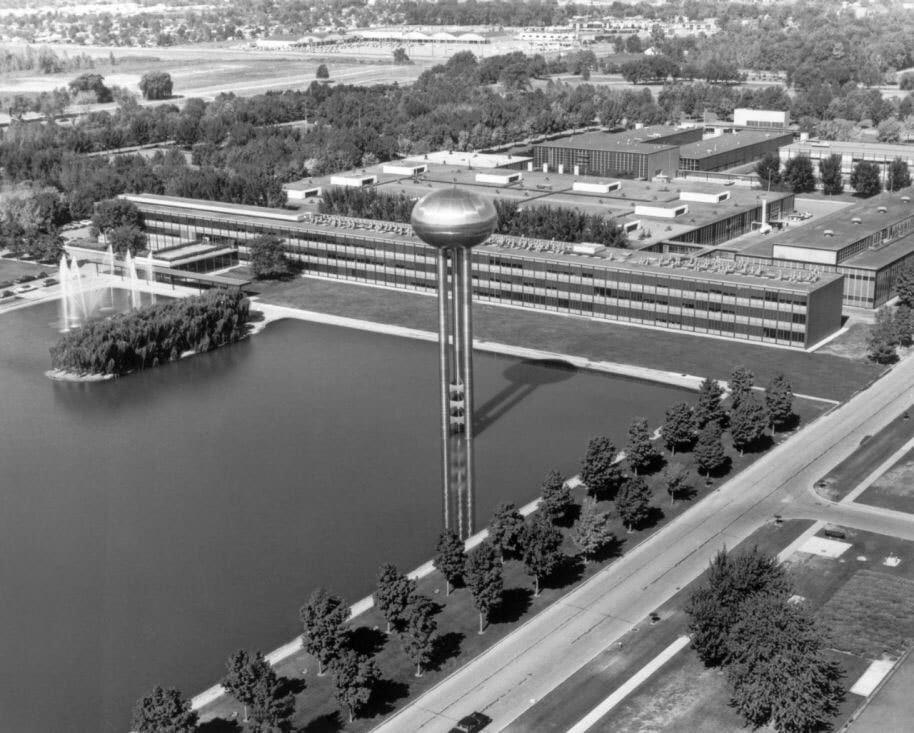
This view looking northwest shows the stainless-steel water tower in the foreground and research buildings in the background. Photo courtesy Library of Congress
“In one of the most elaborate experimental foundries in the world, metallurgists scientifically juggle alloys to produce new materials with better wear properties, greater high-temperature strength and improved resistance to corrosion.
“At the other end of the lake, stands the striking styling building and its silver-domed auditorium. Here the future seems already to have arrived.
“Just as the researchers probe for hidden facts, nearly a thousand stylists and technicians with their imaginations and skillful fingers try to capture the look of things to come. Within this glass-walled building are located studios, engineering departments, drafting rooms and shops.
“There are individual studios for Chevrolet, Chevrolet Truck, Pontiac, Buick, Oldsmobile, Cadillac, GMC Truck and Coach, Electro-Motive, Euclid and Frigidaire. And none of the designers in these studios has access to the other studios—in a way, they compete.
“In the studios, the designs are developed first on paper, then in three-dimensional clay models. In the fabrication shops, prototype models are built, using plaster, fiberglass, wood and metal. There is an entire section devoted to the design of automobile interiors. Other activities include design of household appliances, trucks, buses and railway locomotives. There are color experts, fabric experts, plaster and plastic craftsmen, wood and metal model makers, trimmers and painters.
“On the east side of the lake, the engineering staff building houses a variety of activities. Of prime importance is the role carried on by groups of highly trained engineers and specialists.
“One of these groups, power development, is concerned with engine and engine accessory development. This same group carries on development work in the field of household appliances.
“Another group, transmission development, is concerned with the design and development of automatic transmissions. A third group, structure and suspension, is engaged in the development of new and improved suspension systems. A fourth is the vehicle development group, whose role is to design and develop overall passenger cars, as well as ordnance and military vehicles, using new principles and new approaches.
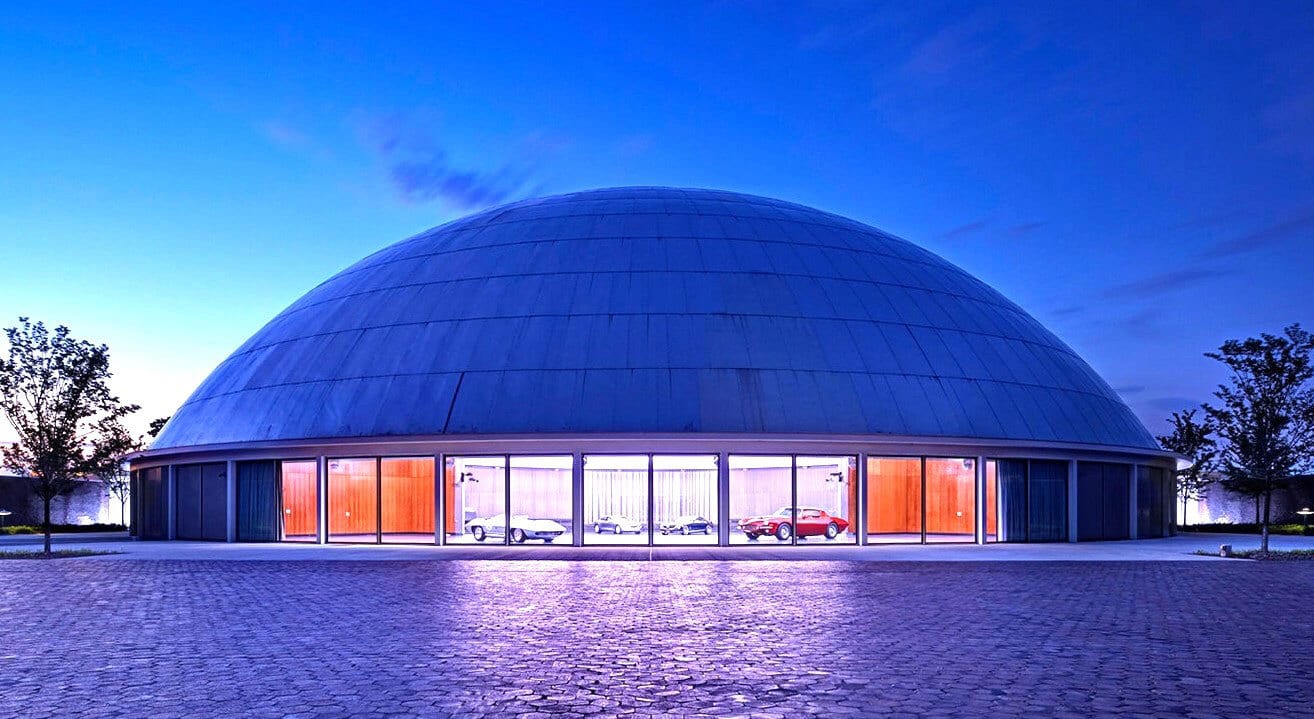
The design dome is one of the landmark structures on the Tech Center campus. Photo courtesy SmithGroup
“From these engineering development groups will come new concepts and new designs for improved safety, better performance and lower cost in tomorrow’s automobile.
“The manufacturing development buildings house a group of activities [for] General Motors manufacturing operations. Engineers and technicians develop ways of making things dreamed up by the fundamental researchers and engineers, but as yet impractical to manufacture by any known method.
“To accomplish this end requires the production tools used in manufacturing plants. Here are located chemical and physical laboratories, metallurgical and spectrographic, and electronic laboratories fitted with elaborate testing equipment and analog computers.
“There are shops for research in the cutting, welding, heat treatment and finishing of metals. The experimental foundry and sand laboratory located here are among the finest of their kind in the world today. And, in addition, there is a large tool room and machine shop equipped with the finest of modern precision machine tools.
“The people who supervise General Motors plants are constantly striving to improve layouts, tools, equipment and methods to achieve three basic objectives. First, of course, is to improve the quality of the products; second, to improve the working conditions of General Motors employees; and third, to reduce the cost of the products.
“The organization has a group of engineers and technicians who spend their entire time searching for new and better ways of making things, unhampered by current production problems. There is also a group of production engineers, standards and methods engineers constantly searching out the best ways of manufacturing.
“This large reservoir of staff experience, plus the knowledge that can be tapped in all the General Motors divisions, provides an organization capable of solving the more difficult manufacturing problems. They conduct long-range development programs and explore untried methods and processes.
“The result may be advice, a technical report or service rendered to a manufacturing division. It may be a very special machine or a new manufacturing process which enables us to make in quantity something long thought desirable but impractical to produce. The end result can be the same in all cases—new and improved ways of making more and better things for more people, today and tomorrow.”
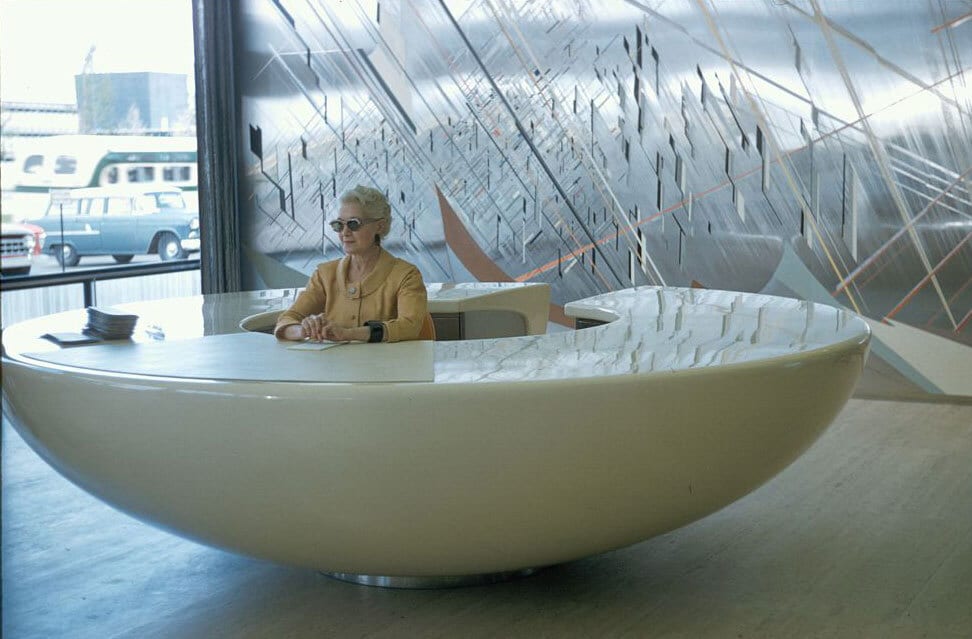
A “teacup” reception desk in the lobby of the styling administration building looks like something out of the Jetsons. Photo courtesy Library of Congress
Architectural Showcase
The Tech Center provided GM employees with jaw-dropping laboratories, shops and studios that ushered in a new era of innovation. Among the facility’s unique highlights was a striking aluminum-domed auditorium equipped with advanced lighting systems. This space served as a venue for design presentations, receptions and banquets, showcasing GM’s forward-thinking approach.
The creation of the 65-foot-tall design dome marked the first time that cars were presented as art, with lights cascading down on freshly finished chrome and paint so that engineers could carefully scrutinize new designs. The 186-foot-diameter dome was considered an architectural masterpiece, boasting shadowless lighting and a bold modern aesthetic.
According to the Michigan Architecture Foundation, the dome and stainless-steel water tower are “interesting departures from the rectilinear paradigm. The dome, originally called the design auditorium, is a hemispherical form intended as a perfectly lit space for the examination and photography of concept vehicles. Balancing the round form diagonally opposite and located within the pool is the 138-foot-tall elliptical stainless steel water tower.
“The site plan’s building layout is an interesting diagram of varying scaled bars oriented in cardinal directions relating to one another perpendicularly, in parallel, and sometimes interconnected to one another. The buildings draw upon principals of modernism including glass curtain walls, metal panels and low elongated rectilinear forms. Brightly colored brick walls punctuate the monotony and regularity of the modernist structures.
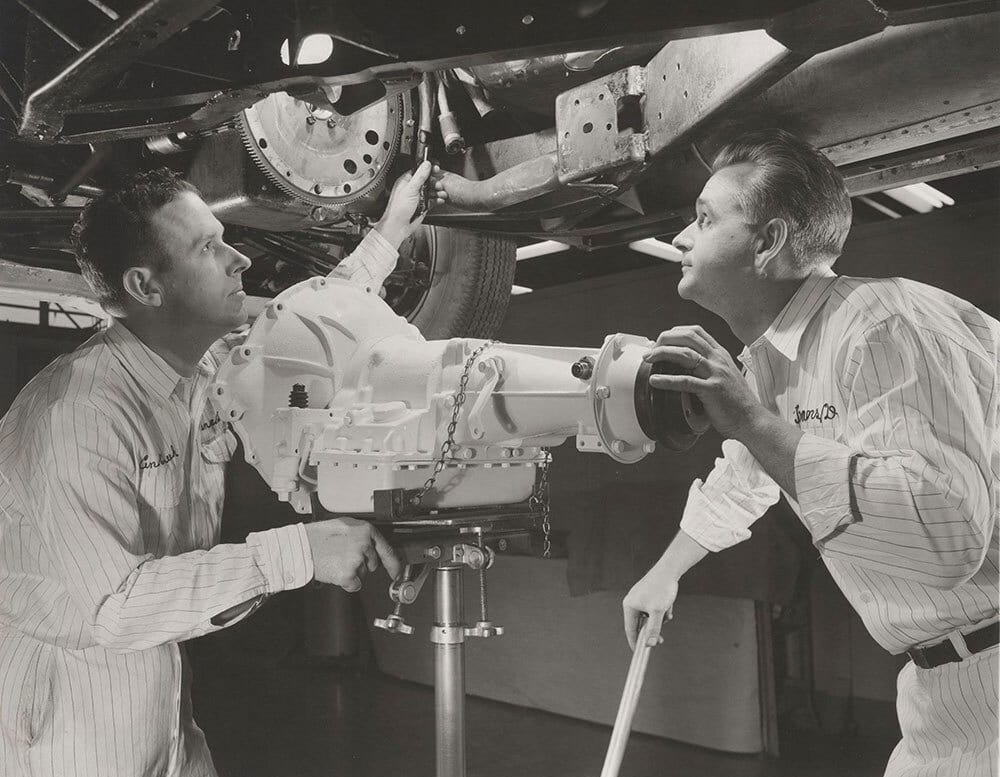
GM engineers experiment with an automatic transmission at the Tech Center. Photo courtesy AACA Library & Research Center
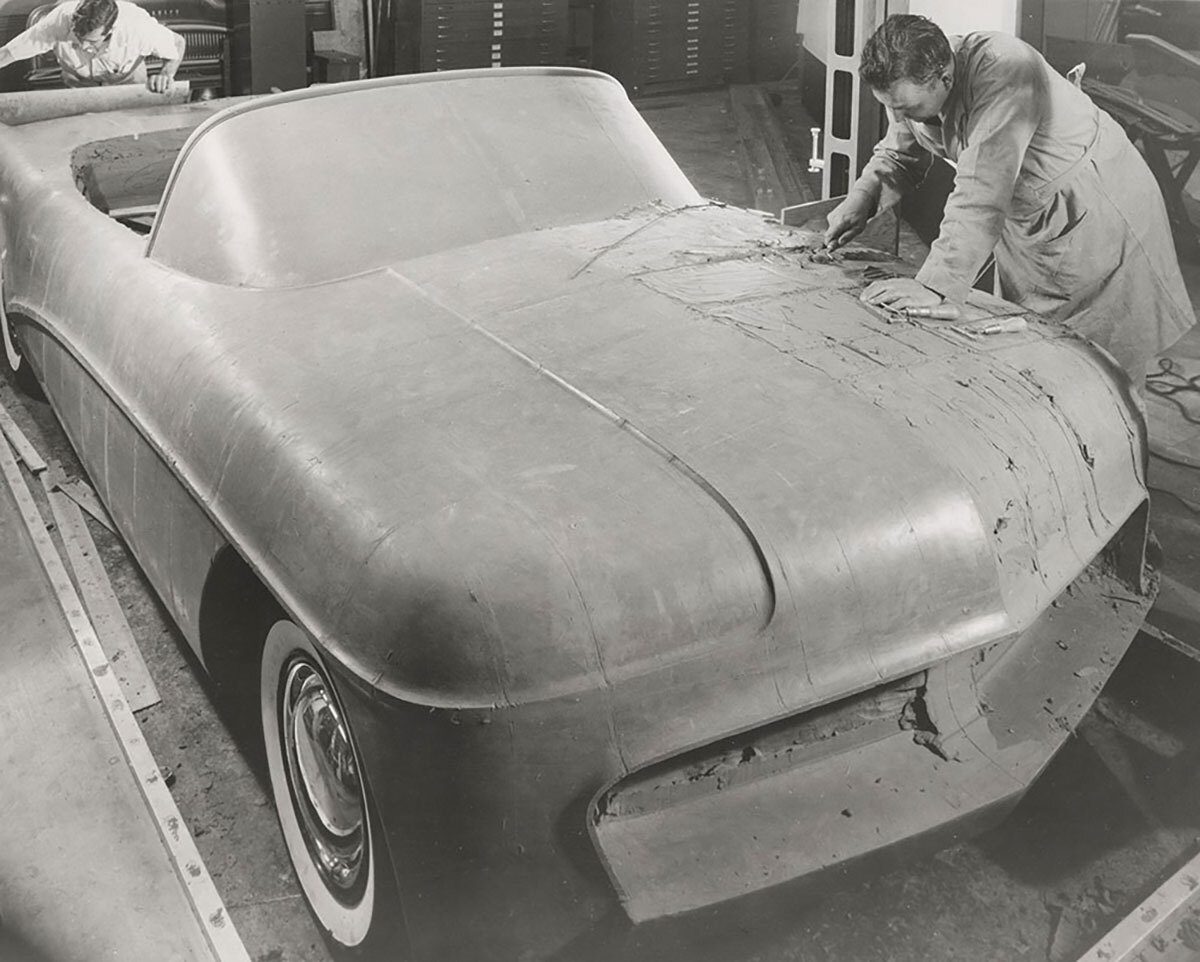
A new Buick convertible takes shape as a clay model. Photo courtesy AACA Library & Research Center
“Large lobbies are appointed with modernist furnishings, major art installations and expanses of glass curtain walls that directly address the reflecting pool. Focal in each space is a monumental stair, suspended by cables from above.”
A dramatic circular “floating” staircase in the research administration building is supported by thin cylinder rods, anchored at the top and bottom. Other interior elements include cutting-edge lighting design and early application of open-office plans to foster a collaborative work environment.
Color was used sparingly as an element that often provided a link between the indoor and outdoor space. Withing the buildings, color was used on doors to punctuate long corridors and create visual excitement. The original furnishings also featured vivid fabrics and materials.
“Saarinen used key facets of GM’s corporate culture to both enable and inform crucial elements of his design for the Technical Center,” says Cooperman. “This adaptation of automobile manufacturing materials and processes is most visible in three aspects of the Technical Center’s exterior detailing: neoprene window gaskets, porcelain-enameled sandwich panels and the double-glazed, ceramic-glazed bricks used on the buildings’ exteriors and in certain interior spaces.
“Saarinen’s office worked with GM to develop a gasket that would ultimately both resemble and function like those in automobile windshields,” explains Cooperman.
Neoprene rubber gaskets, originally developed by GM’s Inland Manufacturing Division (a producer of brake linings, bumpers, steering wheels, turns signals and other auto parts), proved to be watertight. In addition, GM’s AC Spark Plug Division, which used ceramics to mass-produce its products, helped Saarinen and his colleagues develop a glazing compound that enabled the bricks to retain their vibrant color.
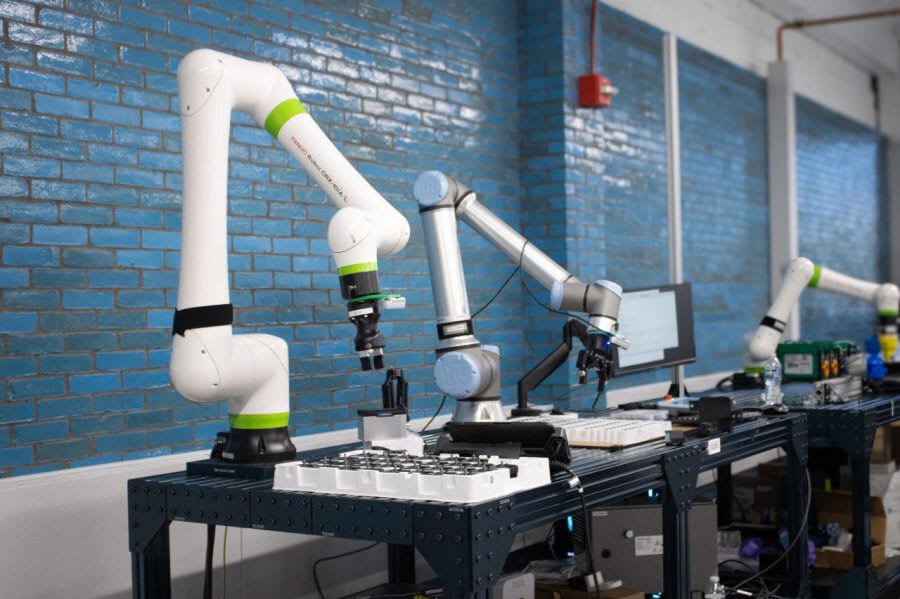
Today, the GM Tech Center houses an Autonomous Robotic Center. The colorful glazed brick wall in the background is a unique feature that dates back to the mid-1950s. Photo courtesy General Motors
Still Going Strong
In 2000, the Tech Center was placed on the National Register of Historic Places by the U.S. Department of the Interior. And, in 2014, it was designated a National Historic Landmark.
The campus has evolved over the last 70 years and is continuously changing to meet GM’s needs. Today, the 813-acre campus includes 27 original buildings connected by 28 miles of roadway. Despite some recent staffing cutbacks, the facility still employs more than 20,000 people.
When the Tech Center opened in 1956, GM engineers were busy working on projects related to automatic transmissions, gas turbine engines and turbochargers. Today, the R&D facility is going strong and many of the original buildings continue to look futuristic. However, the focus inside the walls has shifted to artificial intelligence, autonomous vehicles, batteries, connectivity, lightweight materials, power electronics, robotics and other topics.
One of the newest buildings on the Tech Center campus is the Wallace Battery Cell Innovation Center, which opened in 2022. GM is also in the process of building a 500,0000-square-foot battery cell development center, which will focus on creating lithium manganese-rich prismatic battery cells for next-generation vehicles.
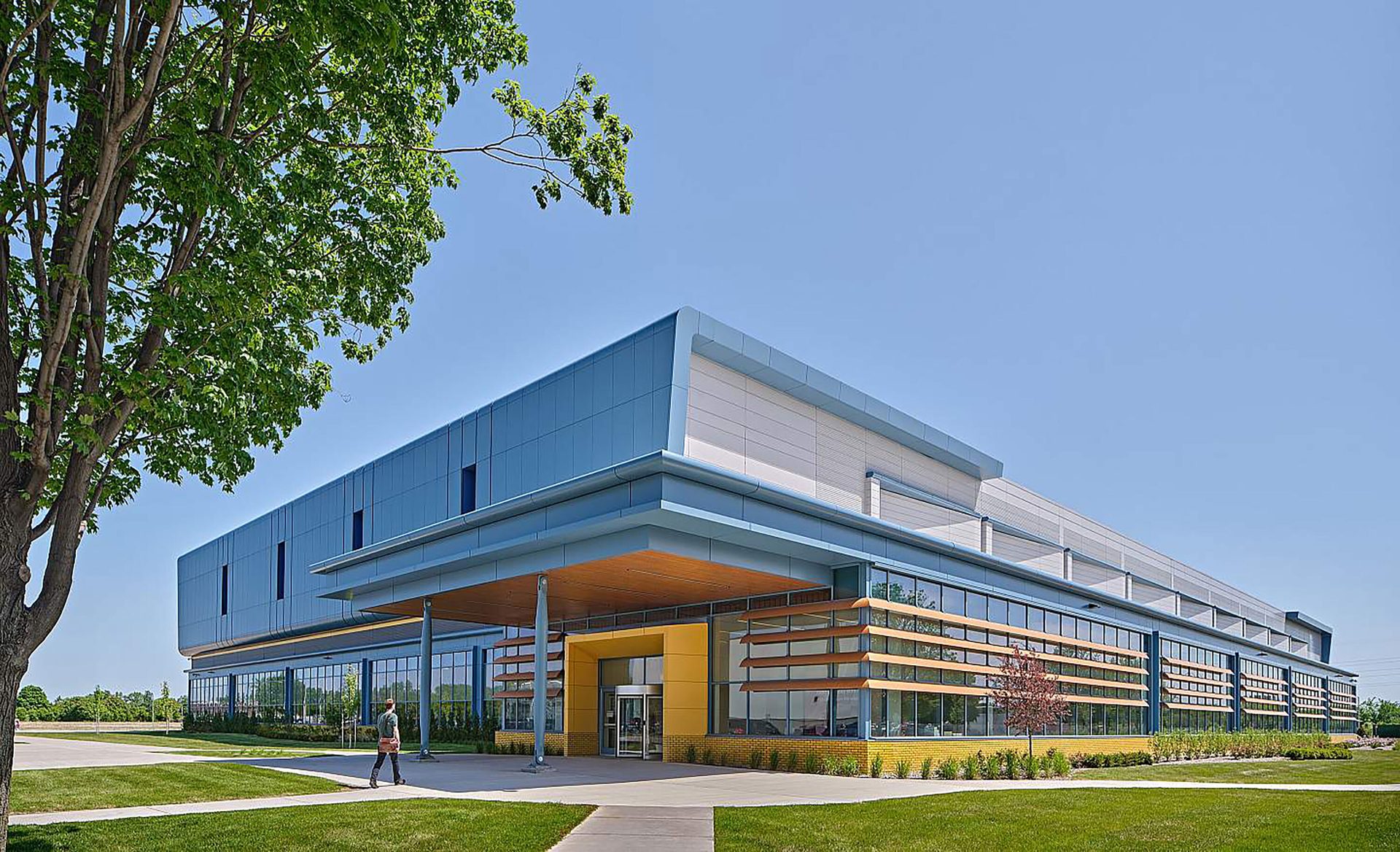
One of the newest buildings on the Tech Center campus is the Wallace Battery Cell Innovation Center. Photo courtesy Ghafari Associates
According to Linda Cadwell-Stancin, Ph.D., GM’s executive director of research and development, Tech Center engineers are currently focusing their efforts on subjects such as:
- Advanced batteries, including new types of propulsion and energy storage systems.
- Engineering and computational acceleration, such as AI-driven design and digital transformation of manufacturing processes.
- Extreme vehicle efficiency, including transformative improvements in internal combustion engine, hybrid and electric power train platforms.
- Future factory technologies that enable fast, flexible, frugal manufacturing processes and empower operators, while enhancing production quality and efficiency.
- Product safety and integration to predict, prevent and mitigate risks.
- Advanced robotic systems and collaborative robots that improve manufacturing safety and quality.
Some recent technology developed at the Tech Center includes the following:
- DR-Weld. This high-performance digital reality tool simulates welding and additive manufacturing technology thousands of times faster than commercial software, reducing simulation from months to days, which enables broad industrial applications.
- Extreme fast charging and affordable battery cells for electric vehicles. “We’ve already deployed this technology in some racing platform low-voltage batteries and are intrigued by our continued research on potential future applications,” says Cadwell-Stancin.
- Low mass and high efficiency medium-duty truck engines. A durable V8 truck engine prototype cuts weight by 15 percent and boosts fuel efficiency by more than 10 percent.
- Ultra-robust silicon all-solid-state batteries. “Silicon and solid-state materials represent two of the most exciting future battery technologies,” claims Cadwell-Stancin. “In this initiative, we’ve brought them together with tests indicating industry-leading battery cycle life and safety, building our excitement to continue developing and maturing the technology.”
ASSEMBLY ONLINE
For more information on GM’s manufacturing history, visit www.assemblymag.com to read these articles: