
MONTH 2023

Automated Assembly
Labor shortages are driving new demand for automation.
Options for Screwfeeding
A fleet of automated guided vehicles transport plastic parts from subassembly lines to final assembly lines. Photo by Austin Weber
AI, digital twins and robots boost quality at a state-of-the-art appliance assembly plant in Clarksville, TN.
Smart Factory
Inside LG’s
Austin Weber // Senior Editor // webera@bnpmedia.com
“Life’s good” is the motto of LG Corp., a Korean conglomerate that is one of the world’s largest manufacturers of consumer electronics and white goods. Life’s also good at one of the world’s most automated household appliance factories. The state-of-the-art facility in Clarksville, TN, mass-produces home laundry products for LG Electronics Inc. (LGE).
Nestled in farm country an hour northwest of Nashville near the Kentucky border, the seven-year-old smart factory assembles a variety of washers and dryers for the U.S. market. LGE claims the vertically integrated facility is “the world’s most advanced production plant for washing machines.”
The 100,000-square-foot factory produces one new appliance every 11 seconds. More than 900 people work alongside 200 mobile robots and 130 fixed robots. LGE Clarksville also excels at using digital twins, machine vision, 5G connectivity and other cutting-edge technology.
The facility boasts a digitally enabled, end-to-end, three-dimensional logistics system, an advanced analytics system based on edge computing technology and machine learning that predicts defects. In addition, flexible assembly lines can mass-produce multiple models of washing machines and dryers to meet changing customer requirements.
By applying cutting-edge tools and production systems, the plant has achieved a 17 percent boost in productivity and a 30 percent gain in energy efficiency.
The World Economic Forum (WEF) named LGE Clarksville a “lighthouse factory” in 2023. Its sister plant in Changwon, South Korea, received the honor the previous year.
According to WEF, lighthouse facilities “implement Fourth Industrial Revolution technologies, such as the Internet of Things, big data, artificial intelligence and robots, into manufacturing and supply chain operations to deliver a wide range of benefits, from increased production efficiency to enhanced environmental sustainability.”
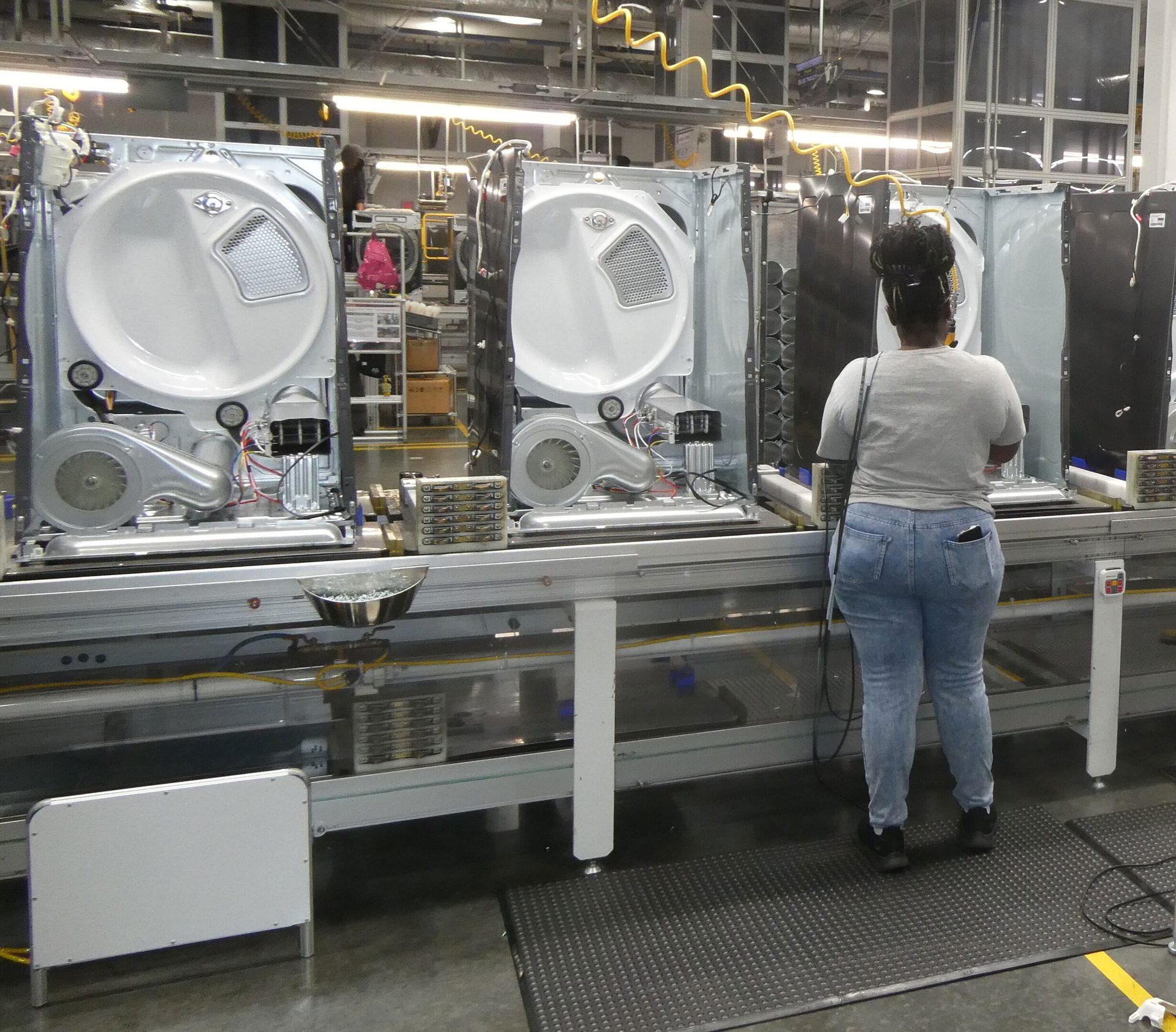
The LG Electronics smart factory produces one new appliance every 11 seconds. Photo by Austin Weber
“[These assembly plants] represent our unmatched leadership in transforming manufacturing facilities into advanced, futuristic hubs utilizing the most revolutionary technologies,” says Lyu Jae-cheol, president of the home appliance division of LGE. “Lighthouse Factory status exemplifies how [we] continue to strive for providing differentiated customer experiences through customized manufacturing innovations.
“[It] illustrates our strong commitment to adopting [Industry 4.0] technologies as the leader of the global premium home appliance market,” explains Jae-cheol. “We are presenting a blueprint for the future of manufacturing; one that delivers better outcomes across environmental, economic and employment aspects.”
LGE is part of LG Corp., a $140 billion conglomerate that also includes LG Chem, LG Display and LG Energy Solution. The company formerly known as Lucky-Goldstar was founded by Koo In-hwoi in 1947 and has been managed by successive generations of his family ever since.
Today, it is the fourth-largest company in South Korea. In addition to appliances, LGE is a leading producer of home entertainment products such as computer monitors, laptops, soundbars and televisions. The $48 billion company’s U.S. subsidiary, LG Electronics USA Inc., is based in Englewood Cliffs, NJ.
In early 2017, LGE announced that it had selected a 310-acre site in northern Tennessee for its first U.S. factory. After studying locations in eight states, LGE claimed the Volunteer State stood out due to its “excellent business climate, quality workforce and central location for distribution to our U.S. customers.”
LGE plans to expand the Clarksville plant in the near future, starting with a larger warehouse. It may also build a refrigerator assembly plant at the site.

Popular Products
In addition to laundry products, LGE makes a variety of kitchen appliances, such as dishwashers, microwave ovens, ranges and refrigerators, plus a line of air purifiers and window air conditioners. However, those products are imported to the U.S. from Korea and Mexico. Commercial and high-end laundry products are also currently made overseas.
The washers and dryers that the company assembles in Clarksville are known for their quality and consistently receive high ratings. For instance, Consumer Reports Inc. recently proclaimed LG to be among the best laundry appliance brands. Based on extensive lab testing and surveys, its machines ranked at or near the top for performance, reliability and overall owner satisfaction.
A recent article in The New York Times also praised the company and ranked the LG WM4000H front-loading washer and the LG DLEX4000 dryer No. 1 in their respective categories. In addition, J.D. Power just ranked LG dryers top in customer satisfaction.
LGE Clarksville makes a variety of dryers, plus front- and top-load washing machines. All of them come in numerous sizes, styles, colors and finishes, including black, silver and white. They are sold by appliance stores and big-box stores such as Best Buy, Costco, Home Depot and Lowe’s.
Front-load machines are designed for quick, high-efficiency cleaning. LG’s products feature tempered glass doors for a sleek, stylish look that resists shock and scratches.
Front-load washers tend to be more energy- and water-efficient, clean laundry better with less wear and have larger capacities. A drum rotates horizontally, lifting and dropping clothes in a tumbling motion. The tumbling motion knocks items against each other, allowing detergent and water to penetrate fabrics.
However, front-load machines are typically more expensive, require more bending and can take longer to complete a wash cycle. Under some circumstances, they can also be prone to leakage, especially if there is a problem with gaskets that seal the doors.
Traditional top-load washers offer fast, convenient loading. The machines are often more affordable and have shorter cycle times. They use an impeller or a vertically oriented drum that agitates clothes using a central post that is equipped with fins to move water.
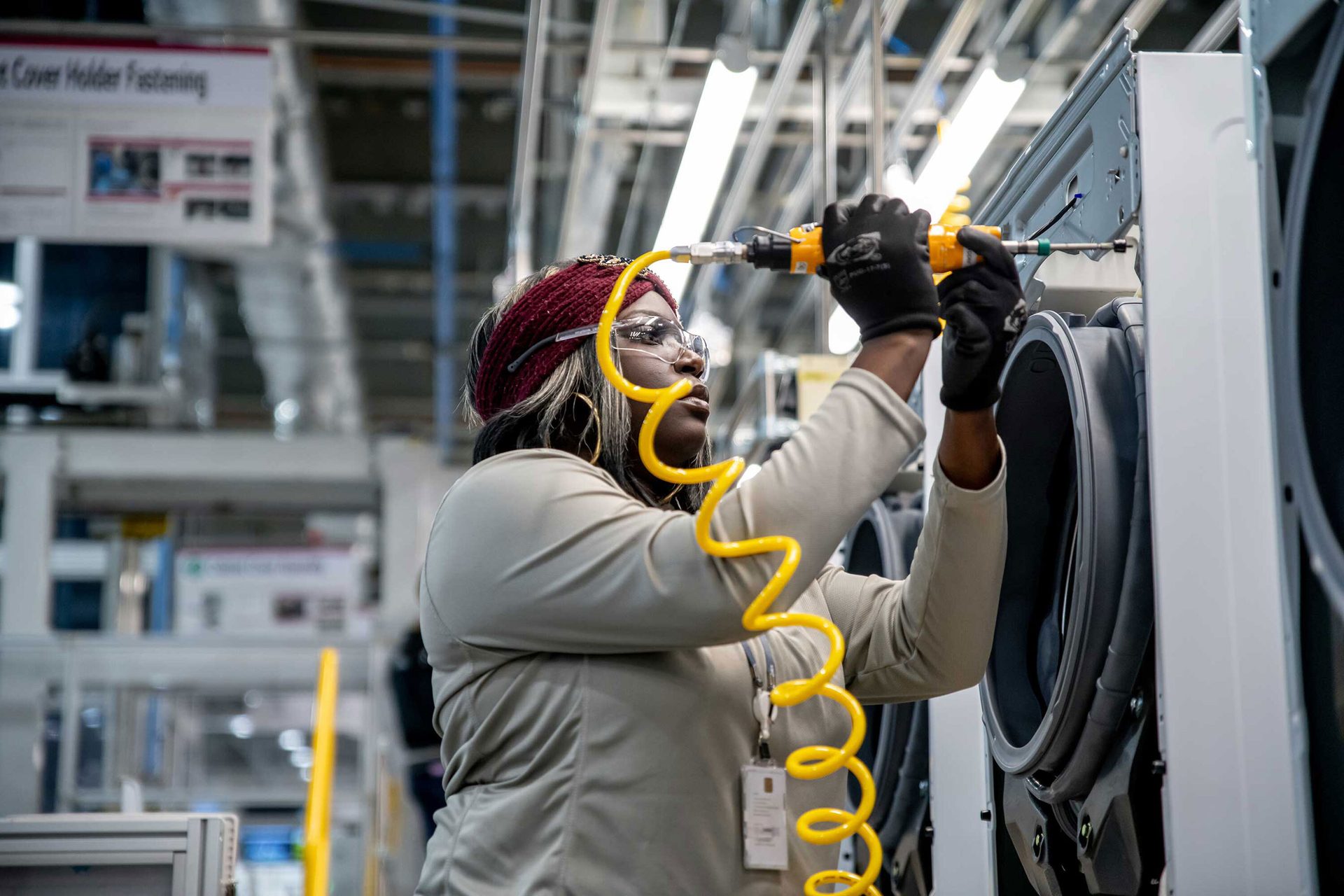
Although the plant is highly automated, some manual screwdriving is used to assemble washers and dryers. Photo courtesy LG Electronics Inc.
Top-load washing machines can be easier to keep clean and require less maintenance. But, they are often less energy- and water-efficient and can be rougher on laundry.
Whether it’s a front- or top-load machine, LGE Clarksville assembles some of the best products in the laundry appliance industry. Front-load washers are available in 4.5 and 5.2 cubic foot sizes, while top-load units are made in 4.1, 4.3 and 5.5 cubic foot options.
All washers feature LG’s innovative 6Motion technology, which uses a direct-drive motor to create multiple types of wash motions for different fabrics. Some machines are also equipped with other advanced features such as ColdWash and TurboWash technology. Another feature called Truebalance is an anti-vibration system that reduces washer noise for smooth, quiet performance.
Electric and gas dryers are also made by LGE Clarksville. In fact, assemblers recently started to make both types of products on the same line. However, gas models tend to be more complex to produce, because they have more components, such as a burner assembly.
Gas dryers come in 29 models, while 52 types of electric machines are available. Capacities range from 7.3 to 9 cubic feet. Features include Sensor Dry and TurboSteam technology that automatically detects moisture levels, adjusts drying time, and reduces wrinkles and odors.
LG’s washers and dryers are equipped with ThinQ technology that enables users to communicate with their machines using a smartphone. It lets them operate units remotely, download new cycles, get notifications and troubleshoot issues.
In addition to standalone washers and dryers, LGE Clarksville assemblers produce stackable machines. WashTowers integrate a full-size washer and dryer into a single vertical unit that frees up valuable floor space. The compact products are designed for apartments, condominiums and homes with small laundry rooms.
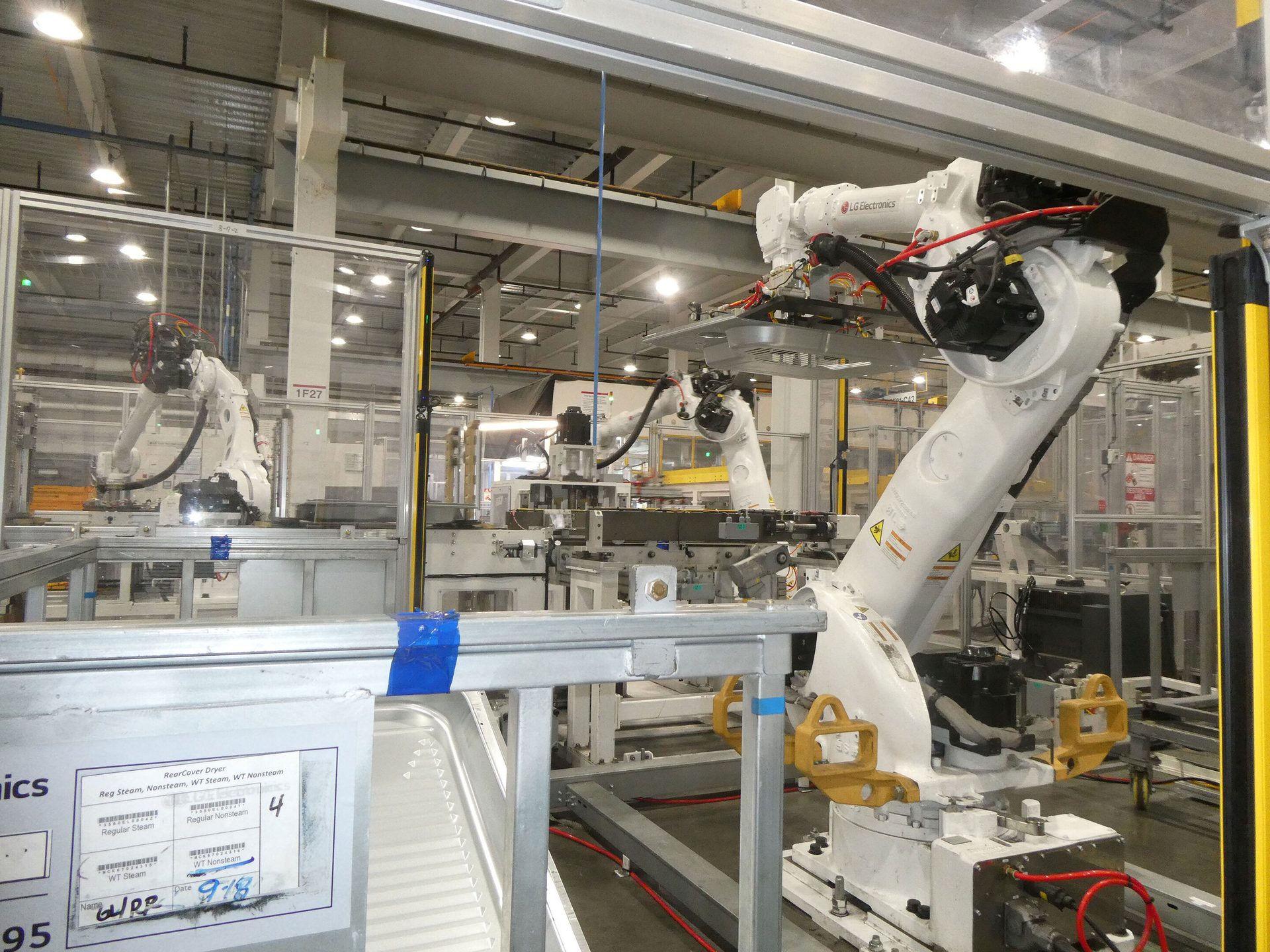
LGE Clarksville uses 130 six-axis robots for welding, painting, screwdriving, material handling and inspection applications. Photo by Austin Weber
Vertical Integration
Vertical integration is a key part of day-to-day operations at LGE Clarksville, which has the capacity to assemble 1.2 million washers and 600,000 dryers annually.
The facility produces most of its parts in-house with state-of-the-art metal stamping and plastic injection-molding operations. Metal parts such as brackets, frames, cabinets, cabinet bases, doors, lids, rear covers, stainless steel tubs and top panels are made in the factory. Plastic parts produced in-house include control panels, detergent dispenser boxes, exhaust ducts, fabric softener dispensers, gaskets, hubs, tubs, plugs, paddles, pulsators, rotors, screen covers and water tanks.
Some components, such as electric motors, are assembled at the plant using imported parts. Electronic control boards, sensors and other critical parts are made by LGE and third parties.
The Clarksville factory has an automated paint shop that applies both liquid and powder coatings to washers and dryers. And, even the Styrofoam that’s used in packaging is made in-house.
“Our facility handles the entire manufacturing process from component to production—everything from metal stamping and plastic injection molding to final assembly, test and packaging,” says Yong Park, president of LGE Tennessee Factory. “That streamlines operations.
“Everything is controlled completely within the walls of the factory,” explains Park. “It enables us to produce a new dryer every 11 seconds and a new washer every 13 seconds.
“By integrating parts production processes, such as stamping, molding and painting, our company has increased productivity by 21 percent [in the past],” claims Park. “While it is not possible to make a direct comparison with current operations, the plant continues to pursue efficiency and productivity enhancements on an ongoing basis.”
Stamping and molding operations take place on the main floor of the two-story factory, where operations flow from west to east. Parts are transported to subassembly and final assembly lines by a fleet of 200 automated guided vehicles (AGVs) and autonomous mobile robots (AMRs).
The machines navigate around factory by scanning 20,000 QR codes that are located on the floor. Each part also has a QR code that enables engineers to trace the root of any defective product.
Tub forming is one of the most critical operations at LGE Clarksville. Sheets of steel are formed, laser welded and inspected for defects using a high-speed quality validation system. QR codes are etched into the side of every part so that they can be scanned and tracked throughout the entire production process.
An intelligent warehouse monitors inventory in real-time and ensures the timely delivery of components and subassemblies using an automated part retrieval system. It has enabled the company to minimize the amount of warehouse space needed by 30 percent compared to conventional logistics systems. The system also shortens the time required for hourly material handling operations by 25 percent.
The smart factory uses a Wi-Fi network comprised of 250 access points and a private 5G network. Eventually, LGE Clarksville plans to transition all of its production equipment to 5G connectivity to ensure more robust communication between machines and workstations.
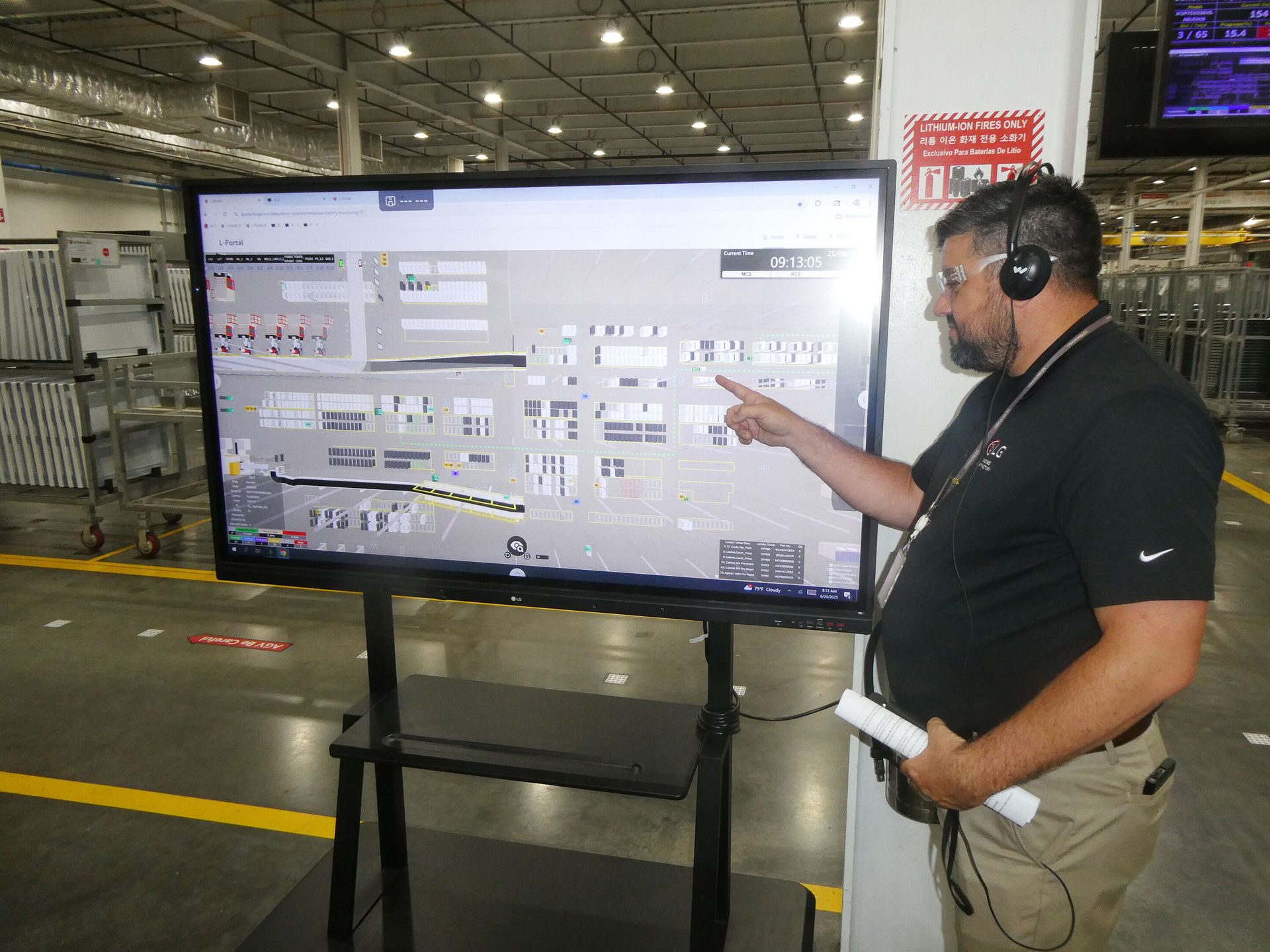
Digital twins enable engineers to see what’s happening on the plant floor in real time. Photo by Austin Weber
Automated Assembly
Automation has enabled the Clarksville plant to boost productivity, improve quality and increase throughput on its high-mix, high-volume assembly lines.
“Automation allows us to be cost-competitive,” says Charles Lonergan, director of manufacturing. “It also increases productivity and improves quality.
“Part of our smart factory strategy centers around having a seamless integration between our people, systems and facility,” explains Lonergan, who formerly worked for an automative supplier and has been with LGE Clarksville since it opened seven years ago.
“This is LG’s first smart factory,” notes Lonergan. “Our second facility is our refrigerator plant in South Korea. Some of the technology initially developed here was applied there. In fact, we have three times more AGVs in Tennessee than at the LG Smart Park.
“The mobile robots transfer material fast and accurately based on stable, uninterrupted communication,” Lonergan points out. “They can hold up to 1,300 pounds and last an entire shift.”
The AGVs automatically recharge their lithium-ion batteries at two stations developed in-house by LG engineers. A software program tracks battery life and lets each machine know when it needs to go to a station and have its battery automatically swapped out by a six-axis robot.
Whether it’s a washer or a dryer, the production process starts with a cabinet forming press on the main floor of the factory. After rolls of steel are automatically stamped into parts on four transfer press lines, cabinets are laser welded and crimped by six-axis robots.
On the second floor of the factory, subassembly lines produce all the plastic components that go inside washers and dryers, such as tubs and control panels, using ultrasonic welding. LG engineers recently installed an automated gate removal system, which replaced a process previously done manually. A vision system verifies quality by checking for flash, short shots and other plastic injection-molding defects
Inspection System

Parts are then transferred via AGV to the final assembly lines located on the main floor. AMRs are currently used only in the fabrication department, but the plant eventually plans to convert its entire fleet to the technology.
“AGVs and AMRs improve overall productivity by freeing up people for other tasks,” says Lonergan. “They do all the heavy lifting for us, transferring parts by cart to and from each production process.
“We use robots and AGVs to safely move heavy parts around the factory, such as washer tubs,” explains Lonergan. “Doing that material handling manually would create ergonomic risks. By applying automation to material movement, operators can focus on value-added production tasks.”
The AGVs and AMRs rely on technology that was developed in-house, such as the LG CLOi CarryBot. Made in collaboration with the company’s telecom carrier unit, LG Uplus, the machines are equipped for 5G communication.
The plant also depends on 130 six-axis robots for various welding, painting, screwdriving and inspection applications.
“Robots make us more efficient and help us control our cost structure,” claims Lonergan. “Generally, they are utilized for tasks that are repetitive, involve heavy lifting or are potentially hazardous, thereby enhancing safety and efficiency for human workers. For instance, six-axis robots are primarily used to handle bulky parts and any subassemblies that have sharp edges.”
Three linear assembly lines—one each dedicated to front-load washers, top-load washers and dryers—are located next to each other. Work in process moves from west to east on traditional fixed conveyors, and screwdriving is used to attach doors and other components.
“Fastening operations are essential for assembling parts that are fundamental to the functionality and durability of washing machines and dryers,” says Lonergan. “That's why our robots automatically adjust to fasten in the correct spot.”
Both DC electric and pneumatic nutrunners and screwdrivers are used on the assembly lines. Currently, 65 percent of fastening operations are automated.
“Torque control and monitoring ensure accuracy and quality,” Lonergan points out. “That’s why torque values are analyzed in real-time during fastening.”
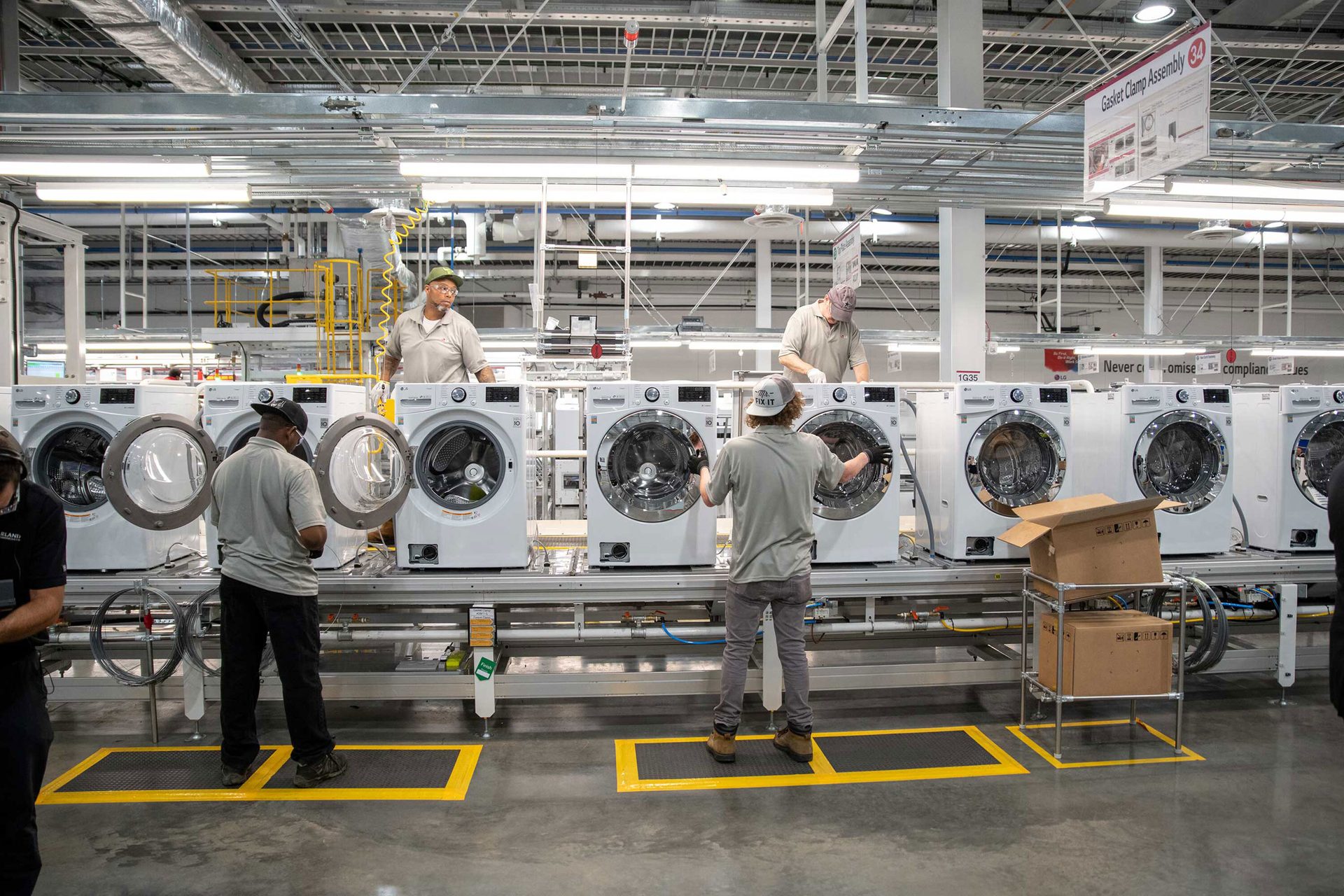
The front-load washer assembly line produces a variety of models. Photo courtesy LG Electronics Inc.
AI and Digital Twins
Since opening in 2018, LGE Clarksville has made continuous progress in multiple areas, including productivity gains, higher levels of automation, more efficient logistics management and improved product quality.
“The plant holds a variety of regular review meetings where key performance indicators such as quality, safety, downtime and inventory levels are closely monitored and managed,” says Park. “These meetings are an important part of our continuous improvement culture.
“By applying data-based AI technology that accurately predicts washing machine performance, the number of tests and energy consumed during testing have been reduced by 22 percent,” explains Park. “The defect rate has been reduced by more than 61 percent via quality optimization.
“Our deep learning-based intelligent platform leverages accumulated data to proactively alert operators and engineers about the potential for future issues,” notes Park.
All of the plant’s manufacturing processes are overseen by LG’s own digital twin monitoring system. It uses artificial intelligence and data analytics to assess inventory status, production performance and machinery failures. An inspection system automatically detects quality problems by learning various types of defects.
“Digital twins enable us to see what is happening on the plant floor in real time,” says Lonergan. “It addresses quality control and process optimization by virtually replicating the factory state in real time. We can make adjustments in our production system to improve the efficiency of our assembly lines.
“For instance, we have a six-camera visual inspection system at the end of our front-load washing machine line,” explains Lonergan. “It helps us detect any abnormalities or errors, and ensures that every product leaves our factory in a perfect state. It checks things such as hose connections to ensure quality.”
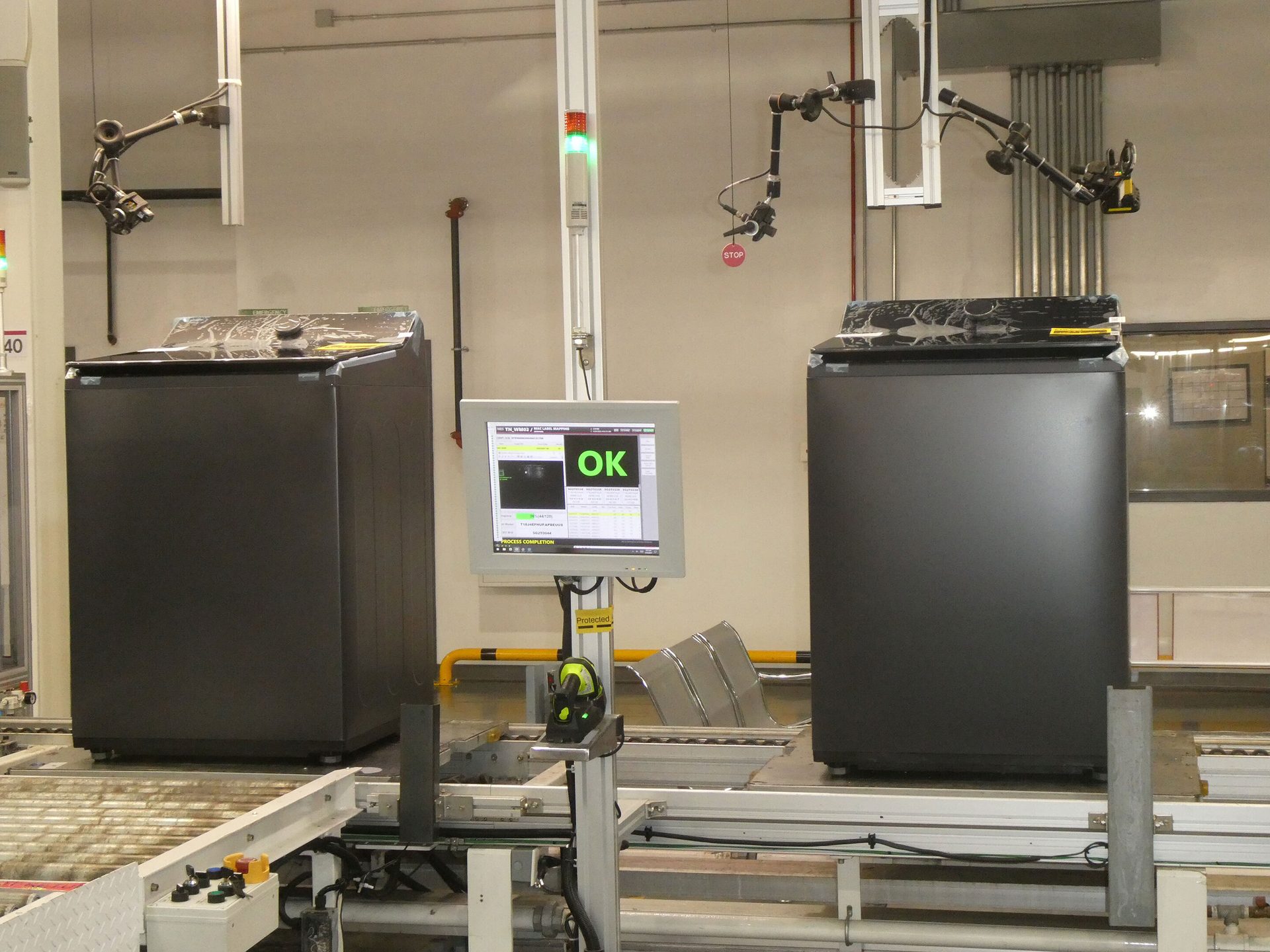
Artificial intelligence technology and visual inspection systems are used to check washers and dryers for defects. Photo by Austin Weber
Washing machines also undergo leak tests and functional tests. Other end-of-line testing includes a sound booth equipped with four microphones to detect any abnormal noises and a visual inspection system that checks control panels. In addition, manual fit-and-finish checks are used to ensure quality.
Digital twin technology enables LGE Clarksville engineers to analyze production processes using virtual reality, touchscreen video boards and controls towers. It can predict if any issues will occur within the next 10 minutes and provide an accurate, up-to-the-minute status of the facility’s logistics operation.
Sensors that use deep learning technology are installed throughout the factory to monitor each phase of production in real-time, helping engineers and operators proactively identify and resolve any possible issues.
After implementing the system, the cost of defective product returns dropped by 70 percent, while overall quality competitiveness and production efficiency were both significantly strengthened.
“Two main applications for AI include our PIE (predictive maintenance) system and our vision systems,” says Lonergan. “Predictive maintenance eliminates downtime during production, because we’re able to recognize abnormalities in the equipment and attack those during non-production time.”
PIE (Plug-in for Intelligent Equipment) is an LG-developed platform that applies deep learning to collect and analyze real-time equipment data, such as motor speeds and vibrations. It enables more efficient production processes by boosting productivity and reducing defect rates.
“Vision technology is also used to improve quality,” explains Lonergan. “It enables us to take multiple pictures of products as they come down the line, compare it to our master image files, and then use AI software to verify that parts meet our specifications.”
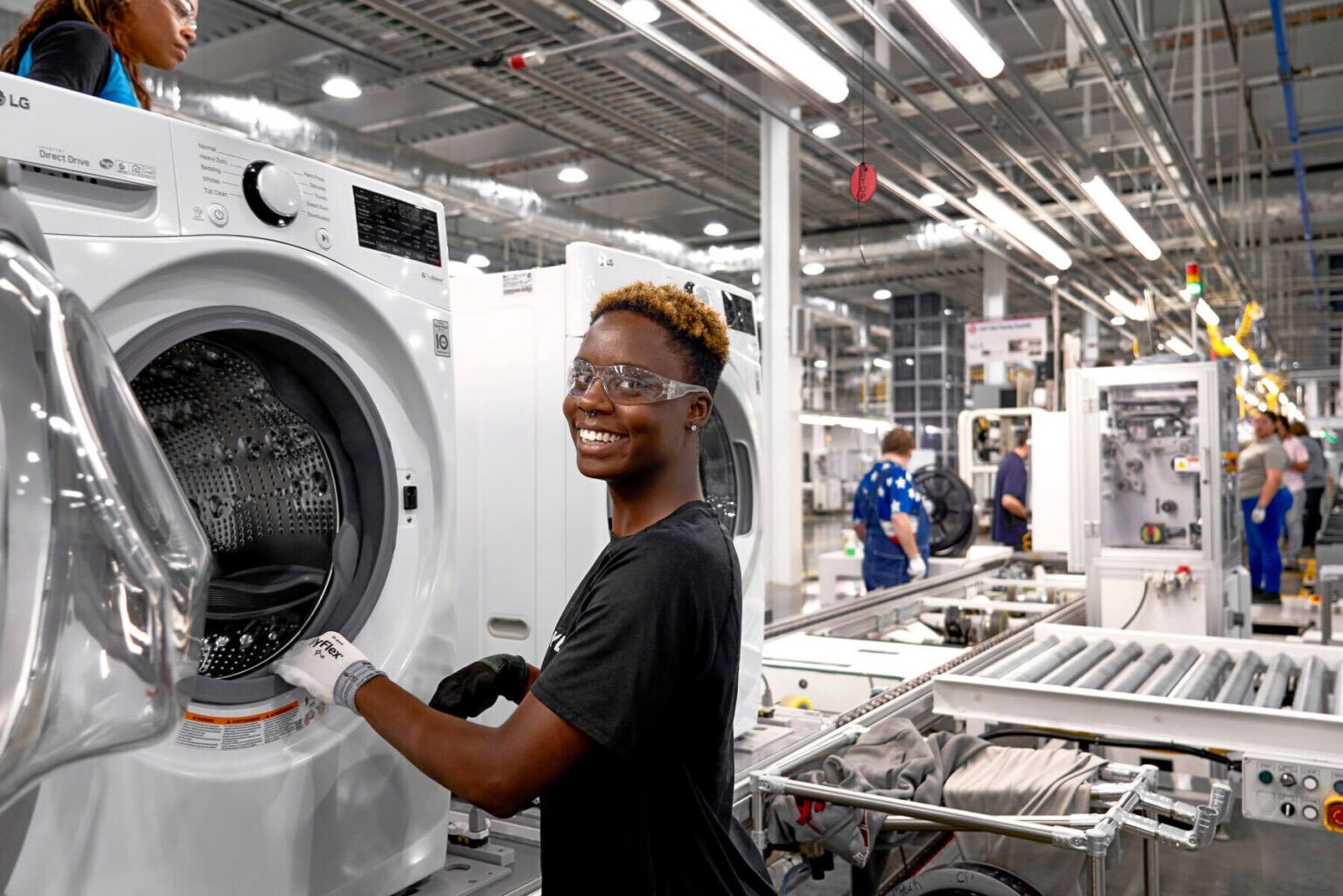
Although advanced automation is used throughout the factory, humans play an important role in day-to-day operations. Photo courtesy Gresham Smith
According to Si-yong, LG is managing full-scale, turnkey projects designed to enhance efficiency, improve quality and increase competitiveness. It expects orders for smart factory technology solutions to reach $272 million this year.
“At the core of [our] smart factory capabilities is a robust platform powered by approximately 770 terabytes of production data,” says Si-yong. “Leveraging AI and big data analytics, our systems transform conventional operations into intelligent, adaptive ecosystems.
“Through digital twin technology, we simulate factory layouts and processes before physical implementation, reducing risk and eliminating guesswork,” adds Si-yong. “Generative AI monitors equipment in real time, identifying issues like unusual vibrations and recommending corrective actions. Vision AI further enhances operational safety and product quality by detecting defects and safety hazards instantly.”
Spreading the Smart Factory Gospel
LG Corp. recently started to market its smart factory technology to manufacturers in other industries, including automakers and suppliers. The goal is to offer end-to-end support, from factory design and process audits to ROI analysis and phased implementation roadmaps.
“Smart factory solutions are no longer optional—they’re essential,” claims Song Si-yong, head of the smart factory business division and the production engineering research Institute at LG Electronics Inc. “We serve a diverse range of customers, from small manufacturers starting their digital journey to large enterprises modernizing complex operations.
“At LG, a smart factory isn’t just about high-tech tools—it’s about smart strategies built around our customers,” says Si-yong. “We believe success isn’t defined by how automated a factory is, but by how agile, resilient and future-ready it becomes.
“We’re proud to collaborate with our partners to build operations that are not only more efficient, but also more competitive and sustainable,” notes Si-yong. “As the manufacturing sector continues to evolve, LG is committed to leading the way by cocreating the future of intelligent production.”
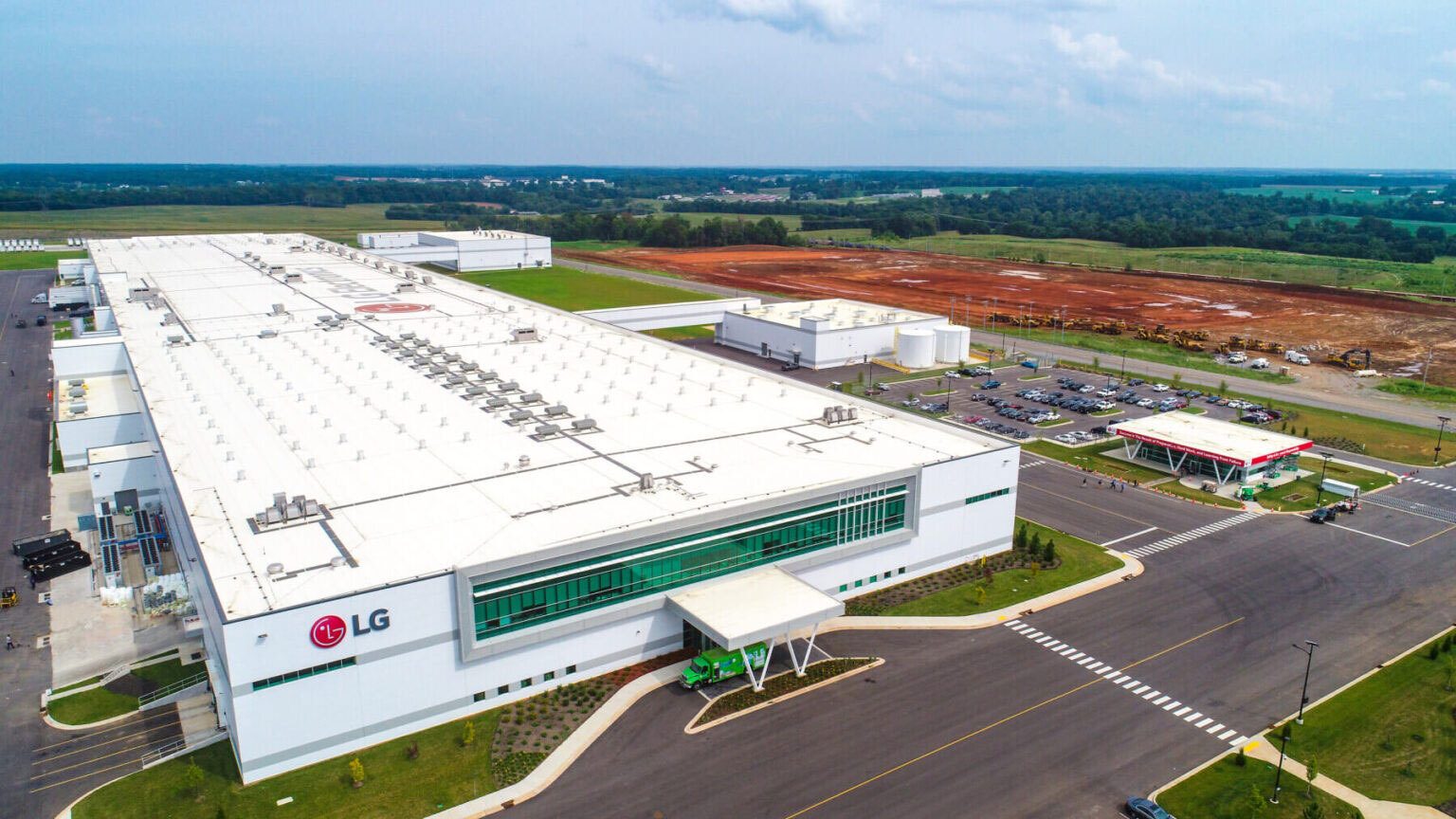
LG Electronics’ smart factory in Clarksville, TN, is one of the world’s most automated household appliance plants. Photo courtesy Gresham Smith
ASSEMBLY ONLINE
For more information on appliance manufacturing, visit www.assemblymag.com to read these articles: