CONTACT
Austin

Lightweight battery-powered aircraft are ready for take-off.
Dual-Cure Potting Compound and Other New Bonding Products
Light-curing adhesives are one-part, solvent-free liquids. Upon exposure to light of the correct intensity and spectral output, the photoinitiator in the adhesive initiates cure, yielding a thermoset polymer that adheres to a variety of substrates. These adhesives cure rapidly on demand, minimizing work in process and offering virtually unlimited repositioning time before curing occurs.
The only limitation of these adhesives has been depth of cure and curing in shaded areas. Dual-cure adhesives are changing that. A new potting material from Panacol is a good example. Read about that and other new adhesive and dispensing technology in this month’s “New and Noteworthy.”
Dual-Cure Potting Material for Electronics Assembly
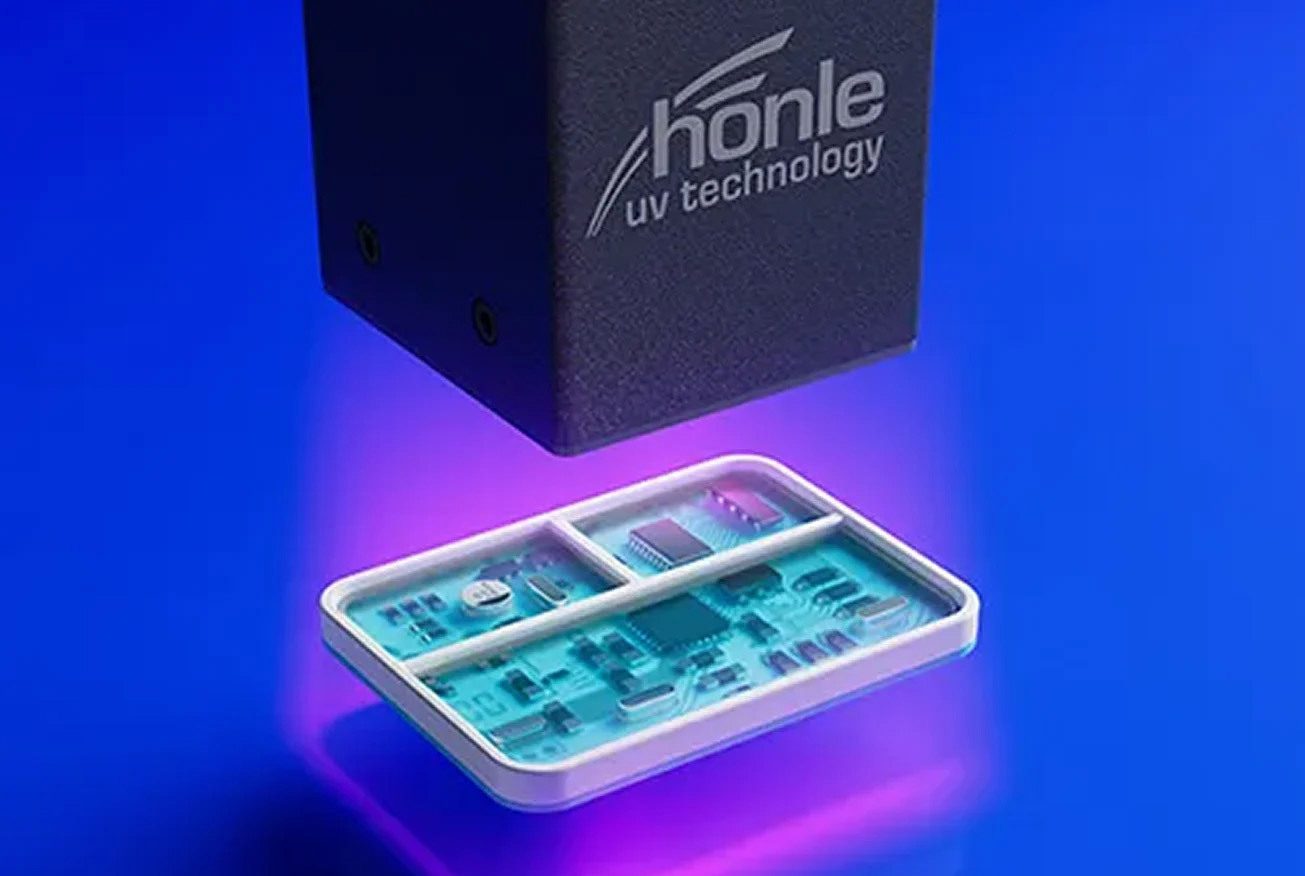
Vitralit UD 8060 F is a one-component potting material for electronics and sensor assembly. The initial cure is accomplished with UV or visible light in a seconds. The adhesive will then use atmospheric humidity and surface moisture to complete curing in areas that are shadowed from light exposure. This second phase of curing occurs without imparting thermal stress on sensitive electronic components. The material is formulated with a modified isocyanate acrylate. It can be cured by irradiating with broad spectrum UV-A or by using wavelengths of 365 or 405 nanometers.
The rapid build-up of mechanical strength prevents warping of the bonded substrates and enables the components to be processed or transported quickly. This makes the material ideal for applications with shadow zones or complex component geometry.
The material is characterized by a high elongation at break of up to 130 percent and good adhesion to various substrates, such as polycarbonate, polymethyl methacrylate, FR4, copper and aluminum. Its temperature resistance ranges from -40 to 130 C. The adhesive also demonstrates good resistance to humid conditions. Bond strength values remain consistent after exposure to 85 C and 85 percent humidity for 120 hours.
Compared to other products in the Vitralit 80 series, Vitralit UD 8060 F offers a particularly soft, flexible bond that can absorb mechanical stresses well. This property makes the adhesive ideal for bonding materials with varying thermal expansion coefficients, and for applications in which vibration loads can occur. This transparent adhesive contains a fluorescent tracer that is only seen when exposed to UV light. This permits fast visual inspection for enhanced quality control.
Panacol
Thermal Interface Material for AI Data Centers
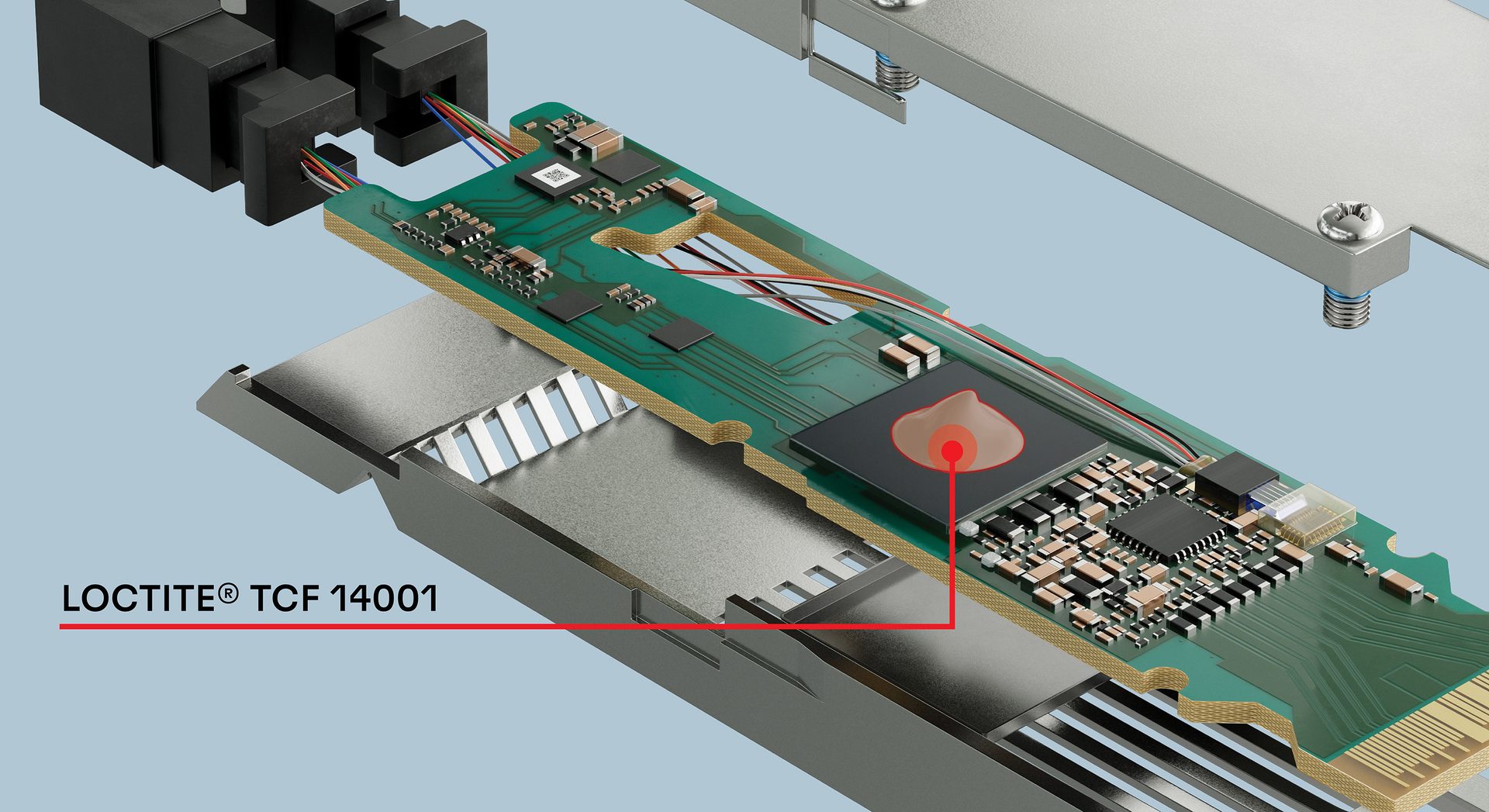
Loctite TCF 14001 is a liquid silicone thermal interface material for AI data center optical components. Designed for 800G and 1.6T transceiver technologies, this 14.5 watts per meter Kelvin gap filler is among the highest thermally conductive liquid materials on the market, enabling elevated transceiver performance through robust heat management.
Escalating AI workloads pose significant bandwidth and latency challenges that can only be addressed by more powerful, high-speed optical technology. While next-generation 800G, 1.6T, and coherent optical transceivers are meeting speed, distance, latency and bandwidth demands, their high-power density chip designs result in increased heat generation. Exceptional thermal control is required to fully exploit their performance potential.
A low-volatility, two-part silicone material, Loctite TCF 14001 exhibits minimal outgassing and very low oil bleed, protecting against any optical interference. The formulation enables precise automated dispensing with stable flow, while its strong interface adhesion and good gap variation tolerance across a range of chip sizes ensure thermal performance continuity even when high thermal loads may induce stress and chip warpage.
Henkel Corp.

Dispense Head for Medical Additive Manufacturing
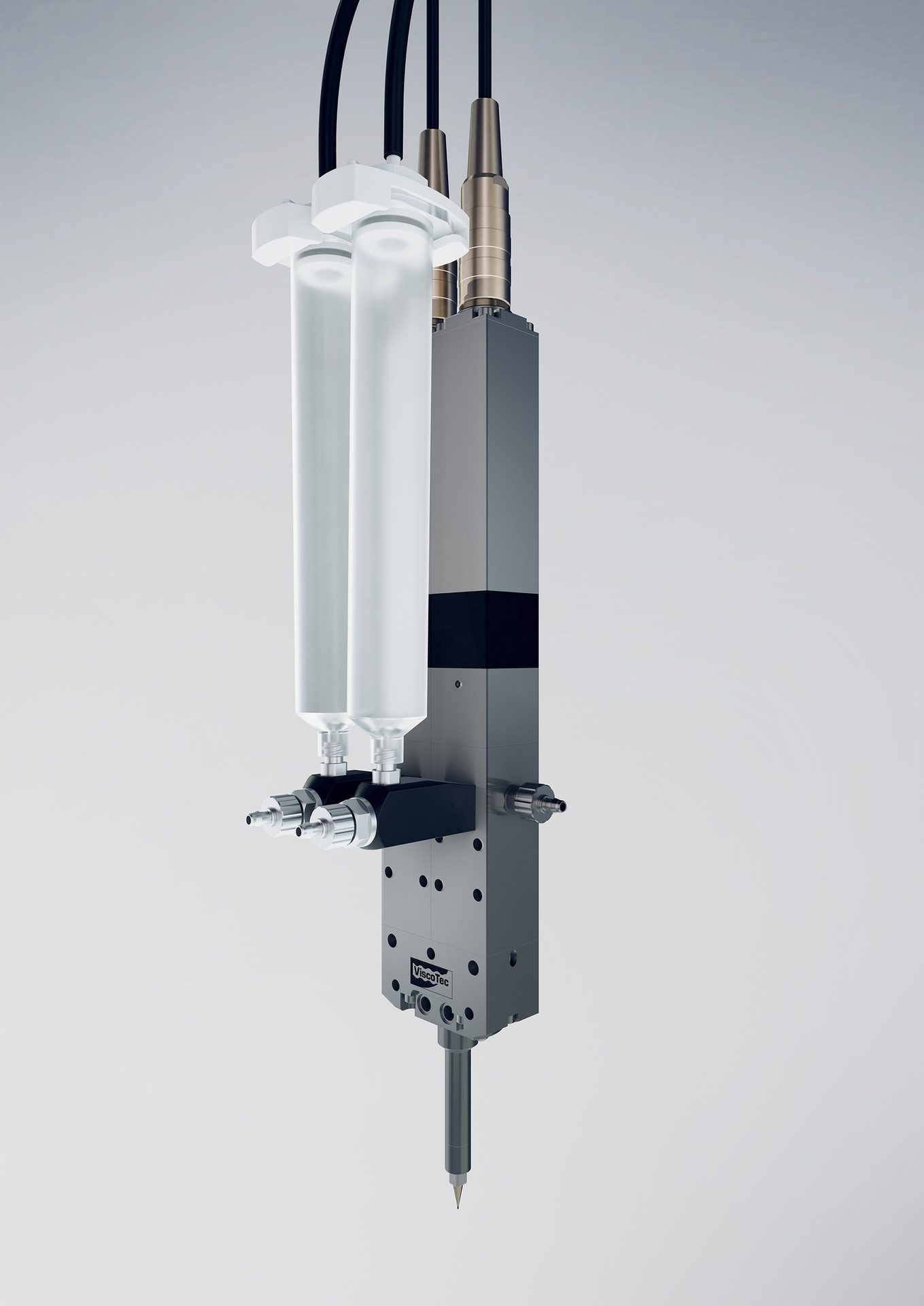
Vipro-HEAD printheads for additive manufacturing are now available for medical-grade applications. Product-contacting components are made of either stainless steel or elastomers and plastics with FDA certification. An autoclavable version that can be sterilized at up to 121 C is also available.
The following print heads have been adapted or further developed as part of the medical grade series: vipro-HEAD 3; vipro-HEAD 5; vipro-HEAD 5/5 for two-component applications; and vipro-HEAD 5 with heating function.
Thanks to these adjustments, materials that are important for medical technology can be processed, including hydrogels, silicones, polycaprolactones and ceramics. This opens up new possibilities for additive manufacturing of patient-specific implants, prototyping, and development of innovative therapy products, even in batch sizes of one.
Typical applications include bone or breast implants; flexible implants, such as silicone vascular structures; tablets for individualized drug release; and wearables.
Printed line width ranges from 100 to 150 microns. Maximum flow volume is 6 milliliters per minute per print head half.
ViscoTec
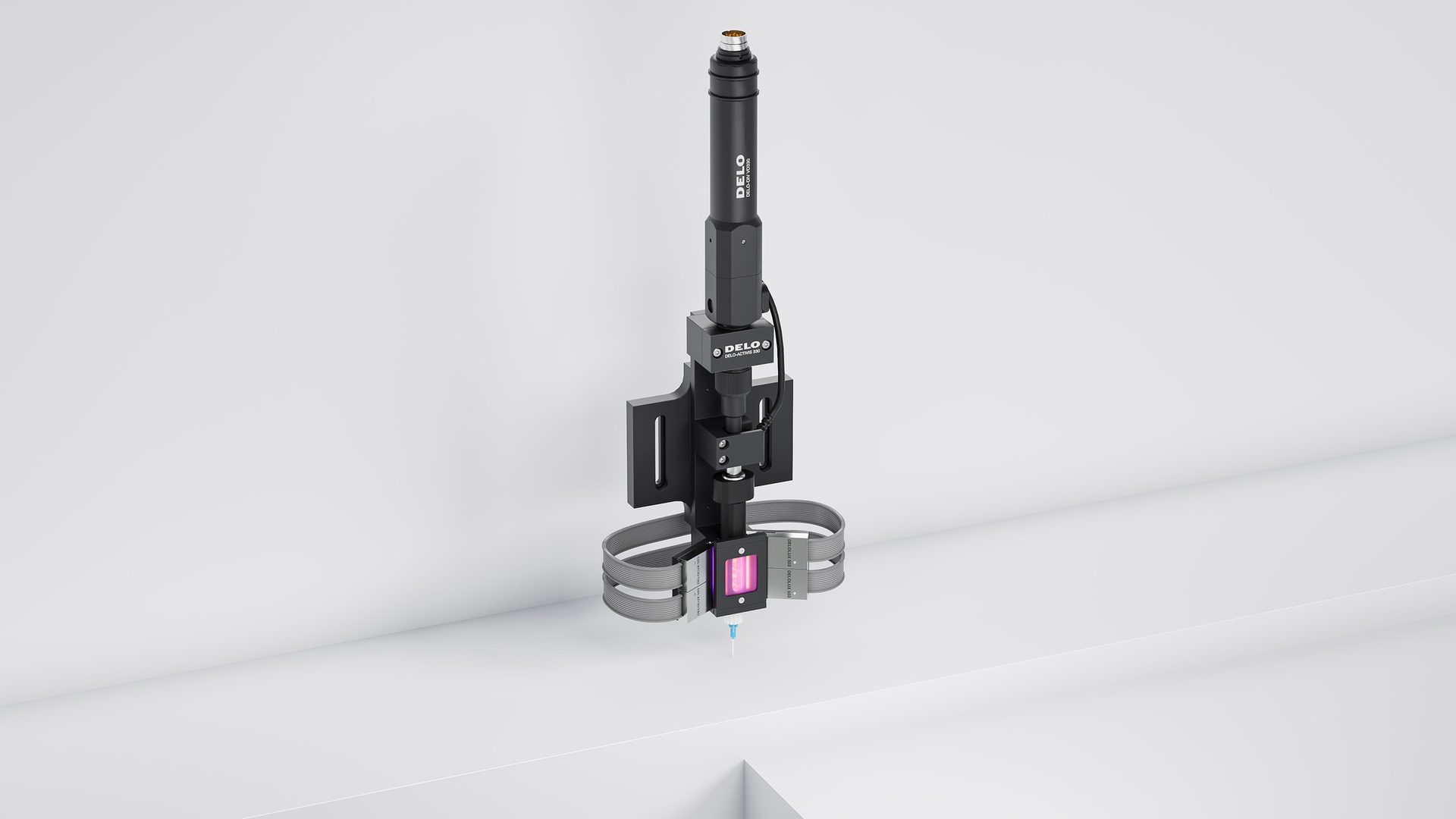
Valve Dispenses and Cures Adhesives in One Step
The Delo-Activis 330 valve is easy to integrate into existing assembly lines and is ideal for dispensing volumes as small as 4 microliters. The valve combines dispensing and curing of adhesive in a single step, offering maximum design flexibility, high process reliability, and up to 98 percent reduction in carbon emissions.
The valve is compatible with DELO’s line of “activation on the flow” adhesives, which now includes eight formulations. The adhesives cover a wide performance spectrum: from low‑viscosity to pasty; from transparent to black; and from soft‑elastic to high‑strength.
During dispensing, the adhesive is pre‑activated through integrated irradiation, initiating curing before the material even reaches the component. This ensures reliable bonding even in shadowed areas and with materials that are opaque to light. An optional post light fixation step prevents slipping or leaking, allowing immediate further processing of components.
DELO Industrial Adhesives