SEE
IT
AT
Presses Will Be Vital for Assembling ‘Green’ Technologies
Electric vehicles, hydrogen fuel cells and solar power will be key components of a future green economy. Ironically, assembling these products will require old technologies: presses and sheet-metal clinching.
Hydrogen fuel cells are particularly intriguing, since hydrogen can be produced with another green technology—high-performance solar cells. Electrolysis plants can use solar power to split water into its components, hydrogen and oxygen.
“Our technologies support the manufacturing and assembly of solar cells and electronic components,” says Frank Ortmann, business development manager at Tox Pressotechnik, a manufacturer of presses and sheet-metal clinching equipment. “But, we also deliver technology for the production of battery cells and packs, fuel cells and systems, and electrolytic cells and electrolyzers.”
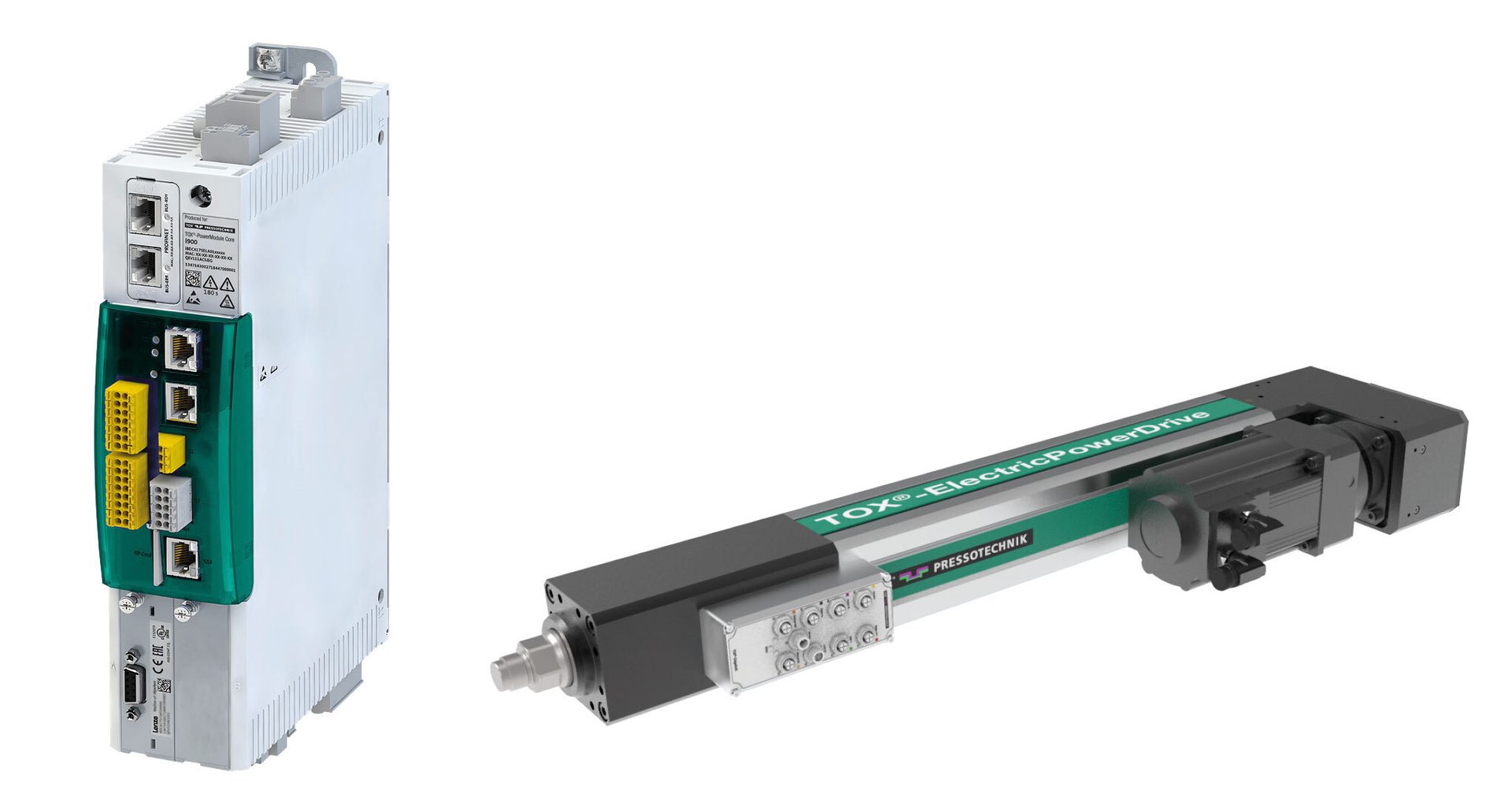
The electromechanical Tox ElectricDrive is an energy-efficient, precise, low-maintenance machine equipped with force and stroke control. Photo courtesy Tox Pressotechnik
Sheet metal clinching is key part of the assembly process for these products. It can be used to join sheet metals of different strengths or to join different materials or coated materials. Adhesives and sealants can even be used between sheets for extra strength or weather resistance.
Clinching is suitable for single sheet metal thicknesses of 0.1 millimeter up to a total layer thickness of 12 millimeters. Materials with a tensile strength of up to 800 newtons per square millimeter can be clinched.
In clinching, a punch and die form ductile materials, resulting in a button-like, positive locking, frictional connection. Since heat is not applied to the joint zone, the properties of the materials do not change, nor is there any distortion.
For connections for power transmitting applications, such as power rails for fuel cell systems or connectors for EV battery cells, manufacturers can use TOX’s eClinching process. Durable electrical connections are created through numerous metallic microcontacts. This forming process does not require a secondary joining element, such as fasteners, filler metal or solder. Compared to a welded joint, the connections have a higher dynamic strength throughout their service life. The connections are gas- and liquid-tight, which improves corrosion resistance. The process is also less expensive and more environmentally friendly than welding or soldering.
Besides clinching, presses can be used for other assembly techniques, such as riveting or press-fitting.
“Both techniques ensure that the housing components of a battery pack, such as tray cover or cross member, are joined together securely and durably,” says Ortmann.
Depending on the design, more than 100 connection points can be required for an EV battery pack. These connection points can be designed as separable or inseparable.
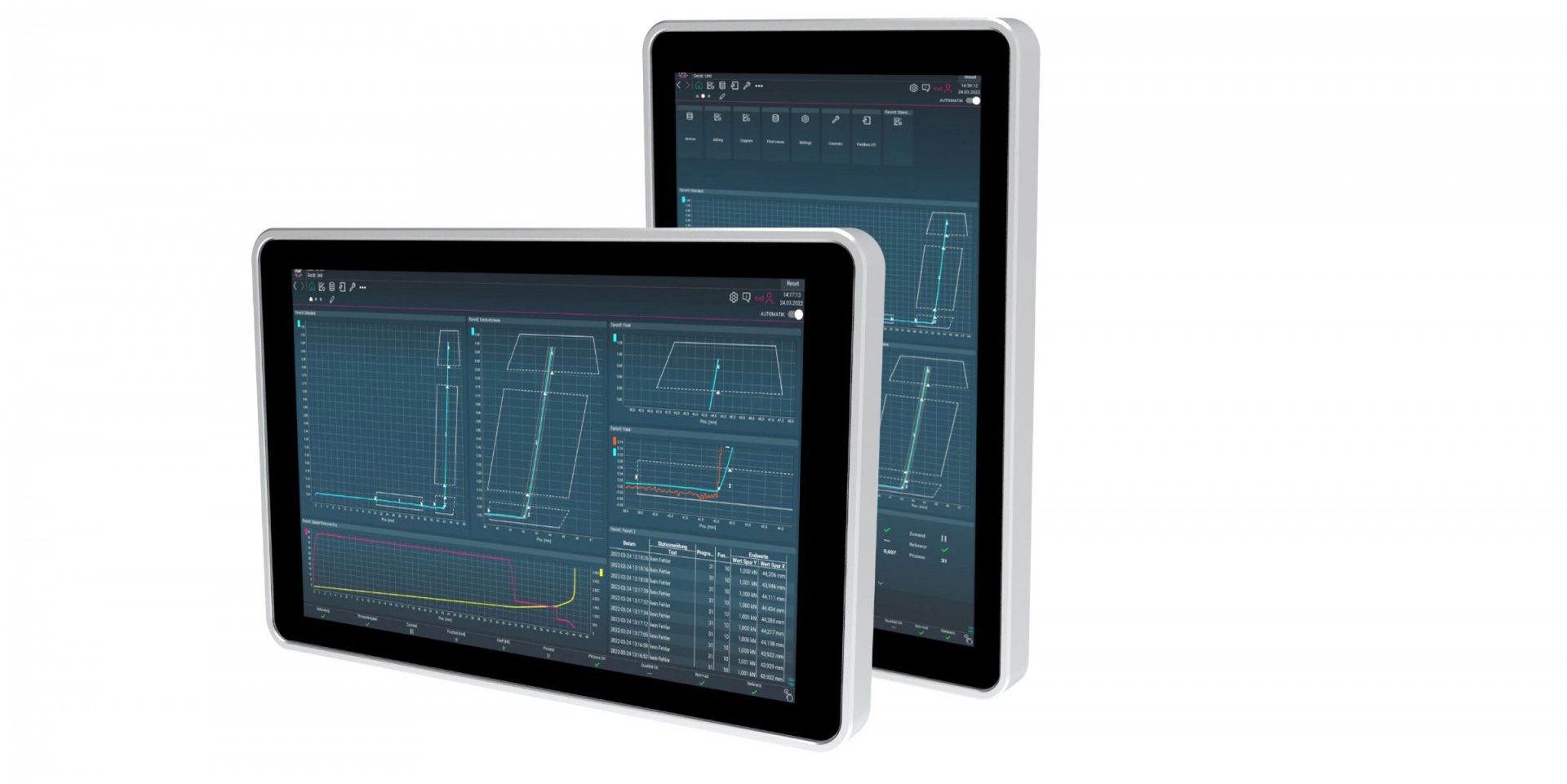
To ensure quality, the controller monitors force and ram position during the pressing process. Photo courtesy Tox Pressotechnik
Technology Options
Regardless of what method is used to assemble the product, Tox offers a variety of technology options to get the job done. The company provides manual, pneumatic, hydropneumatic and electromechanical presses. Presses are available as handheld tools, benchtop machines, stand-alone assembly stations, or even end-of-arm tools for robots. Also available are controls, sensors and software for process monitoring and quality assurance.
The electromechanical Tox ElectricDrive is an energy-efficient, precise, low-maintenance machine equipped with force and stroke control. Press force ranges from 0.02 to 1,000 kilonewtons. The press can be integrated quickly into automated assembly lines thanks to its preconfigured and calibrated operating system.
“The ElectricDrive is available in a special clean room version,” says Ortmann. “This is necessary to prevent conductive or interfering particles from getting into the production process of sensitive components. This is the only way to ensure the high quality of the components.”
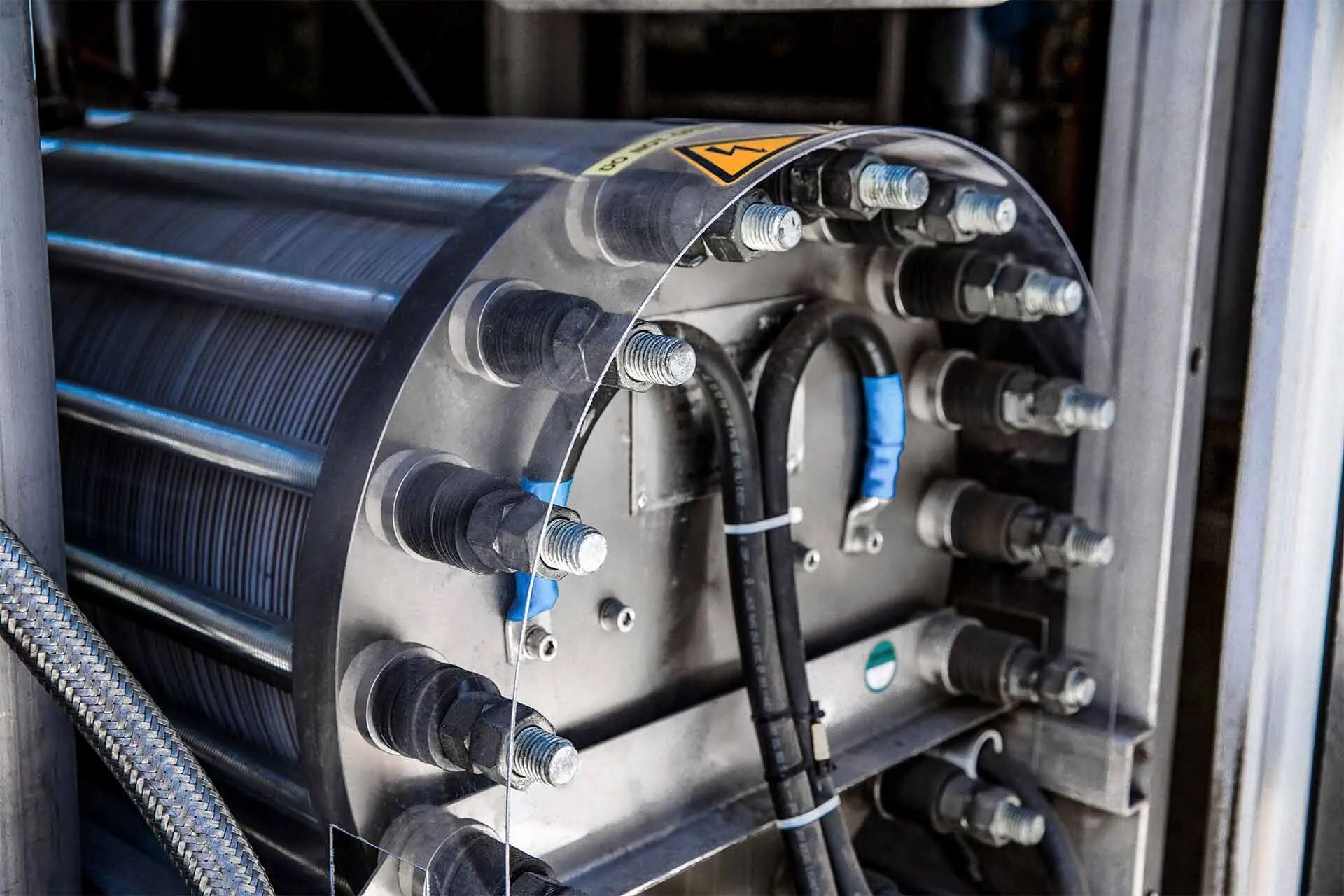
Electrolyzers split water into hydrogen and oxygen using electricity. Photo courtesy Tox Pressotechnik
A hydropneumatic press can be used to press film onto battery cells without the formation of bubbles. This press consists of an energy-efficient pneumatic cylinder with integrated, closed hydraulic system and an automatic power intensifier. The product range provides press forces of 2 to 2,000 kilonewtons, power strokes of up to 69 millimeters, and total strokes of up to 400 millimeters. Key features include a power bypass, complete separation of air and oil, and a hydraulic damping system for the return stroke.
For production of battery cells, electrolyzers and fuel cells, the Tox ElectricDrive Core is a good option. The system consists of an electromechanical drive, a controller and intelligent software. It is suitable for forming, pressing, punching, stamping and clinching.
“We can adapt the system to the respective task in a modular way and configure it,” says Ortmann.
The software is intuitive. The configurable process monitoring system can detect, for example, an incorrect number of bipolar plates in an electrolysis or fuel cell stack. The program continuously monitors the pressing process and assigns the relevant process parameters to the individual stacks.
“Our press system enables the pressing of stacks with forces up to 1,000 newtons, and holding or readjusting forces set during the setting process over long periods,” says Ortmann.
Source: Tox Pressotechnikd.
Keeping Full Control
Traceability has long been the standard in the automotive industry, and electric and autonomous vehicles are no exception. OEMs must be able to continuously monitor all production parameters independent of the technology used. With the Tox Multi-Technology Platform, every connection can be checked during production, and inspection results can be archived online.
“The user can easily install and operate the system with the software,” says Ortmann. “Changeovers are not a problem. Process parameters are imported from the network, and the system components are automatically configured.”
For example, TOX has implemented a number of press systems for assembling fuel cell stacks and electrolyzers with forces up to 1,000 kilonewtons per joining module. For this application, the key is to monitor the process, compensate for tolerance issues, and document the process. Because it’s a pressurized component, safety must be guaranteed at the highest performance level for personal protection.
“We also support manufacturers with regard to checking bipolar plates for their conductivity and tightness,” Ortmann explains. “Adding to this is mechanical joining with the clinching of tightening straps, bipolar plates, electrolytic cells and electrically conductive connections, as well as press-fit assembly of valves for hydrogen pressure vessels.”
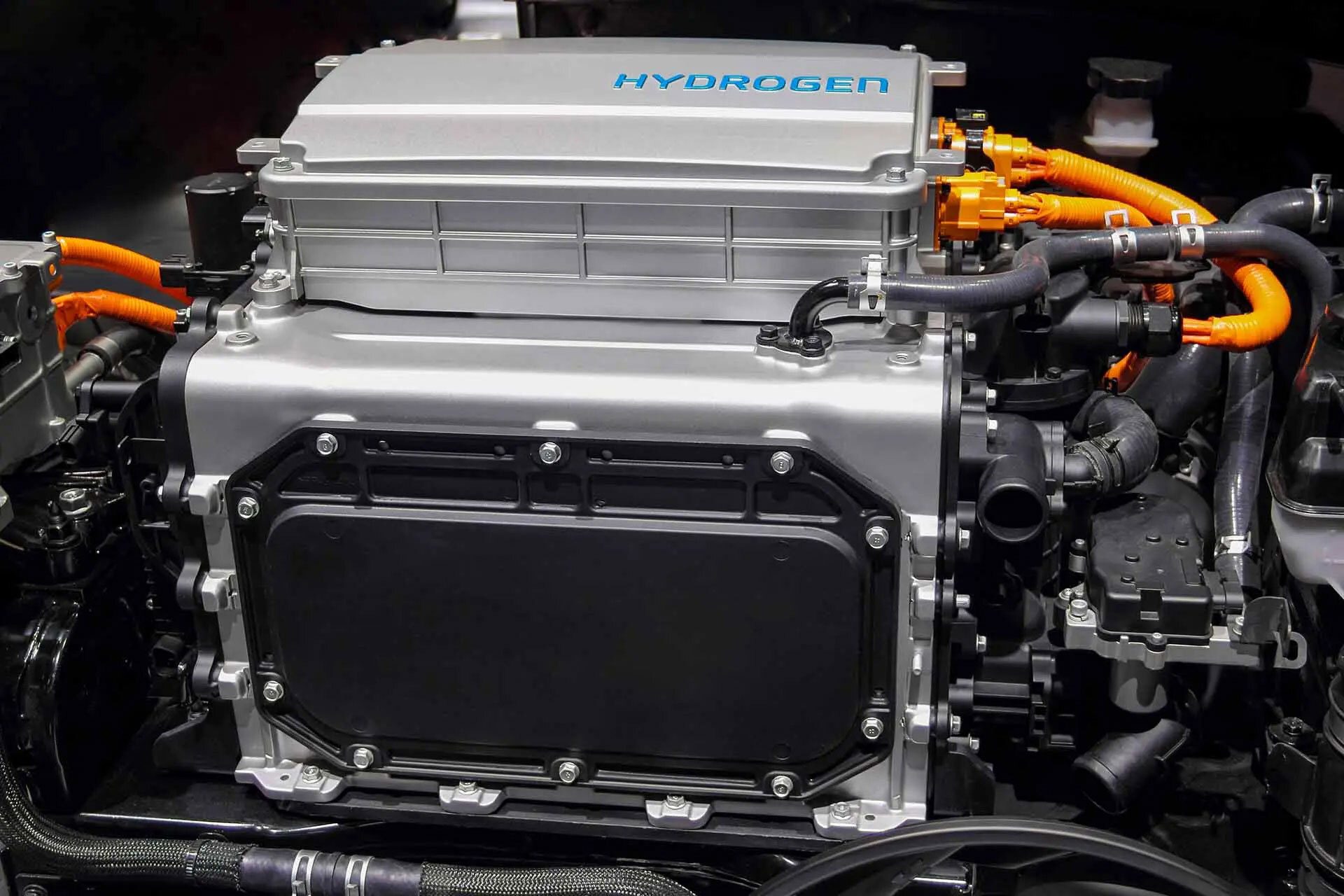
Fuel cell stacks convert hydrogen from a tank and oxygen from the air into electric current. Photo courtesy Tox Pressotechnik
For more information on presses and sheet metal clinching, click https://tox.com or visit the company’s booth at The Manufacturing & Automation eXchange (MAX), which will be held March 25-26, 2026, at the Music City Center in Nashville, TN.
MAX was created in direct response to the shifts shaping manufacturing today: smart factories, integrated systems, workforce challenges, and the need for collaboration across disciplines. MAX merges the strengths of five manufacturing brands—ASSEMBLY, Quality, Adhesives & Sealants Industry, ISHN, and Packaging Strategies—to create one collaborative, unified event that reflects how modern manufacturers think, work, and solve.
Besides presses, you’ll find more than 200 suppliers of automation, fastening tools, robotics, software, adhesives, packaging equipment and safety products.