ASSEMBLY LINES
‘Assembly Plant of the Year’ Award Call for Nominations
CHICAGO—ASSEMBLY is seeking nominations for its 2022 Assembly Plant of the Year award. The 19th annual award will recognize a manufacturing facility in the United States that has applied world-class processes to reduce production costs, increase productivity, shorten time to market and improve product quality.
Entries will be judged by ASSEMBLY’s editorial staff on a broad range of operational performance measures and the use of production tools. The winning facility will receive a crystal award and a commemorative banner. It will also be profiled in the October issue of ASSEMBLY.
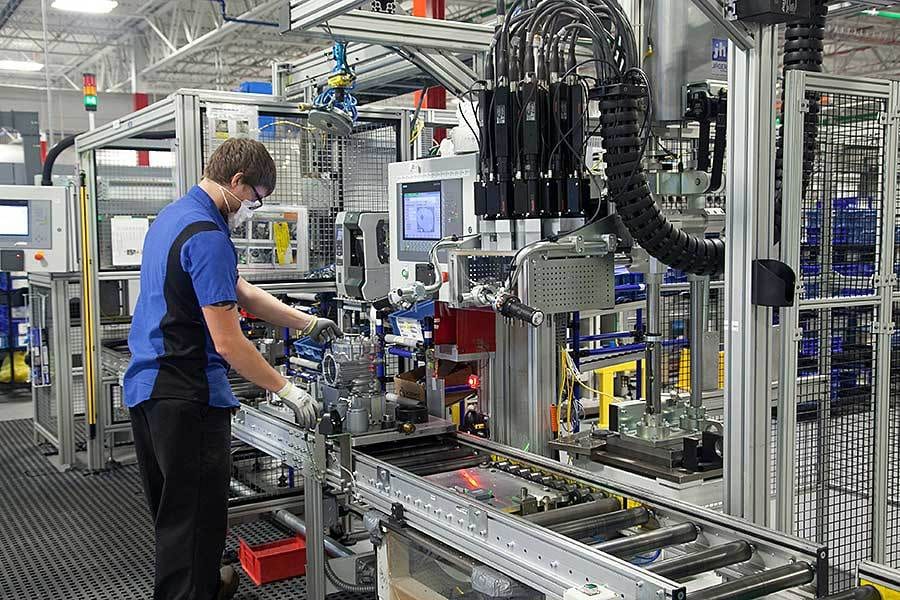
GKN Automotive’s Newton, NC, drivetrain factory was the recipient of the 2021 Assembly Plant of the Year award. Photo courtesy GKN Automotive
Previous recipients have been GKN Automotive, Newton, NC (2021); Murakami Manufacturing USA Inc., Campbellsville, KY (2020); GE Appliances, Decatur, AL (2019); Ford Motor Co., Sterling Heights, MI (2018); AGCO Corp., Jackson, MN (2017); Bosch Rexroth Corp., Fountain Inn, SC (2016); Polaris Industries Inc., Spirit Lake, IA (2015); STIHL Inc., Virginia Beach, VA (2014); Northrop Grumman Corp., Palmdale, CA (2013); Ford Motor Co., Wayne, MI (2012); Philips Respironics, New Kensington, PA (2011); Eaton Corp., Lincoln, IL (2010); Batesville Casket Co., Manchester, TN (2009); IBM Corp., Poughkeepsie, NY (2008); Schneider Electric/Square D, Lexington, KY (2007); Lear Corp., Montgomery, AL (2006); Xerox Corp., Webster, NY (2005); and Paccar Inc./Kenworth Truck Co., Renton, WA (2004).
Companies interested in applying for the 2022 Assembly Plant of the Year award can fill out the online form at www.assemblymag.com. There is no entry fee, and more than one plant may be nominated.
The deadline for submissions is April 29. For more information, contact Austin Weber at webera@bnpmedia.com or 224-202-2340.
Manufacturers to Invest Big in Digital Twin Technology
NEW YORK—ABI Research has released a white paper entitled “70 Technology Trends That Will—and Will Not—Shape 2022,” which identifies 35 trends to keep an eye on and 35 others that, although attracting huge amounts of speculation and commentary, are less likely to move the needle over the next 12 months. Those trends include digital twins and 5G networks, respectively.
“The fallout from COVID-19 prevention measures, the process of transitioning from pandemic to endemic disease and global political tensions weigh heavily on the coming year’s fortunes,” says Stuart Carlaw, chief research officer at ABI Research. According to Carlaw, one trend that will affect manufacturers is digital twin technology, which is projected to grow 28 percent annually from $4.6 billion in 2022 to $33.9 billion in 2030.

Demand for digital twin technology will grow 28 percent annually between 2022 and 2030. Photo courtesy General Electric
“Digital twins are not a technology, but a composition of solutions aimed at bridging the physical and digital worlds, from design through simulation, manufacturing, assembly, and after-sales service and support,” explains Carlaw. “Over the last few years, digital twins have grown from a concept to become mainstream with the help of Industrial Internet of Things dashboards and near-real-time reporting.
“This level of maturity has been accompanied by new thought constructs, such as the use and implementation of AI at scale; changing requirements like the need for model libraries and standards bodies; and soon, the emergence of digital twin marketplaces that enable independent software vendors and other third parties to build relevant tools for the ecosystem,” Carlaw points out. “These tools are essential for continued value creation and the wider democratization and adoption of digital twins.”
However, Carlaw predicts that despite a lot of hype, 5G technology will not permeate the manufacturing world in 2022. That’s because there are still fewer than 84 sites around the world with publicly announced private network deployments. All of them are at large companies and facilities, such as ABB, Airbus, BASF, Daimler, Ford, Haier, Konecranes and Nippon Steel.
“While important, current deployments are mostly used as campus networks or in a lab or intermediary production development center for non-industrial production applications,” says Carlaw.
“In its current form, working with and trialing 5G in manufacturing favors large companies and factories with the capital to [invest], test and learn,” explains Carlaw. “These larger companies and locations have started to evaluate the cost and benefits of different deployment scenarios. However, 5G will not be relied upon for production-critical applications at scale until 2024.”
Voting Open in ‘Coolest Thing Made in Indiana’ Contest
INDIANAPOLIS—Indiana calls itself the “Crossroads of America.” But, the Hoosier State is also a hotbed of basketball and manufacturing. Inspired by March Madness, the Indiana Chamber of Commerce is running a Coolest Thing Made in Indiana tournament that boasts a 65-company field.
Manufacturers participating in the event include large and small companies in a variety of industries, such as Caterpillar, Conn Selmer, Janus Motorcycles, Nexus Valve, Nexxt Spine, Subaru and Toyota.
“We put the call out that we wanted to hear from manufacturers of all kind of things, and we certainly did,” says Kevin Brinegar, president and CEO of the Indiana Chamber of Commerce. “Among the entries are very familiar products and some emergent ones that are just starting to make their mark.”
Artificial intelligence and machine learning technology enables robots and humans to work in close proximity. Photo courtesy University of British Columbia

According to Brinegar, that goal of the contest is “to showcase the wide variety of manufacturing taking place in the state that has helped our economy thrive.”
Companies could select one product each and will face off in a single-elimination bracket format with winners chosen through public fan voting. For fairness, the initial matchups were generated via an online randomizer. To participate, a company did not need to be headquartered in Indiana, but the product entered must be manufactured in the state.
To view or download the bracket, click www.indianachamber.com/coolestthing.
Discarded Car Batteries Get Recycled Into Appliance Parts
DARMSTADT, Germany—Engineers at the Fraunhofer Institute for Structural Durability and System Reliability (LBF) have developed a way to turn recycled plastic into household appliance components, such as dishwasher case bottoms. They worked with Bosch GmbH and Bosch-Siemens-Hausgeräte GmbH (BSH) on the R&D project.
“There is still a lack of trust in recycled materials,” says Dominik Spancken, an engineer at Fraunhofer LBF who headed up the project. “While a portion of packaging is often manufactured from recycled plastic, companies are still reluctant to do the same with higher-end products.
“Ultimately, batch variations of what used to be waste means that properties such as strength, odor and appearance differ from the properties of newly made plastic,” notes Spancken. “However, if the recyclate is processed efficiently, its properties can be adapted to match those of virgin plastic.”
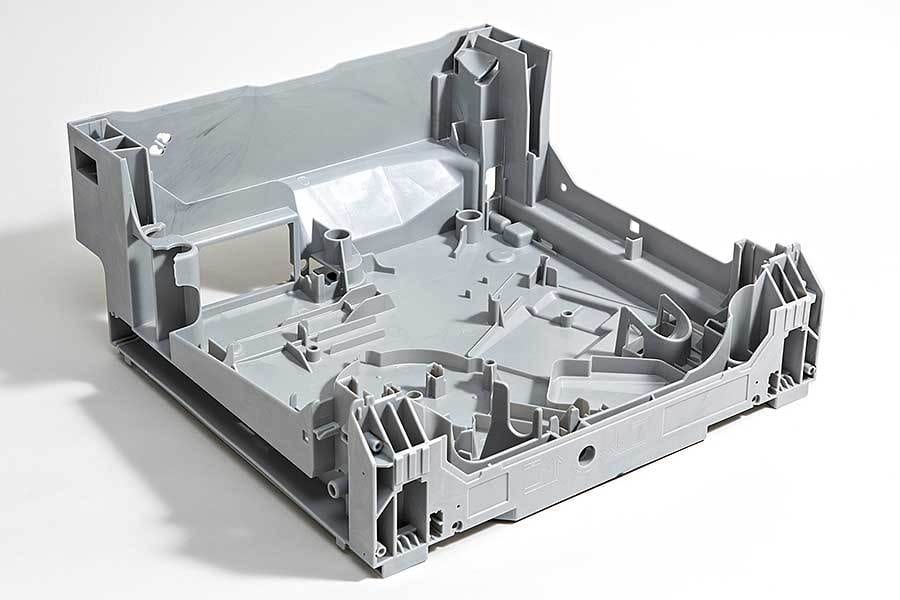
This dishwasher case bottom was made from recycled plastic. Photo courtesy Fraunhofer Institute for Structural Durability and System Reliability
To investigate new applications for recycled plastic, Bosch optimized recycled material from the plastic housings of automotive starter batteries, including additives that were originally used to increase strength and enhance visual properties.
Next, engineers looked for ways to make household appliances more sustainable and easier to recycle. They decided to focus on dishwasher case bottoms. This component, which weighs approximately 2 kilograms, forms the base structure of a dishwasher. It holds the side walls and houses ancillary components, such as pumps, sensors and reservoirs.
“We initially investigated how the optimized recyclate behaved under mechanical stresses,” explains Spancken. “[Then, we] produced a test specimen and subjected it to a set force around 100,000 times in an automated process.
“This figure is primarily based on a finger-thick pin on the dishwasher case bottom,” Spancken points out. “This is subject to mechanical stress every time the dishwasher door is opened and closed, and represents the area subject to the greatest load on the dishwasher case bottom. If we assume that the dishwasher door is opened 15 times a day and that the appliance has a lifespan of around 18 years, the door will be opened around 100,000 times throughout the dishwasher’s entire service life.”
To confirm this result, Spancken and his colleagues also conducted tests on the component itself, in addition to pure material testing.
“We calculated material characteristics from the material tests,” says Spancken. “Using these characteristic values, we then developed an assessment methodology to check whether the pin is durable.”
The engineers clamped the pins from case bottoms made from virgin material in a test bench and applied loads to simulate those resulting from use of the dishwasher, specifically when the machine door is opened and closed.
Because underfloor heating and radiant heat from the dishwasher can heat the pin to up to 50 C, Spancken and his colleagues adjusted its temperature to reflect this.
“We were able to extrapolate the behavior of a pin made from recyclate using the tests on the virgin material and the calculation methodology,” explains Spancken. “The result is encouraging. The resilience values recorded for the pins made from recyclate differ only very slightly to those made from virgin material.”
ARaymond Acquires CGA Technologies
GRENOBLE, France—ARaymond, a leading supplier of fastening and assembly products, has acquired CGA Technologies, an Italian manufacturer of high-performance thermal cooling plates. It also recently acquired Castello Italia S.p.A., a company that specializes in plastic tube extrusion for pneumatic applications.
“As a leader of fastening and assembly solutions for more than 155 years, we continuously strive to reinvent ourselves and stay ahead in the fast-moving markets that we operate in,” says Antoine Raymond, CEO of ARaymond. “The automotive industry is shifting to electric and autonomous vehicles, and we want to actively contribute to this extraordinary transition.
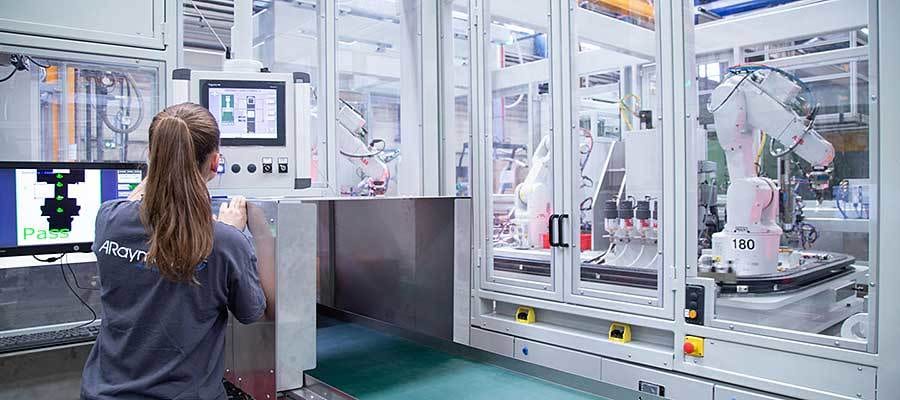
ARaymond has acquired CGA Technologies and Castello Italia S.p.A. Photo courtesy ARaymond
“To meet our customers’ evolving demands, we have a clear vision that agility and time to market are critical, and that our customers are expecting complete solutions,” explains Raymond. “For all these reasons, the acquisitions of CGA Technologies and Castello Italia S.p.A are an ideal fit.
“With this expansion, we are building up our network to create sustainability for the future,” claims Raymond. “This includes putting the well-being of our collaborators and the protection of our environment at the forefront of our priorities for future generations.
“We want to provide a service and product offering of the highest quality that meets both our customers and employees demands for long-term growth and sustainability,” Raymond points out. “The future of ARaymond is about creating sustainable, complete and quality solutions that increase assembly efficiency, while being driven by [our] core commitments to human values and protecting the environment.”
February 2022