
MONTH 2023
Automated Assembly
Labor shortages are driving new demand for automation.
Options for Screwfeeding
A SCARA robot picks and places parts. Photo courtesy Steven Douglas Corp.
The line produces 3,000 assemblies per day with a 94 percent efficiency rate.
Assembles Switches
Robotic Automation System
John Sprovieri // Chief Editor
Since it opened in 1998, systems integrator Steven Douglas Corp. (SDC) has completed more than 1,400 automation projects. Based in Concord, OH, the company has built automated assembly systems for myriad industries, including consumer products, automotive parts, medical devices, electronics, energy and even aerospace.
“I’m continually impressed by the growth and adaptability of our team,” says Steve Belliveau, founder, CEO and chief technical advisor of SDC. “Over the years, their ability to learn and master new technologies has been instrumental in helping us deliver creative and robust machines.”
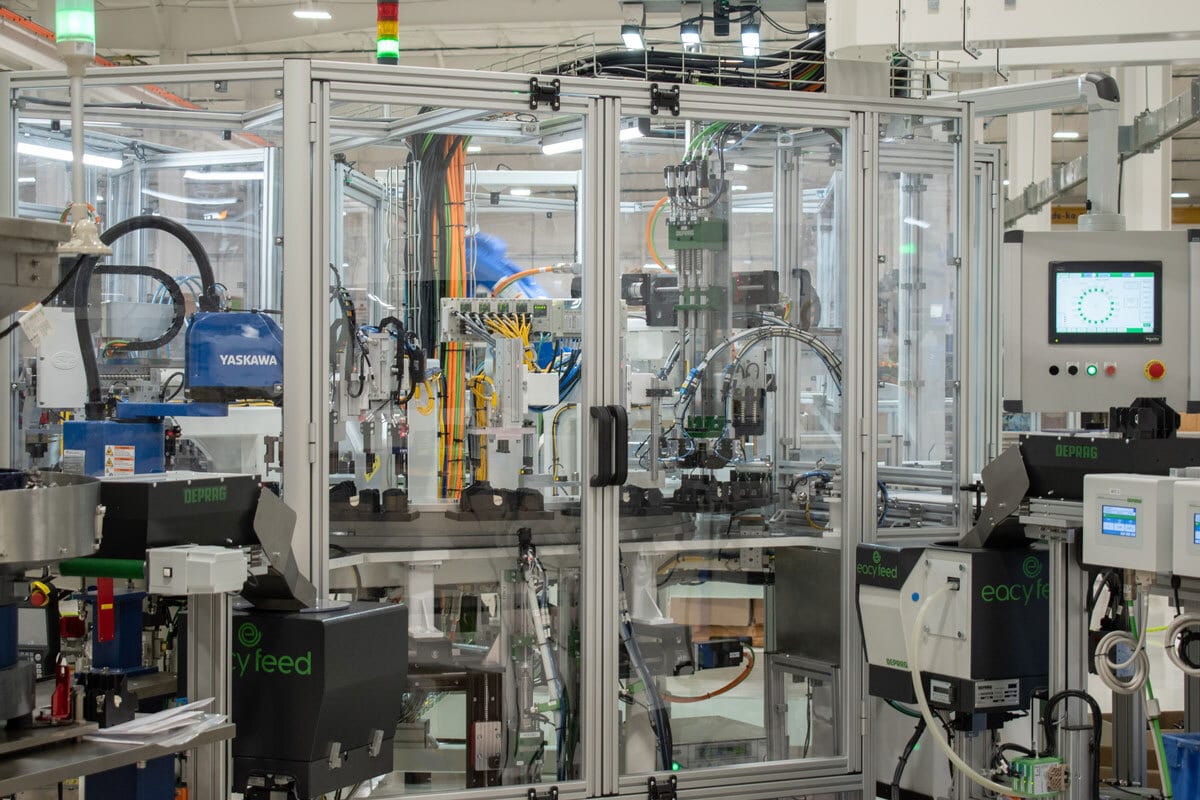
This automated assembly system employs a mix of six-axis, SCARA and Cartesian robots. Photo courtesy Steven Douglas Corp.
Recently, a global manufacturer of industrial technology contacted SDC to build an automated system to assemble electrical safety switches. SDC had already built several machines for this manufacturer, so it was familiar with how the integrator worked.
The new system had some unique requirements. First, the manufacturer was launching a smart factory initiative, so the system would need to be equipped with industrial internet of things (IIoT) technology. The manufacturer also required the system to be equipped with robots from Yaskawa Motoman. The latter, at least, was easy, since SDC is a certified integrator for Motoman, as well as Fanuc, Epson, Mecademic and ABB Robotics.
Other requirements included:
• Custom parts feeding systems for more than five parts.
• Automated grease dispensing.
• A manual loading station with safety light curtains and pressure switches.
• Multiple test and inspection stations.
The key components of the system include:
• Six-axis and SCARA robots from Motoman.
• Automatic screwdrivers and nutrunners from Deprag.
• Vibratory bowl feeders and linear tracks from Bellco Feeders.
• Vision systems from Keyence.
• An HMI and PLC from Modicon.
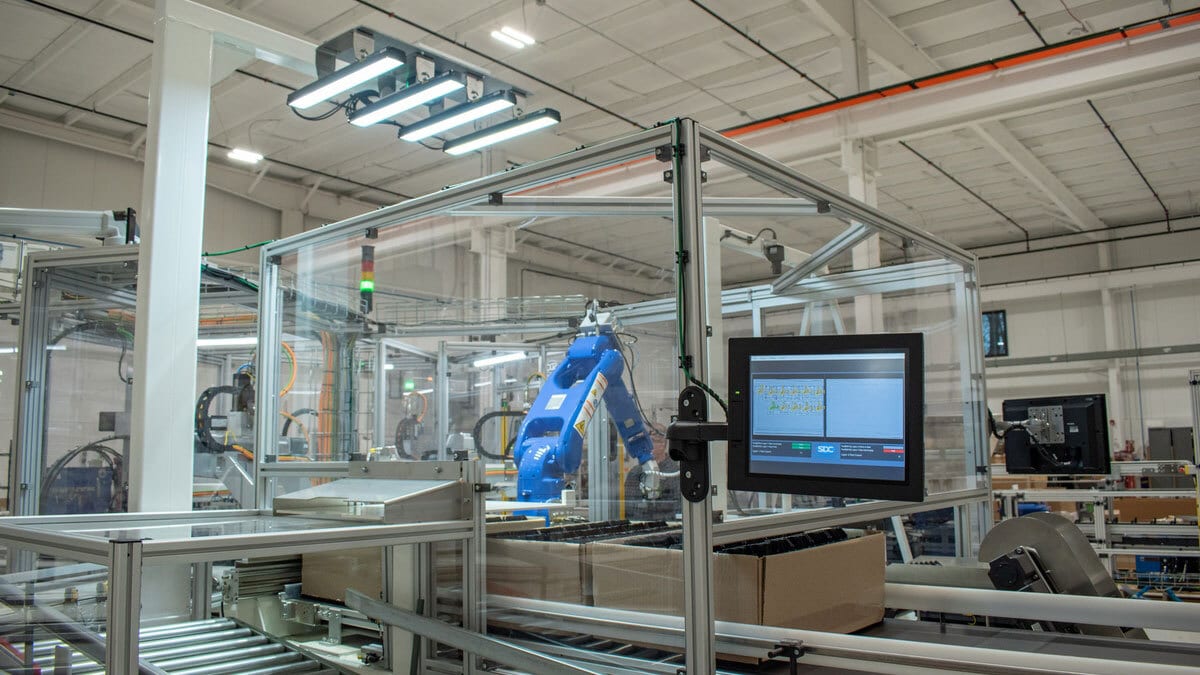
This six-axis robot performs two functions: picking parts from a bin and picking parts from a flex feeder. Photo courtesy Steven Douglas Corp.
The system also contains several standardized, pre-engineered components that were designed and built by SDC. These include flex feeders, servo-driven pick-and-place units, and a rotary indexing ring. This minimized custom engineering work, eliminated major design risks, and accelerated implementation.
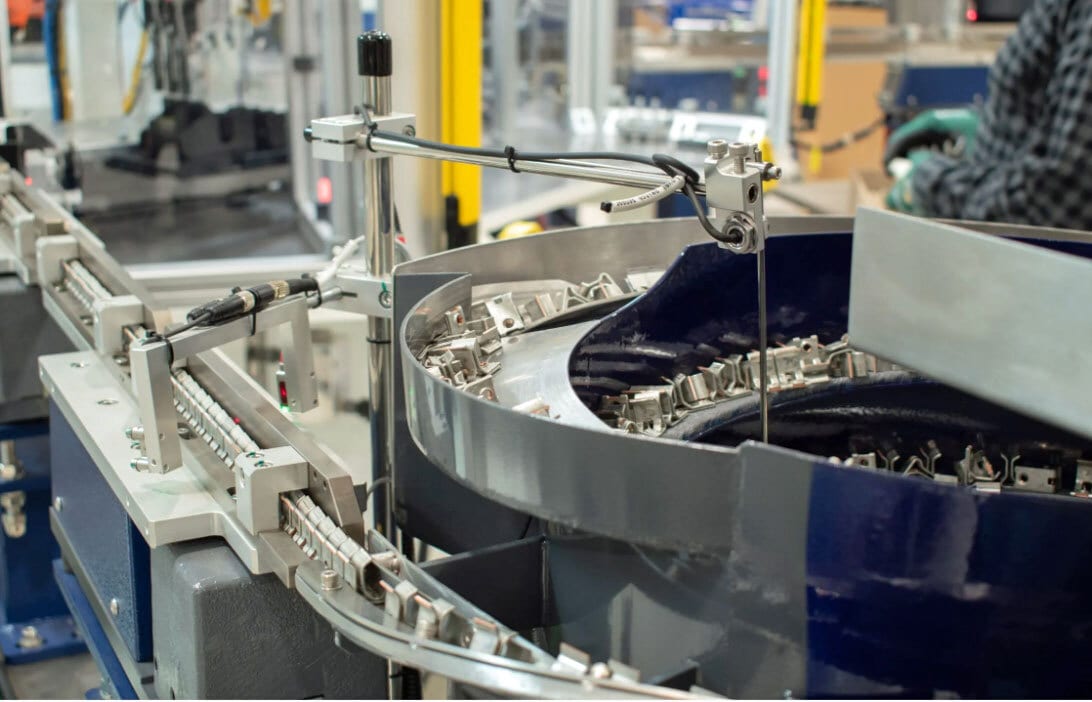
Vibratory bowls feed parts to a linear track. Photo courtesy Steven Douglas Corp.
Adaptive Workflow
At the first station, the six-axis robot performs two functions: picking parts from a bin and picking parts from a flex feeder. The robot places these parts into a nest on the indexing ring.
Machine vision enables the robot to recognize the orientation of parts in the bin and pick them accurately. This saves time and money by eliminating the need to present the parts in trays or other dunnage.
The flex feeder provides a steady flow of pickable parts. Unlike traditional feeding systems that require mechanical adjustments, the flex feeder accommodates various part geometries without the need for tooling changeovers. This reduces setup time and increases flexibility.
A vision system enables the robot to locate and pick parts with minimal errors. An illuminated vision window ensures clear visibility and enhances the accuracy of the picking operation. The feeder’s conveyor strategically moves and reorients parts to optimize pickability. Automated repositioning ensures that parts are consistently presented in an ideal orientation for picking.
Built to work with a variety of robotic systems, the flex feeder supports high-speed pick-and-place applications. Built-in accumulation and buffering optimize production flow for maximum throughput.
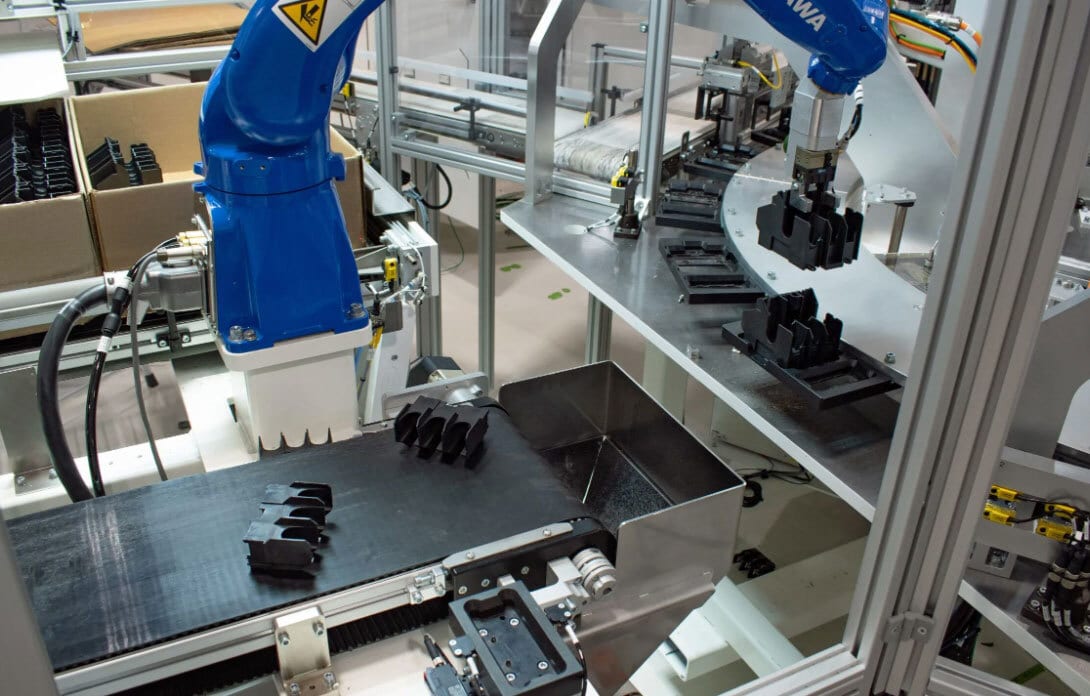
A flex feeder provides a steady flow of pickable parts. Photo courtesy Steven Douglas Corp.
The indexing ring is a custom-built, high-speed assembly machine platform. Its open design allows engineers to place process modules both inside and outside the ring, which is based on a heavy steel frame. Its durable construction ensures long-lasting reliability with minimal maintenance. The ring facilitates quick tooling changes to accommodate different parts and assemblies.
At the next station, an automatic dispensing system applies grease to the parts.
Additional parts are installed at subsequent stations by a person, a SCARA robot, and servo-driven, multi-axis pick-and-place units.
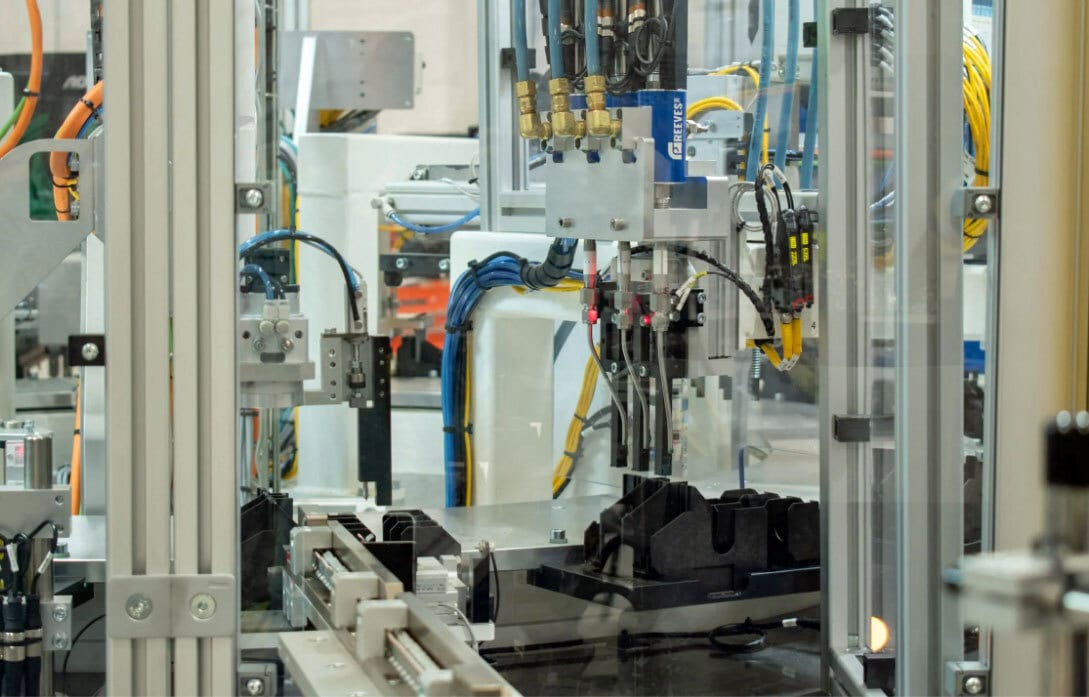
An automated system dispenses grease onto multiple parts simultaneously. Photo courtesy Steven Douglas Corp.
Part placement and retention through the different assembly processes was critical to machine function and finished product quality. The tolerance of the molded and formed parts made SDC engineers refine acceleration and deceleration profiles and fine-tune assembly fixtures and other part-locating and retention devices.
Automatic screwdriving and nutrunning systems install fasteners from above and below the assembly. Initially, pneumatic cylinders were used to move the tools up and down. However, this proved insufficient to meet cycle time. A servo-driven linear actuator solved the problem and also improved accuracy.
The system also includes 10-kilovolt hipot testing and multiple electrical and mechanical verification zones to ensure the safety and compliance of every assembled part.
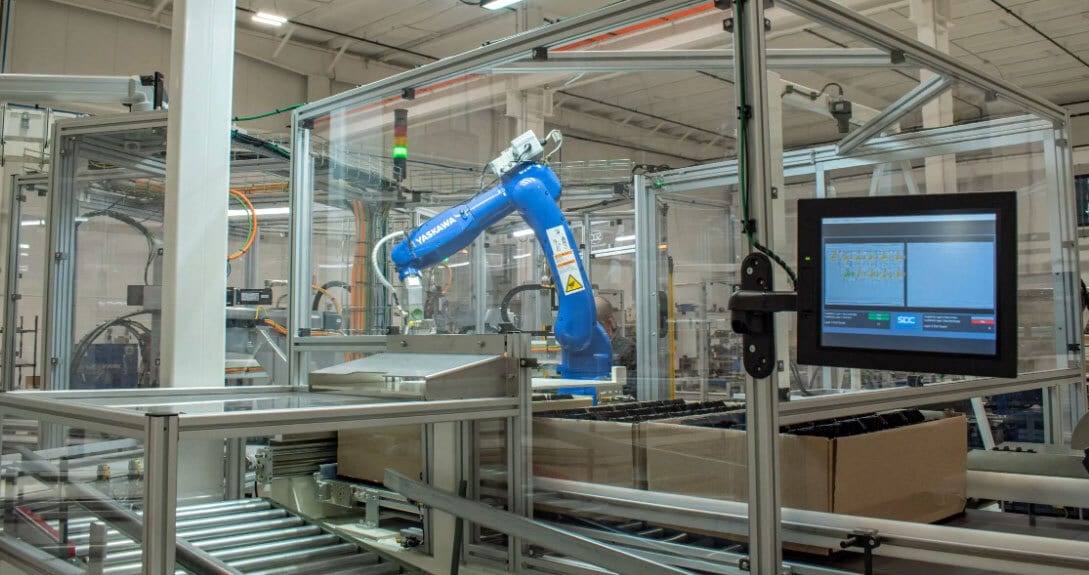
Seamless integration with the factory’s IIoT ecosystem enables the manufacturer to track efficiency and monitor machine performance. Photo courtesy Steven Douglas Corp.
Results and Business Impact
The system produces 3,000 assemblies per day with a 94 percent efficiency rate. It was designed to meet final assembly line demand without requiring overtime. Seamless integration with the factory’s IIoT ecosystem enables the manufacturer to track efficiency and monitor machine performance.
The new machine replaces a legacy system that was in operation for more than 40 years, offering at least twice the throughput and close to double the efficiency of the previous equipment.
For more information on automated assembly systems, click https://sdcautomation.com. For more information on robots, click www.motoman.com.
ASSEMBLY ONLINE
For more information on automated assembly systems, visit www.assemblymag.com to read these articles: