MONTH 2023

Assembly Presses
Labor shortages are driving new demand for automation.
Options for Screwfeeding
Clinching is ideal for assembling the stainless-steel walls of a dishwasher, because it does not punch a hole in the sheets and it maintains the cosmetic appearance of the metal. Photo courtesy V-Zug
Electromechanical press monitors force and displacement for quality control.
Stainless Steel Sheets
Appliance Maker Clinches
Wolfgang Laux // Head of Marketing // Tox Pressotechnik GmbH & Co. // Weingarten, Germany
Swiss appliance manufacturer V-Zug AG began in 1913, making galvanized sheet metal products for homes, agriculture and the construction industry. In the early 1920s, the company invented a manually operated drum-type machine for washing clothes. From there, the company introduced products to create a complete laundry room, including a sink, a boiler to heat water, and a centrifuge to help with drying.
From those humble beginnings, the company grew to become one of Europe’s top appliance manufacturers. Today, the company’s portfolio includes washers, dryers, ovens, cooktops, steamers, range hoods, dishwashers, refrigerators, wine cabinets, coffee makers and microwaves. In 2024, the company tallied sales of $744.3 million.
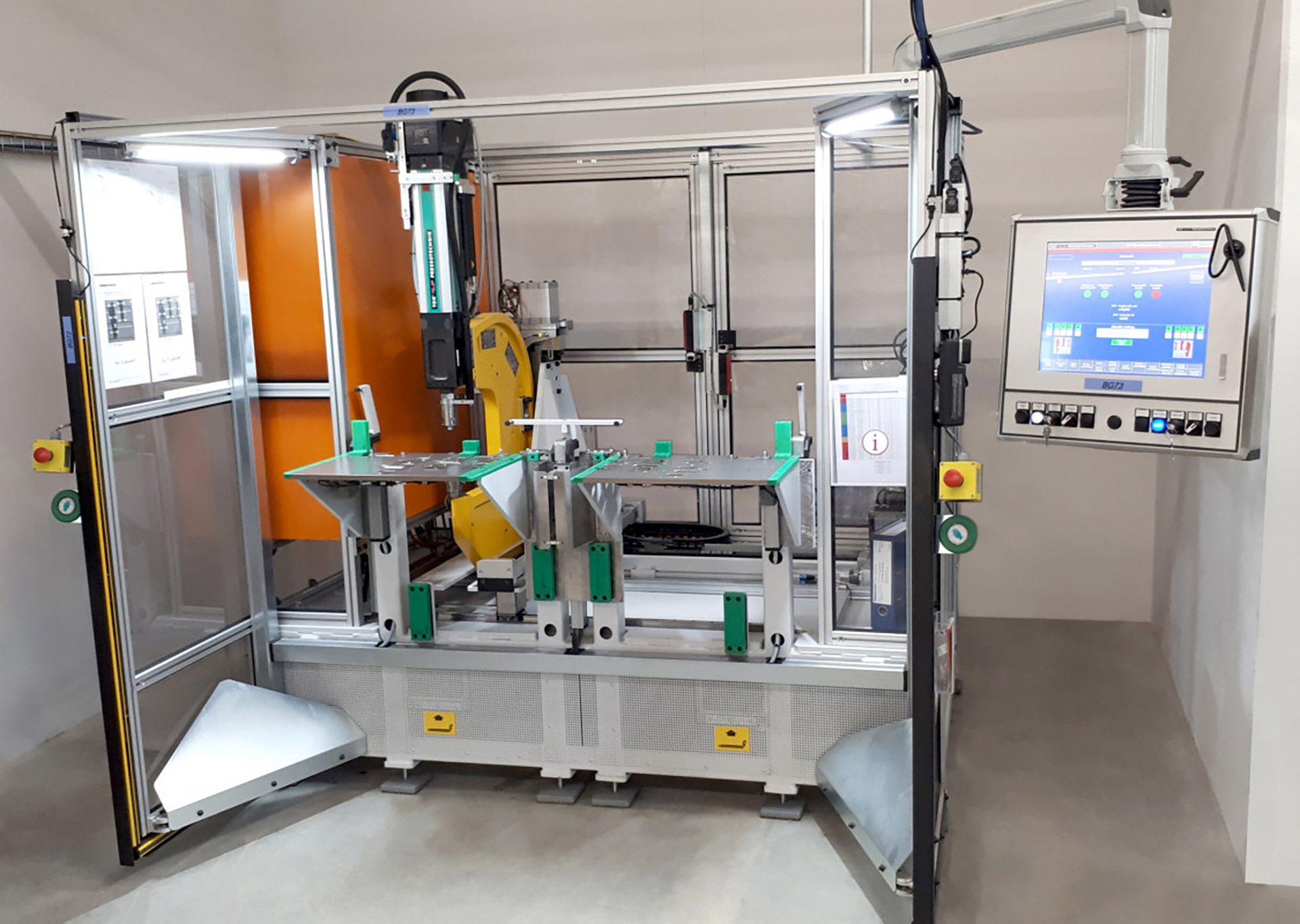
This semiautomated system allows two sheet-metal walls to be clinched in a single operation. The centerpiece is a single-point C-frame press powered by a compact electromechanical drive. Photo courtesy Tox Pressotechnik
Clinching Dishwasher Assembly
V-Zug’s products are designed for durability, energy efficiency and ergonomics. For example, a special feature of the company’s Adora line of dishwashers is the OptiLift, which allows consumers to lift the lower basket up to hip height, reducing strain on the back when loading and unloading dishes and silverware.
To accommodate the guide rails and lifting mechanism of the basket, stainless steel plates must be fixed inside the dishwasher housing. The sheet metal clinching process from Tox Pressotechnik is ideal for this task, since it joins the thin stainless-steel sheets quickly and reliably. In contrast to riveting or welding, the surface and the material structure remain intact and sealed.
“It’s the most efficient solution for us,” says Patrick Bon, head of dishwasher design at V-Zug. “Although we have been using Tox clinch tools for several years, we have not yet had a complete system from Tox.”

The specific task was to fix three components to each of the two housing sides of the large-capacity vats. “Our customers expect top quality, so the assembly must be both visually and technically flawless,” says Bon.
Tox developed a semiautomated system that allows two casing walls to be clinched in a single operation. The centerpiece is a single-point C-frame press powered by a compact Tox ElectricDrive electromechanical drive. The maximum tool opening is 73 millimeters, which is sufficient for V-Zug project.
The press drive is installed on the die side and applies a nominal force of 80 kilonewtons. Sensors monitor force and displacement. The precision force sensor is accurate to ±1 percent of the end value. The piston operates dynamically at a speed of up to 200 millimeters per second.
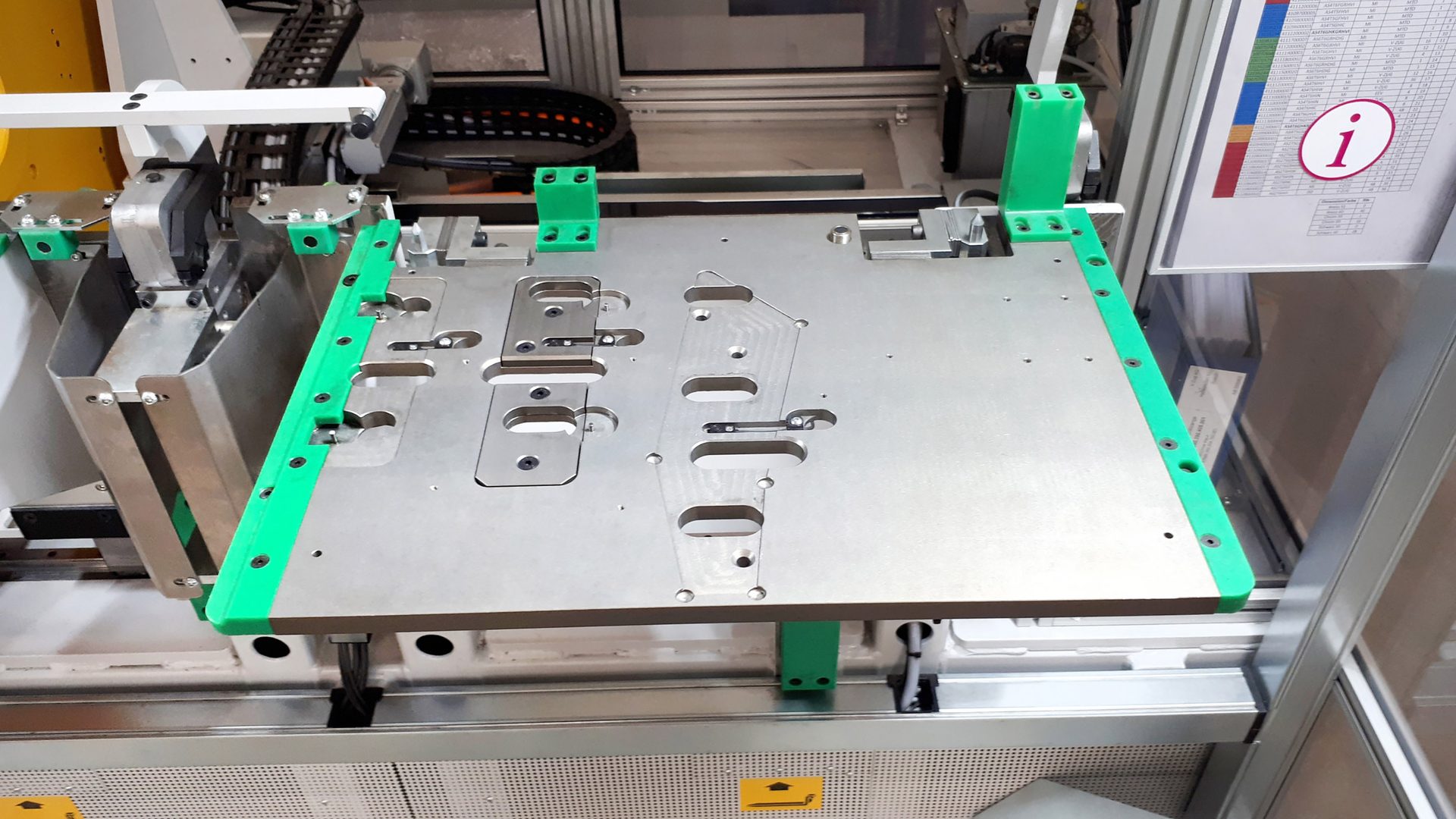
This fixture prevents errors by ensuring that parts are always loaded correctly. Photo courtesy Tox Pressotechnik
The press is mounted on two linear slides, so it can automatically position itself at each clinching point.
To start the assembly process, a worker loads three sheets onto a worktable. He then places a 60-liter large-capacity tub on top. Mix-ups and incorrect assembly are ruled out thanks to fixtures that act as templates.
The surface of each sheet is moistened before each clinching point is set. This reduces friction and protects the tools and sheet metal surfaces. Tox added a spraying device to the system for this purpose.
With the parts loaded, the operator activates the system with a single-hand control. The parts are clamped in place, and the clinching process starts. The press moves on back-and-forth and side-to-side to process the two side walls one after the other. Each wall receives 15 clinch points.
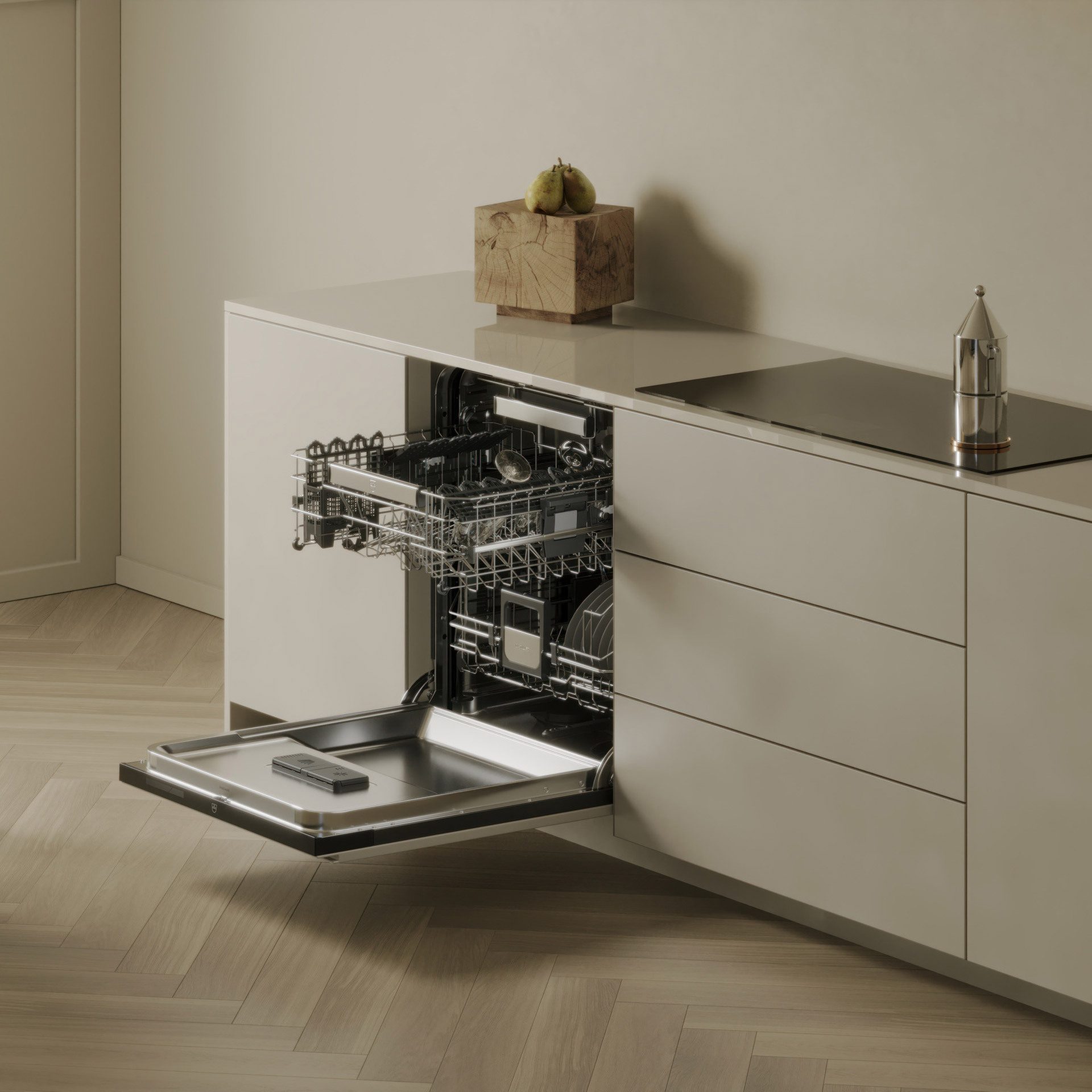
Founded in 1913, V-Zug has become one of Europe’s top appliance manufacturers. Photo courtesy V-Zug
Variable Process
There are two programs: one for clinching three trays per side and one for clinching two trays per side. “This allows us to produce the housings for dishwashers with and without the comfort slide function for the cutlery drawer on one system,” explains Christoph Fässler, project manager for system planning at V-Zug.
As soon as the process is complete, the control system automatically opens the clamps. The operator then removes the housing, reloads the worktable and places the vat, which has been rotated 180 degrees, back down to repeat the process on the second side wall.
Engineers can create movement sequences and operating modes via a touchscreen and view evaluation results. The screen is connected to the axis controller via an Ethernet connection.
To prevent errors or injuries, Tox equipped the system with several safety features. For example, sensors check whether the parts have been inserted and the vat has been placed in position. The system is only accessible from the front, with light protection grids monitoring access during the process. The other sides are sealed off by clear polycarbonate panes. This allows workers to keep a safe eye on the joining process.
The control system can be expanded at a later date to accommodate additional dishwasher variants. All fixtures are designed as interchangeable parts and can be swapped out whenever necessary.
The system arrived at V-Zug ready to use and only had to be connected to electricity and compressed air. “Everything went smoothly,” recalls Fässler. “For us, the system was not about maximizing output, but about ensuring quality.”
ASSEMBLY ONLINE
For more information on sheet metal clinching, visit www.assemblymag.com to read these articles: