ON CAMPUS
AUSTIN WEBER // SENIOR EDITOR
CONTACT
AUSTIN

Penn State Harnesses AI Technology to Improve Laser Welding Quality
Laser welding is a noncontact joining process that has many advantages, including high speed, a small heat-affected zone, precision and versatility. However, variables such as power, wavelength and travel speed can affect joint quality.
As the technology becomes more affordable, laser welding is being used to assemble everything from aluminum auto parts and consumer electronics to plastic medical devices and toys. And, it’s increasingly popular with manufacturers of products such as construction equipment and washing machines.
Laser welding is also widely used to produce bipolar plates for fuel cells, because it offers a combination of precision, strength and low thermal impact. Fuel cell assembly requires long, narrow welding paths between bipolar plates. Thin stainless steel foils are preferred for these plates, because they can reduce weight and enable more complex channel designs.
However, laser welding is prone to quality issues, due to rapid cooling and the need for tight tolerances.
Laser welding is a noncontact joining process that has many advantages, including high speed, a small heat-affected zone, precision and versatility. Photo courtesy Caleb Craig/Pennsylvania State University
“With high-speed laser welding, defects will occur when the laser beam moves faster than the molten pool can form and stabilize,” says Jingjing Li, Ph.D., a professor of industrial and manufacturing engineering at Pennsylvania State University. “Common defects are humps and bottom cavities.
“Different laser welding and work materials may have different defects, such as porosity, cracking and undercut,” explains Li. “Humping typically occurs when the welding or scanning speed surpasses a critical threshold.
“It directly limits the maximum welding speed, thereby constraining overall productivity,” warns Li. “And, it poses difficulties in achieving a smooth surface finish and a consistent weld strength.”
Understanding how process parameters and material properties influence the onset of humping is essential for process control. But, this can be challenging due to limited experimental and simulation data.
Traditional methods of developing equations are time consuming and require tons of numeric data. Engineers must either produce more than 1,000 data points from their own experiments or review and interpret data points from prior studies by other researchers to accurately formulate an equation.
Unfortunately, data from prior experiments is often only available as text. That requires a tedious process of combing through many research papers to identify the data and then convert it to the correct format.
“We have enough existing data, but most of it is text-based rather than numeric data and highly experimental, meaning it is difficult to generalize to new welds,” says Li. “Traditionally, we cannot develop equations without numeric data.”
The risk of China decoupling is an important consideration for companies sourcing there.
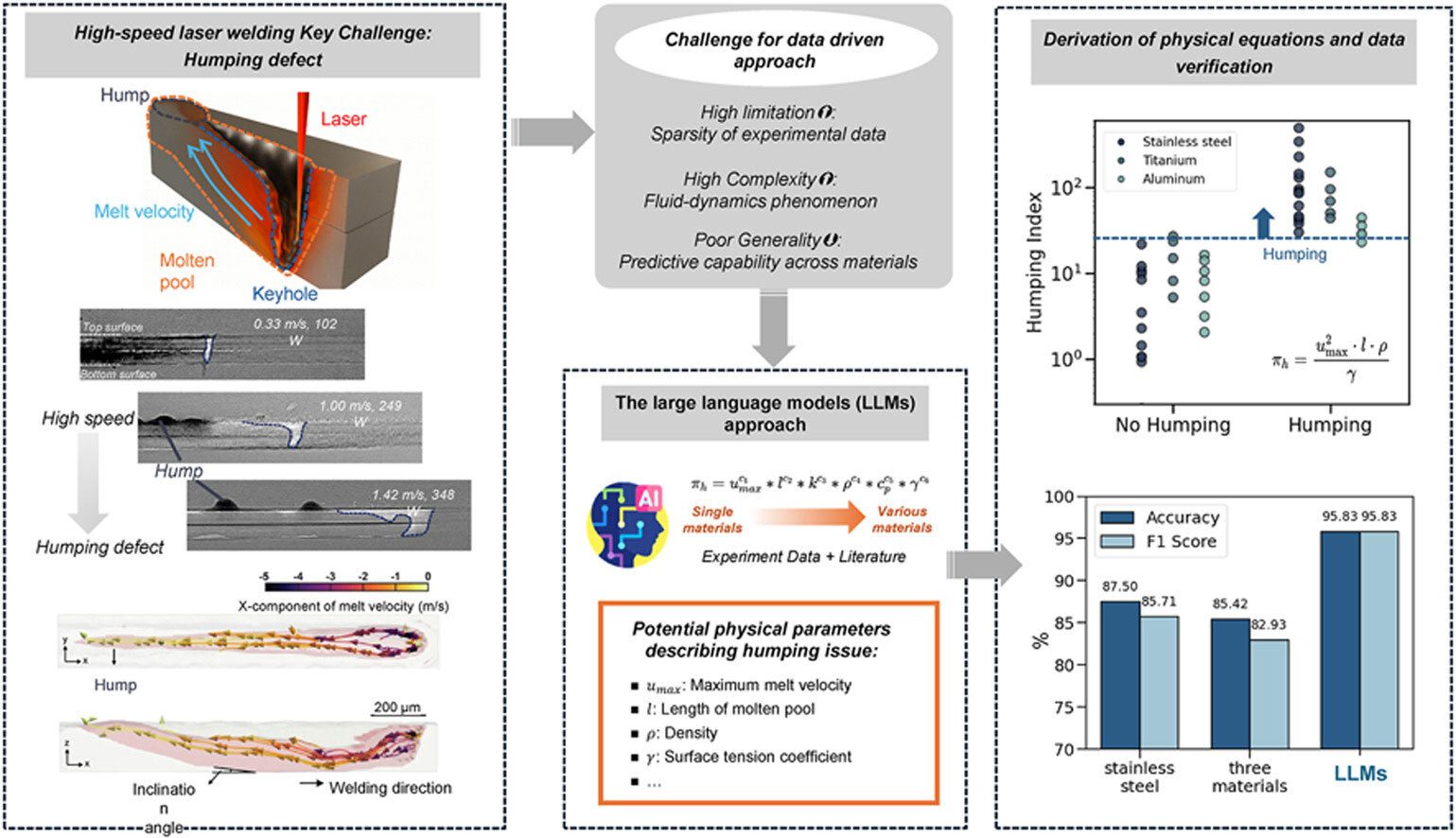
Welding defects can occur when a laser beam moves faster than the molten pool can form and stabilize. Illustration courtesy Jingjing Li/ Pennsylvania State University
To address the challenge, Li and her colleagues recently harnessed artificial intelligence technology. They used large language models (LLMs) to evaluate a wide variety of parameters that can contribute to laser welding defects and quality issues.
According to Li, benefits of using LLM technology include transformability (handles multiple tasks via the same architecture); textual data utilization (learns deeply from diverse language sources); zero or few-shot learning (adapts to new tasks without retraining); contextual understanding (maintains coherence over long text); adaptability (can be easily fine-tuned for specific domains); and knowledge integration (combines and explains complex information).
“We used LLMs because we only had limited experimental data on stainless steel,” explains Li. “They help generalize the equation for other materials, such as aluminum and titanium alloys.”
The Penn State engineers developed an integration framework that uses minimal new experimental data to identify relevant information in existing scientific literature. By combining information from existing research and their own experiments, the LLM-powered framework can derive numeric equations that accurately predict physical phenomena.
Engineers are exploring how laser welding variables such as power, wavelength and travel speed can affect joint quality. Photo courtesy Caleb Craig/ Pennsylvania State University
Using their new approach, the engineers have been able to optimize laser welding applications, which typically have a high potential for technical failure. They tested their equations using laser welding machinery at Argonne National Laboratory and the Edison Welding Institute.
Several engineers from General Motors were also involved in the R&D project, which was support by the U.S. Department of Energy Efficiency and Renewable Energy.
The numeric equations enabled the engineers to better understand the connections between various parameters, leading to highly detailed insights into why and when certain physical responses appear during welding.
Using an equation also allowed them to effectively incorporate data taken from prior experiments when predicting the physical properties of a new weld, even if the physical characteristics of the old welds, such as metal type or the speed of the welding system, were not identical.
Li and her colleagues used 48 total datasets to develop their framework, five of which came from their own experiments and 43 from existing research. They used the data from their experiments, including types of metal and frequency of humping, to develop candidate equations representing specific variables and their relationships. Then, they developed a rubric to use as the LLM processed existing scientific literature.
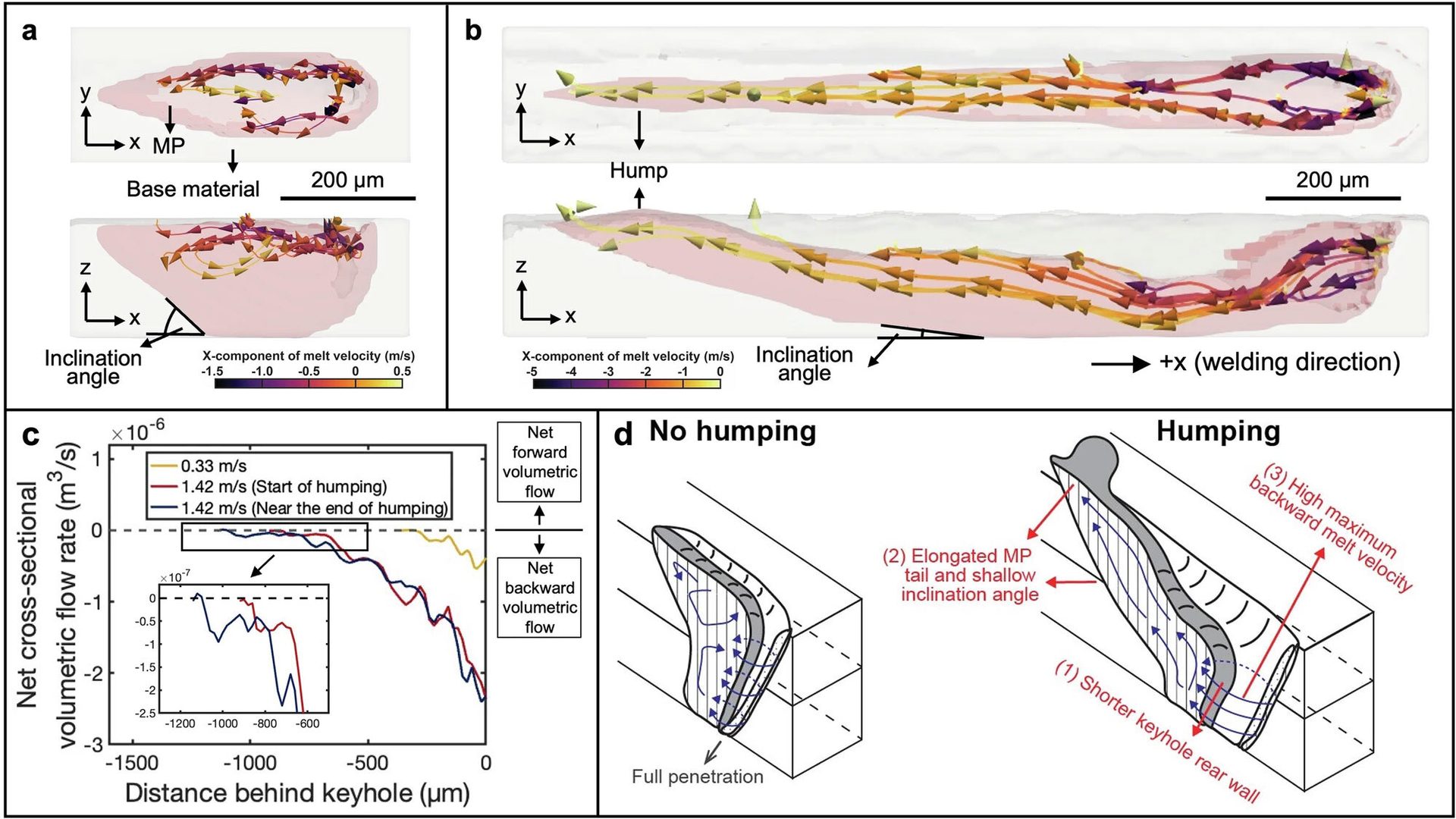
Humping typically occurs when laser welding speed surpasses a critical threshold. Illustration courtesy Jingjing Li/ Pennsylvania State University
The LLM could identify relevant information, convert the correct data and recommend equations most likely to describe how different physical parameters would influence the quality of a weld or whether the weld would experience humping.
While the process of selecting an equation is not fully automated by the LLM, it is much more efficient and generalizable than previous approaches. Using the framework, 10 equations can be generated in about one minute, which is much more efficient than the hours of research it takes to create one equation with traditional methods.
The engineers then score and rank the equations based off the developed rubric, using the equation with the highest score.
“We use the physical parameters of the weld like melt velocity, thermal conductivity and density to determine how the equation is going to be applied,” explains Li. “This still requires a lot of domain knowledge from other researchers, but can be built upon, and keeps our equations standardized across different materials and physical properties.
“We have filed a patent to address the humping and bottom cavity defects in high-speed laser welding,” says Li.
The Penn State engineers also plan to continue optimizing their framework and apply the LLM to additional production processes, such as additive manufacturing.
About the Author
Austin has been senior editor for ASSEMBLY Magazine since 1999. He has more than 25 years of b-to-b publishing experience and has written about a wide variety of manufacturing and engineering topics. Austin is a graduate of the University of Michigan.