A special section to ASSEMBLY

CableEye testers can be used for the testing all cables, from prototyping and assembly to post-deployment diagnostics. Photo courtesy CAMI Research Inc.
Sophisticated test equipment ensures reliability of military imaging systems.
Defense Systems
Testing Wire Harnesses for
Christopher E. Strangio // President // CAMI Research Inc. // Acton, MA
In war, the outcome of a battle depends on good intelligence and reconnaissance. Where is the enemy? How many of them are there? In the U.S. Civil War, for example, scouts could easily miss enemy movements, leading to armies marching past each other or blundering into battle.
These days, evading detection is much more difficult. Military leaders benefit from satellites, drones, cameras, infrared sensors and other high-tech surveillance gear.
Assembling such equipment is the business of PVP Advanced EO Systems Inc. in Lake Forest, CA.
Founded in 1974, the company manufactures state-of-the-art imaging systems, positioners and components for military, aerospace and commercial applications. Advanced EO specializes in electro-optical and infrared sensors and systems for space, airborne, ship and land-based applications. Its customers include U.S. Customs and Border Patrol, the U.S. Secret Service, U.S. Marine Corps, U.S. Air Force, U.S. Navy, U.S. Department of Homeland Security, NASA, the Panama Canal, the South Korean Navy and Saudi Aramco Oil.
Certified to the AS9100D quality management standard for aerospace and military systems, Advanced EO has had to develop capabilities to assemble cables and wire harnesses, test complete systems, design and test cables for test fixtures, and evaluate and test returned equipment.
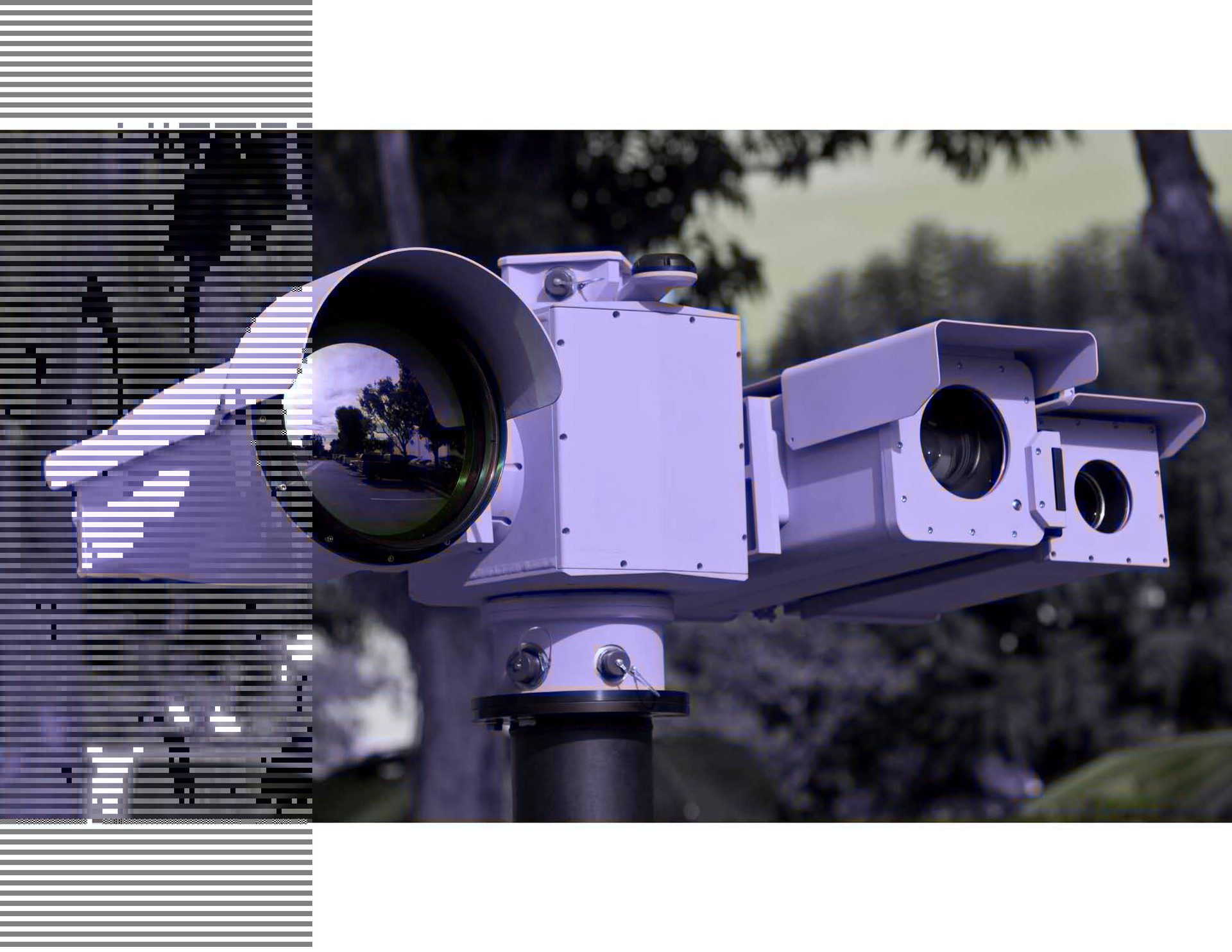
Advanced EO manufactures state-of-the-art imaging systems, positioners and components for military, aerospace and commercial applications. Photo courtesy PVP Advanced EO Systems Inc.
To do all that, Advanced EO relies on CableEye wire harness testing systems from CAMI Research. To measure the quality of connections in cables and wire harness, the company purchased a CableEye Model M3U to measure electrical resistance in the spring of 2019. Later that year, the company added a Model M4 to its tool chest to check capacitance and twisted pairs. Advanced EO has been using a variety of CableEye testers ever since.
Cables for surveillance devices are usually low-volume assemblies and custom for each product. As a result, Advanced EO needs testers with a high degree of flexibility to deal with unique test settings, connector types and combinations.
CableEye testers can be used for the testing all cables, from prototyping and assembly to post-deployment diagnostics. These multiconductor testers easily link to custom test fixtures and harnesses and instantaneously check for faults, identify the type of faults, and pinpoint fault locations. Depending on the model, the testers detect and dynamically display continuity (opens, shorts, miswires and intermittent defects), resistance, capacitance, diodes, dielectric breakdown and insulation resistance. They can also check twisted pairs for correct pairing. Testing for intermittent defects pre-screens the cables for the kinds of faults that can be stimulated by vibration.
These automation-ready testers provide detailed, wire-by-wire reports, which can be synched to harness through bar code tracking. Because CAMI’s PC-based testers log all test data, post-deployment comparisons of cable integrity are a cinch. This enables engineers to approve reinstallation of wiring. It also provides diagnostic feedback to engineers for potential design improvement.
Test Evaluation of Returned Equipment
Advanced EO developed the Commanders Pan Viewer (CPV) specifically for General Dynamics Land Systems for the mobile gun variant of the Stryker wheeled combat vehicle. The CPV consists of an azimuth drive assembly, single-axis elevating head, servo controller, and drive amplifier card sets.
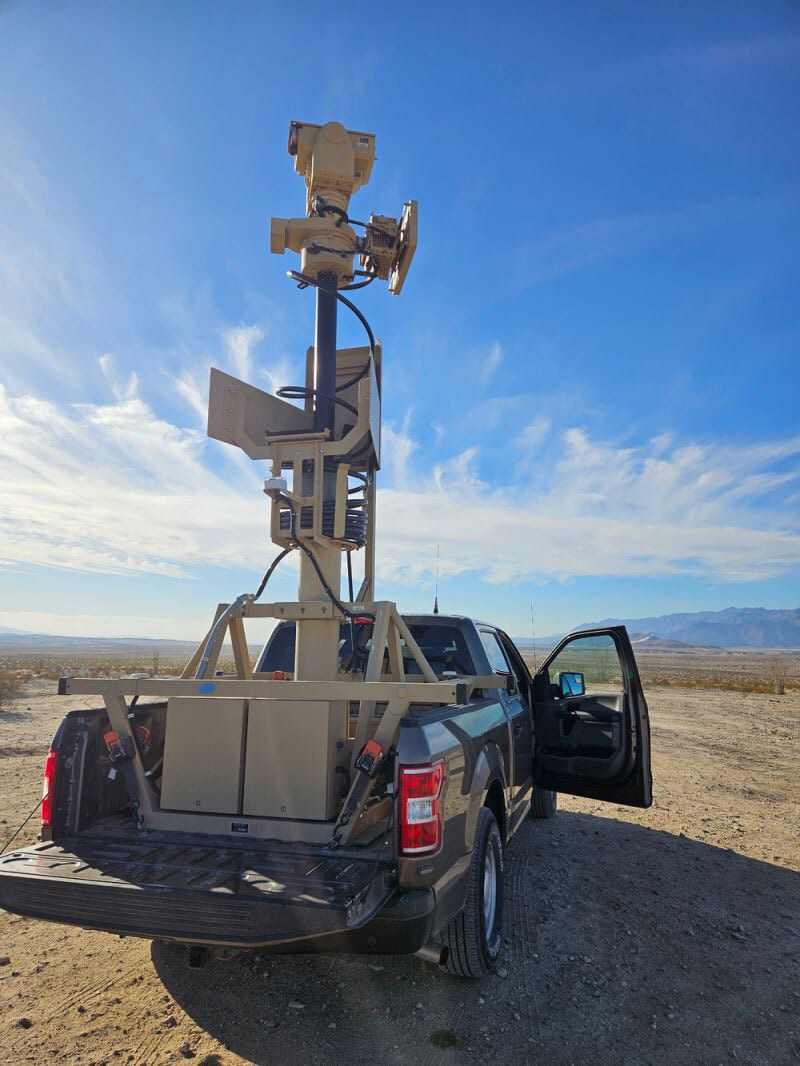
Advanced EO’s customers include the U.S. Customs and Border Patrol and the Department of Homeland Security. Photo courtesy PVP Advanced EO Systems Inc.
A two-sensor camera set (infrared and standard video) is dropped into the azimuth unit and looks up at the gyro-stabilized mirror in the single-axis head. The servo card and power amp cards are installed into a backplane rack in the vehicle. When in operation, the tank commander can pan and tilt the system to view targets and assess the battlefield.
The CPV was qualified for military deployment in battlefield conditions. It has been in service with the U.S. Army since the early 2000s, and it has been deployed in active hostile regions around the world. More than 200 systems are in use.
As part of its contract with General Dynamics, Advanced EO troubleshoots and repairs returned CPV units. Some of the units have seen many years of use.
“Our recently purchased CableEye testers have allowed us to detect approaching catastrophic failures of our slip-ring and connections before they get back out in the field,” explains David Reynolds, engineering technician at Advanced EO.
During one test, for example, a technician discovered out-of-spec continuity limits on a ready-to-ship slip ring unit. This could mean that the slip ring may have sustained field-related stress.
“We were able to pull the unit back for further evaluation. Being able to check resistance thresholds will help manufacturing, test and repair departments ensure a reliable product to our end users,” says Reynolds.
Cables in motion experience fatigue, which can cause complete or intermittent failures whether that motion is constant. Cables may flex intentionally as part of a preprogrammed robotic move, or unintentionally due to operationally or environmentally induced vibration. Checking for intermittent failures, especially while servicing product, is an important part of a performance evaluation.
Fortunately, CableEye cable and harness test systems can identify and pinpoint the source of even the most elusive intermittent failures. The intermittence test is properly performed when the sample rate is high enough to statistically capture enough random events to raise the confidence level in the test result to an acceptably high degree.
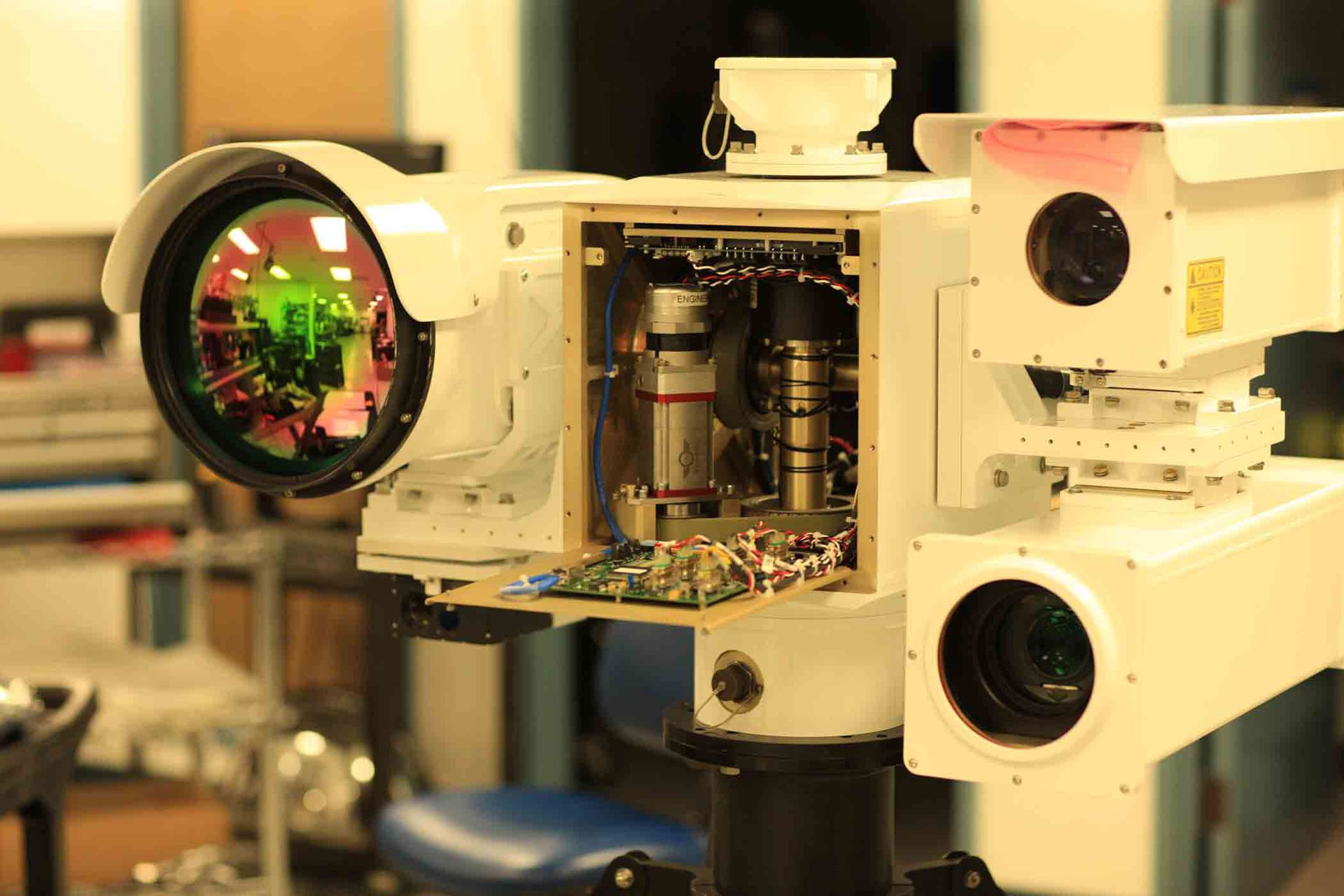
Advanced EO assembles electro-optical and infrared sensors and systems for space, airborne, ship and land-based applications. Photo courtesy PVP Advanced EO Systems Inc.
Companies running stringent quality programs will want test equipment with the fastest cycle time possible. With CableEye testers, rates can be as fast as 11 milliseconds per cycle. Manufacturers also need testers that deliver diagnostic information above a simple pass-fail, so they can get quantitative and qualitative data for process improvement.
Although the intermittence test mode is often referred to as a “continuous test,” the test signal itself is always pulsed to sweep through the full set of test points. In this context, “continuous” simply means that the test is continuously sweeping through these test points. If the sample speed were set too low, there would be a high likelihood that a cable would falsely pass the intermittence test. Care must be taken when setting test parameters to avoid such false positives.
Testing Complete Systems
Advanced EO continues to support legacy devices such as NASA’s long-range telescope with mid-wave and long-wave infrared sensors, as well as current offerings, such as the Night Hawk high-performance systems with high-definition infrared imaging, laser rangefinder, laser designator, and long-range daylight high-definition cameras.
Part of the challenge with this wide-ranging product line is to develop a test procedure to ensure the cabling is correctly assembled and consistent with the engineer’s designs.
“We could check continuity entirely by hand, but that is laborious and inaccurate. This where our first CableEye M2 helped to ensure cables were correctly pinned,” says Reynolds. “With the M4 system, we are able to verify resistance ranges and capacitance measurements, so we are even more assured cables are in spec.”
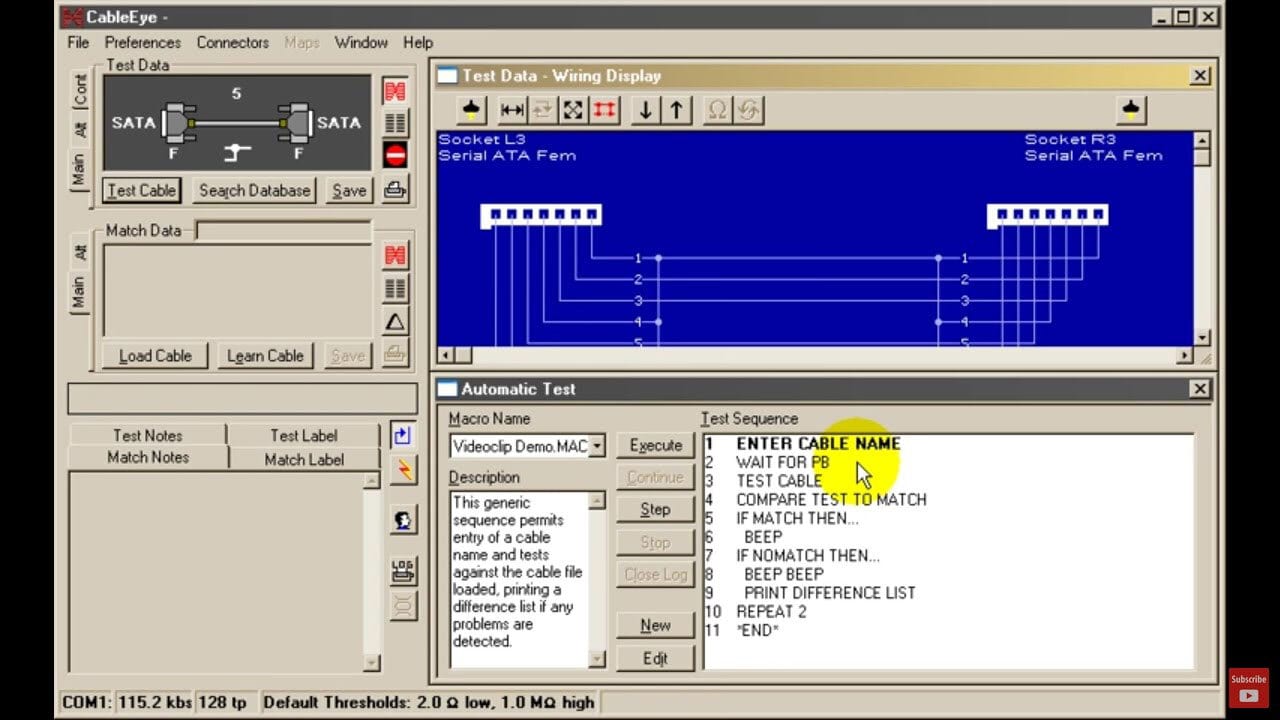
CableEye testers easily link to custom test fixtures and harnesses and instantaneously check for faults, identify the type of faults, and pinpoint fault locations. Photo courtesy CAMI Research Inc.
Test Cable Design
Custom cables are needed for almost all of Advanced EO’s products. The first step is to design, build and test the test fixture that will connect the cable to the CableEye equipment. This involves some combination of standard and custom connector boards and cables that may connect directly to the 64-pin header of the tester. These test interface fixtures are themselves tested with the CableEye unit.
A “golden,” or error-free, cable for a new product can be created physically or digitally within CableEye. Advanced EO often creates a physical golden cable. The CableEye learns the golden cable, which has been manually tested and verified as good. In this learning process, all key wiring and electrical data (including resistance values) are automatically detected by the tester. The unit verifies that the wire nets are correct and that they correspond to the red-line engineering document. Pass-fail criteria, such as resistance thresholds, are programmed in if they differ from the default settings, and the cable file is saved to the searchable database as “match data” against which subsequent assemblies can be tested.
Being AS9100-certified means that Advanced EO is required to maintain documentation to show continuous improvement.
“The CAMI Research products have been instrumental in helping us to meet and exceed these requirements,” notes Reynolds. “Each new cable now ends up in the database, and we require the CableEye test reports to be included. CAMI has been instrumental in guiding us in how to improve the test procedures and test library.”
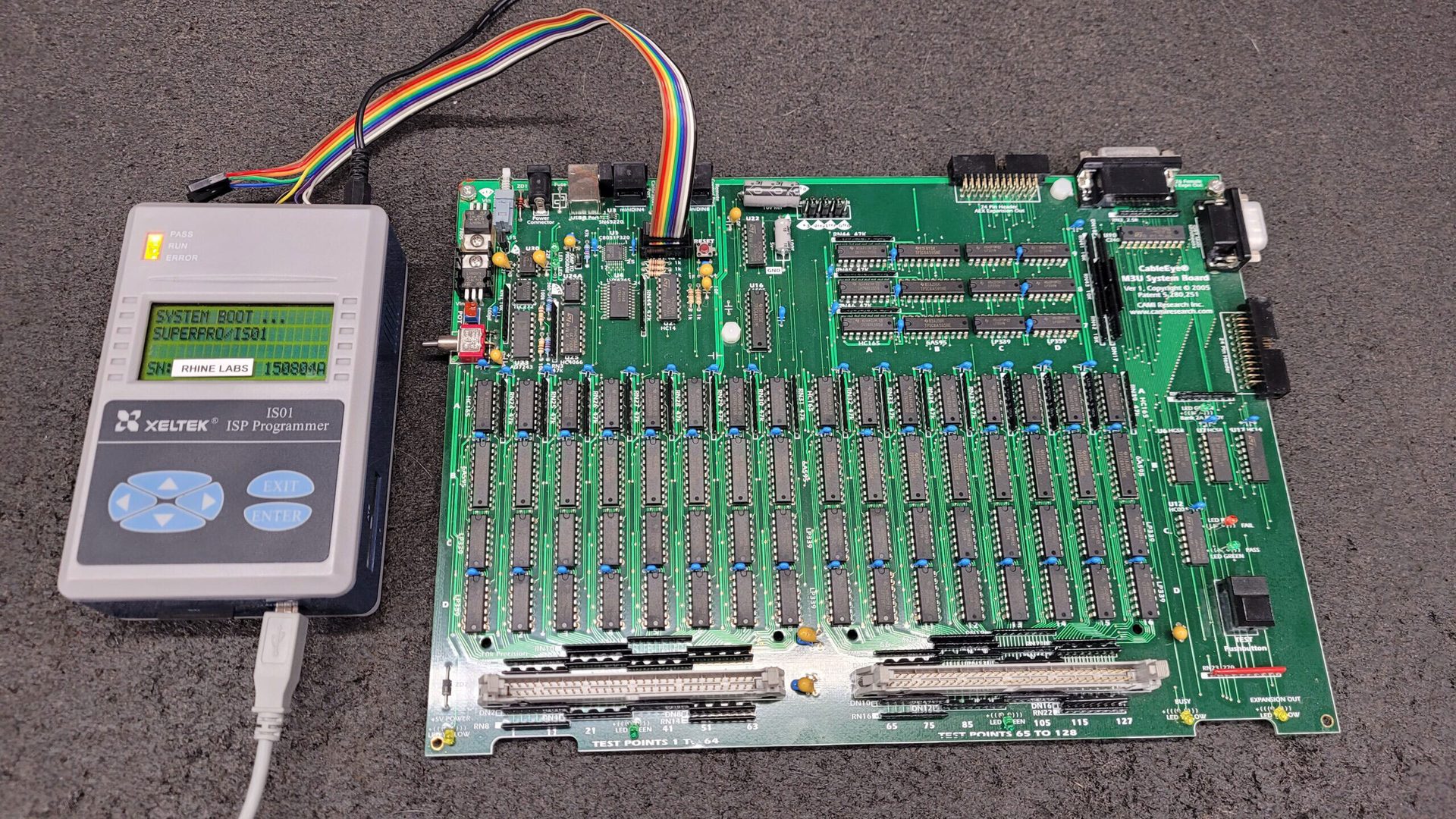
The testers detect and dynamically display continuity (opens, shorts, miswires and intermittent defects), resistance, capacitance, diodes, dielectric breakdown and insulation resistance. Photo courtesy CAMI Research Inc.
Measuring resistance accurately is necessary to check the quality of a connection or whether a resistor is inline. Dual threshold set-up is required for this, whereby the engineer programs both a maximum conductor resistance and a minimum isolation resistance. Without measuring resistance, the tester will indicate if the intended connection is connected, but not whether that connection is compromised by something that affects total resistance, such as a poor soldering job or electrical leakage between conductors because of contaminant material.
“Once pass/fail criteria are programmed, we then run the cables to be tested,” Reynolds continues. “I absolutely love the graphical user interface with the CableEye product line! Passes are clearly indicated on both test platform and on the interface. Moreover, the CableEye product makes everyone who uses it a star. We catch our mistakes before they get to the final test environment, which makes us much more efficient and makes for even happier customers.
“The CableEye system has made our testing much more efficient. Cables are more thoroughly assured to perform in the end environment. And, the system clearly tells us when we need to address assembly errors,” he adds. “I love this machine! Our chief technology officer has mandated all future cables be tested with the CableEye tester, and we will likely purchase another unit soon to keep up with the testing demand.”
For more information about wire harness testing equipment, visit www.camiresearch.com.