ROBOTICS REVIEW
CONTACT
Austin

Lightweight battery-powered aircraft are ready for take-off.
Austin Weber // Senior Editor // webera@bnpmedia.com
Robots Automatically Disassemble Appliance Components
Panasonic is using AI technology to tackle sustainability challenges.
To address landfill issues, appliance manufacturers are developing sustainability programs that focus on recycling and reuse. Photo: CasarsaGuru / iStock / Getty Images Plus
ROBOTICS REVIEW PRODUCTS
Every year, millions of household appliances are replaced and discarded. As old products pile up, it’s creating a big problem in landfills.
To address the issue, manufacturers are developing sustainability programs that focus on recycling and reuse. The goal is to create a circular economy that features closed-loop programs where disassembly lines are strategically positioned near final assembly lines.
One of the companies leading the way is Panasonic Corp. That’s because the firm known for batteries and consumer electronics also produces a variety of home appliances, including air conditioners, dishwashers, microwave ovens, refrigerators, toasters and washing machines.
Engineers at Panasonic’s R&D facility in Osaka, Japan, recently developed an automated disassembly process that uses robots to precisely separate metals, plastics and other materials. It’s part of the company’s Green Impact initiative.
“The circular economy is the transition from a make-use-dispose model to systems that maximize customer value while minimizing virgin resource use,” says Andrea Murphy, director of environmental affairs and sustainability at Panasonic North America.
With their innovative design, COVAL's CVGC carbon vacuum grippers correspond perfectly to the demands of collaborative robot applications. The CVGC series stands out with a compact, light, strong carbon structure, collaborative safety measures, a choice of gripping interfaces, with or without an integrated vacuum generator. It is easily incorporated on your robot guaranteeing a fast setup.
COVAL Vacuum Technology, Inc.
919-233-4855
contact-us@coval.com
www.coval.com
New Generation Collaborative CVGC Carbon Vacuum Gripper
According to Murphy, disassembly is increasingly important for manufacturers due to several factors, such as:
• Regulatory pressure. “Global regulatory pressure is increasing and there are market advantages to being an early adopter that can help lead thoughtful and actionable regulation,” explains Murphy.
• Risk avoidance. “The availability and cost of critical materials is on the rise,” notes Murphy. “We want to ensure that we will have materials for our businesses. Recovering critical materials, such as cobalt, copper, nickel and rare-earth metals, reduces risk and reduces exposure to price volatility and supply shocks.”
• Customer convenience. “Consumer convenience is core,” claims Murphy. “We can save money and we can help secure a sustainable future for society. But, these will not be successful if our efforts do not provide that extra value to the customer.”
Robots are used to remove heat pumps and disassemble other components used in appliances. Photo courtesy Panasonic Corp.
Optimizing Disassembly
Panasonic’s disassembly CPS (cyber-physical system) simulates and optimizes processes using 3D CAD tools. The resulting data influences both new product design and automation efforts, contributing to efficient part reuse and remanufacturing.
“Precise disassembly enables high-purity separation of materials, allowing the production of high-quality recycled materials and advancing the recycling process,” says Murphy. “By incorporating design principles that enhance maintainability, [we are able] to achieve longer product lifespans and resource recovery.
“A disassembly CPS is a cross-industry technology solution that integrates advanced technologies such as generative AI, IoT and sensors to digitally reconstruct physical environments, thus enabling visualization, standardization and optimization,” Murphy points out.
“These insights are then used to create new value, including improved efficiency, productivity and quality,” adds Murphy. “Built on [our] manufacturing expertise, we can apply this to many areas to enable fundamental, root-cause-driven problem solving, such as autonomous disassembly.”
Murphy defines autonomous disassembly as “robotic or hybrid human‑robot workcells that identify parts, choose tools and execute safe removal sequences without preprogramming for a single, fixed product state. They can adapt in real time with artificial intelligence and machine vision technology.”
Panasonic’s circular economy strategy involves design for disassembly and design for repair and maintenance.
“We strive to improve our design in providing easier access to components that require maintenance or replacement, with features such as improved tool access and the use of mechanical fasteners instead of adhesives,” says Murphy. “[We are also] leveraging simulation and AI-driven optimization to further evolve the design for robotic disassembly.
“By using AI to run extensive trial-and-error simulations, we can identify the most effective design configurations for both assembly and disassembly,” notes Murphy. “With some of our home appliances, for example, we are looking at redesigning them to enable robots to carefully dismantle them in a way that allows valuable components to be harvested for recycling or possibly re-use.”
Panasonic engineers are using six-axis robots to disassemble air conditioners, microwave ovens and washing machines. Photo courtesy Panasonic Corp.
Design for repair or maintenance incorporates designs that can extend a product’s lifecycle and simplify part swaps.
“After analyzing repair data and current designs, we have developed circular friendly improvements,” explains Murphy. “A great example are the heat pumps used in washing machines.”
Panasonic pioneered the use of heat pump technology for drying efficiency. By moving the device from the bottom to the top of their machines, engineers made this key component more easily accessible for repair.
The heat pump can now be easily cleaned and maintained to provide a longer life time for the entire washing machine. The design change also resulted in a 50 percent reduction in the amount of time it takes to repair a machine.
Role of Robots
Panasonic engineers are programming six-axis robots to disassemble air conditioners, microwave ovens and washing machines. Magnetic grippers lift the cover off appliances, while screwdrivers remove fasteners. End effectors equipped with other types of tools cut wires and carefully remove components.
“Robots are pivotal to automating disassembly, especially at scale,” says Murphy. “On the human side, using robots for repeated high-impact tasks can help prevent injuries.
“Additionally, robots distance people from electrical, thermal and chemical risks during battery and capacitor removal,” adds Murphy. “By using AI, the robots are able to self-train and adapt. They can run different scenarios for dismantling or find better ways to design appliances for disassembly.”
Artificial intelligence technology determines the optimal way to take a product apart without damaging any sensitive components. Controls provide feedback so that parts can be easily removed, reused or repaired. They also provide the robots with precise positioning control to replicate manual work.
A dismantling database stores data on each model. The data is used to improve equipment utilization rates and lay the foundation for automating the process further.
“The automatic dismantling equipment uses machine vision technology to capture images,” says Murphy. “By using AI, the cameras accurately detect screws even when there is dirt or rust on them. Then, it positions a robotic arm equipped with a screwdriver to remove the fasteners.”
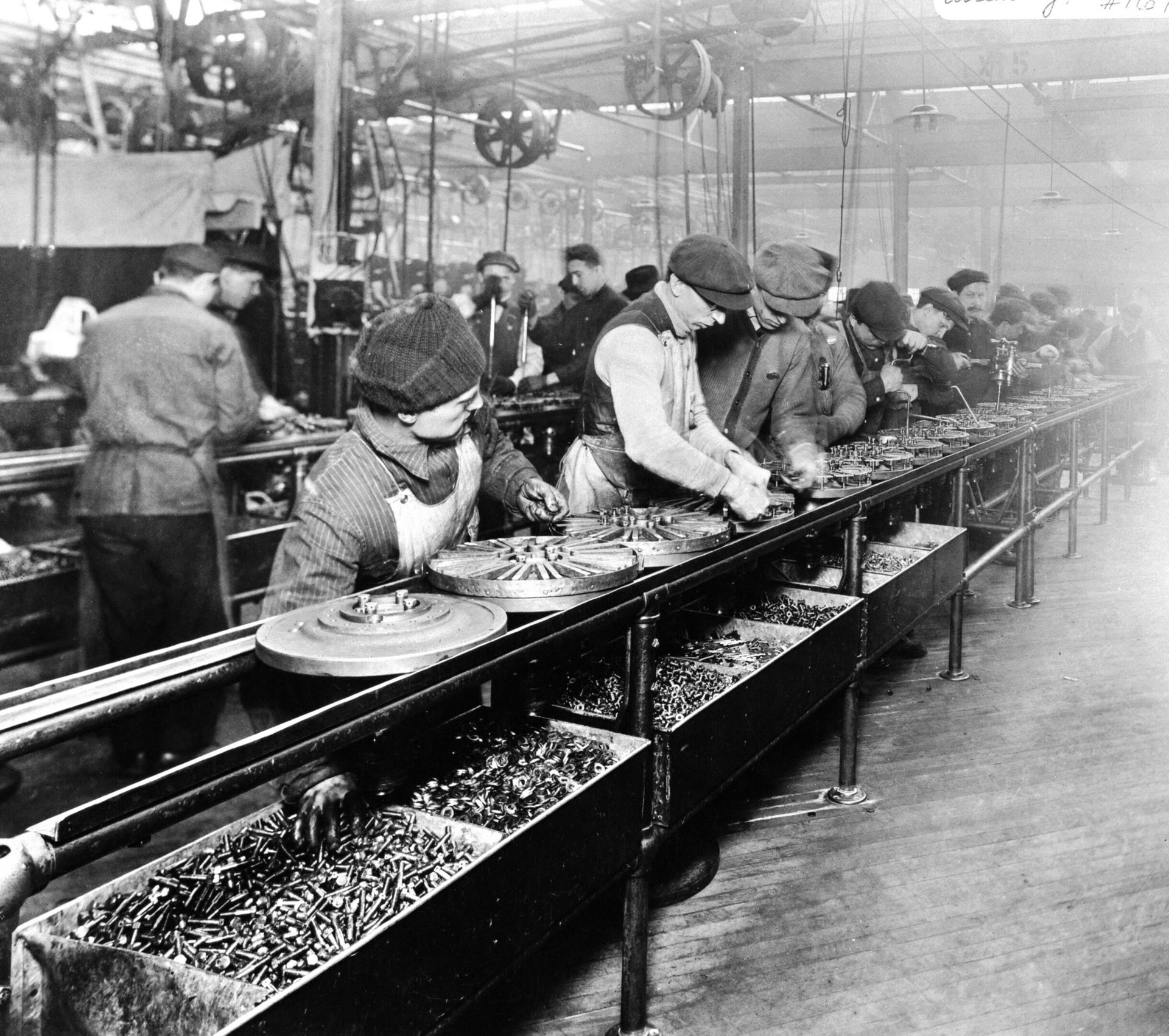
“A company with Ford’s scale can really influence the supply chain and business practices across our entire industry,” adds Sue Slaughter, purchasing director at Ford Motor Co. “It is so important that we not only think about how [we] can use our purchasing power to fuel our business needs, but also to advance sustainability.”
Because the automotive supply chain is extremely complex, the Guiding Principles contain expectations about business ethics, working conditions, human rights, health and safety, environmental leadership and supply chain due diligence for suppliers at all tiers. All suppliers are expected to uphold these standards and enforce them throughout their supply chain.
The Guiding Principles are based on fundamental elements of social, environmental and governance responsibility that are consistent with applicable laws and international standards created by organizations such as the United Nations.
Topics covered under the revised guidelines include the following:
Business ethics, including counterfeit parts and data protection.
Environmental issues, such as air quality, carbon neutrality, chemical management, circularity and water management.
Health and safety issues, such as personal protective equipment and workspace.
Human rights and working conditions, such as benefits, wages and working hours.
Responsible supply chain management, such as ethical sourcing of raw materials.
The BMW Group has implemented several projects in its packaging logistics unit to help the environment and conserve resources. The goal of the initiative is to work closely with suppliers to reduce carbon emissions and adhere to the principles of a circular economy.
BMW’s European assembly plants are using more recycled material in their packaging. For newly awarded contracts, the proportion of recycled material in reusable packaging for logistics purposes will almost double this year from around 20 percent to over 35 percent.
Using alternative sustainable materials, reducing single-use packaging, introducing lightweight packaging in certain areas and reducing transport volumes will also help cut carbon emissions.
BMW is monitoring the impact of individual measures via a CO2 calculator for packaging. The automaker’s overall aim is to reduce CO2 emissions in the supply chain by 20 percent per vehicle compared to 2019.
“Our re:think, re:duce, re:use, re:cycle approach is being implemented consistently in packaging logistics,” says Michael Nikolaides, head of production network and logistics at BMW Group. “We’re using innovative strategies to consistently reduce the volume of resources we use, thus reducing our carbon footprint.
“We are also doing our part to get the BMW iFACTORY up and running, with a particular focus on the ‘green’ side of things…with an emphasis on flexibility and efficiency, sustainability and digitalization,” explains Nikolaides. “It provides an answer to the challenges involved in the transformation to e-mobility and [leverages] the latest technologies to create a production process that uses minimal resources.”
According to Nikolaides, BMW is using more recycled material, such as expanded polypropylene (EPP) packaging. “Our newly developed EPP packaging already contains 25 percent recycled material,” he points out. “EPP is used in special containers, as its shape can be adapted to the components being packaged, allowing them to be transported safely.
“Around 360,000 of these containers are needed each year,” claims Nikolaides. “Using 25 percent recycled material allows us to save almost 280 tons of CO2 annually. There are plans to increase this proportion of recycled material even further, with the first pilot schemes with 100 percent recycled material currently underway. If these tests are successful, this configuration will become standard for new contracts from 2024.
“An additional 680 tons of carbon emissions savings can be made every year by using covers and so-called small load carriers with 50 percent recycled contents,” says Nikolaides. “As things stand, these measures are focused within the European markets due to the current waste management situation and available recycling infrastructure. But, we are working toward expanding to our locations in China, Mexico and the United States.”
BMW also plans to use folding large load carriers in place of traditional pallet cages made of steel. The plastic alternatives will be made from over 90 percent recycled material. They work in a similar way to the collapsible shopping crates that most people are familiar with.
When they’re empty, the carriers can be folded up, making them easier to transport. Nikolaides claims that using 15,000 of these new containers will reduce CO2 by around 3,000 tons per year.
“When it comes to packaging, the sky’s the limit,” says Nikolaides. “We’re launching pilot projects using bio-based materials to replace oil-based substances such as polyethylene and polypropylene.
“We are also investigating whether and in what ways we can use materials from recycled household appliances in our packaging,” explains Nikolaides. “In the long term, our aim is to use alternatives to raw materials across the board.”
BMW Initiative Targets Sustainable Packaging
BMW is using sustainable packaging in its assembly plants. Photo courtesy BMW Group
ASSEMBLY ONLINE
For more information on sustainable manufacturing, visit www.assemblymag.com to read these articles: