
JUNE 2023

ASSEMBLY LINES
Lasers Join Lightweight Sandwich Structures
DRESDEN, Germany—Engineers at the Fraunhofer Institute for Material and Beam Technology (IWS) here have developed a process to produce lightweight panels and profiles significantly faster, as well as cheaper, than with conventional methods. It eliminates the need for adhesives or other additional materials, and facilitates the recycling of the lightweight structures produced.
By using lasers, they weld filigree hollow chamber structures with cover sheets to form lightweight sandwich panels. Laser-based “sandwich plating” creates higher production speeds and a wider range of uses for lightweight panels.
“With this technology, lightweight panels and profiles can be produced significantly faster and more cost-efficiently than with conventional methods,” claims Andrea Berger, a researcher at Fraunhofer IWS. “In addition, the new process eliminates the need for adhesives and other additional materials. This facilitates the recycling of the lightweight structures produced with it.”
A new production process makes lightweight structures without the need for adhesives and other materials. Photo courtesy Fraunhofer Institute for Material and Beam Technology
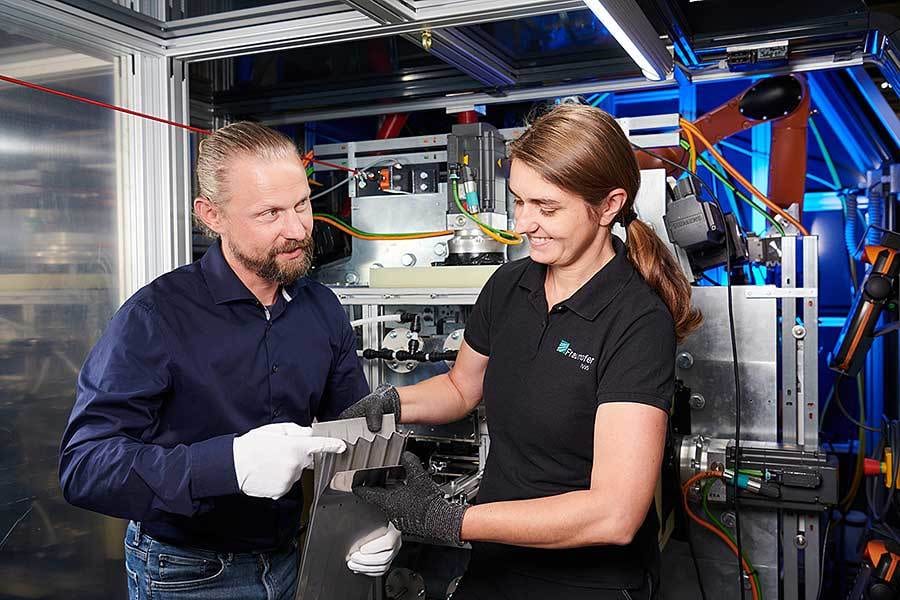
Instead of centimeter-thick heavy steel plates, many manufacturers prefer to use sandwich plates. Despite their significantly lower weight compared with solid steel, these are strong enough for automotive and aerospace applications.
These sandwich panels and profiles consist of honeycomb, trapezoidal, web or spherical hollow chamber structures. On these inner structures, manufacturers weld or glue thin sheets on both sides.
Fraunhofer IWS engineers developed the new laser rolling process to help a railcar manufacturer that was already using lightweight aluminum profiles. However, the applied extrusion process did not allow for arbitrarily thin inner webs. Approximately 1.5 millimeters constituted the technological lower limit.
The engineers solved this dilemma by guiding a flexible core layer of very light internal structures between two rollers, over which a cover sheet rolls at both the top and bottom. Scanner-controlled lasers aim obliquely from both sides precisely into the thin gap between the core layer and the cover sheet. Then, they heat the metal surfaces with pinpoint accuracy. The rolls then press the slightly melted surfaces of core layer and cover sheet together so firmly that they bond permanently.
Compared with conventional methods, such as extrusion at high temperatures, laser welding saves a significant amount of energy, because the energy-rich light only has to melt the metal surfaces locally to a wafer-thin thickness. It also suits low-cost mass production.
According to Berger, laser sandwich plating can also be used to produce stable structures that are only a few tenths of a millimeter thick. This solves the problem in railcar manufacturing, for example.
In addition, an ecological benefit arises at the end of the component life cycle. Laser-joined sandwich panels contain neither adhesives nor solder or other foreign materials that require laborious separation again later in recycling plants.
Manufacturers Face New Types of Competitive Pressures
MUNICH—Manufacturers in many industries are under severe cost and efficiency pressures, according to a recent study conducted by Roland Berger Strategy Consultants GmbH.
Faced constantly with new challenges, manufacturers have followed a proven strategy for decades: reduce costs, increase quality and defend profit margins to persist in challenging markets. Although this approach has long been successful, it is now reaching its limit.
According to the “Next Generation Manufacturing” study, six megatrends are redefining what makes production competitive: sustainability, industry disruption, regionalization, populism, customization and digitalization.
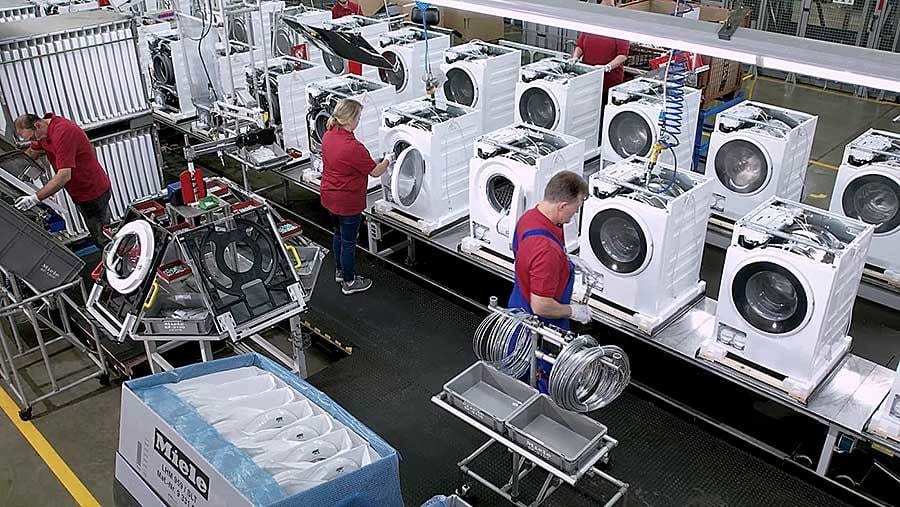
To become a next-generation manufacturer, companies must rethink their production networks and supply chains. Photo courtesy Miele
“The view of competitiveness in the manufacturing industry is changing from a largely cost-oriented approach to a more holistic one, in which CO2 emissions, political risks or the increasing complexity of supply chains play a much bigger role,” says Marcus Berret, global managing director at Roland Berger. “Companies that are restructuring their production now are giving themselves the chance to transform it from a burden into a competitive advantage.”
Two-thirds (67 percent) of respondents claim that the manufacturing sector is under severe pressure to increase efficiency and reduce costs. And, 51 percent would therefore prefer to stop in-house manufacturing and implement an asset-light model.
“Companies would rather focus on sales and marketing and outsource the actual assembly,” claims Oliver Knapp, a partner at Roland Berger. “However, this approach will only solve the ‘old world’ problems.
“Outsourcing production may in fact harm, rather than aid, companies,” warns Knapp. “In contrast, a restructuring of production taking into account megatrends such as sustainability, regionalization or customization can create a competitive advantage.”
While all six megatrends initially pose challenges for manufacturers, they also offer an opportunity to set themselves apart from competitors and realign their production in the long run.
Knapp says sustainability is the most important development. This is followed by regionalization, because production sites are shifting closer to domestic markets—partly due to vulnerable supply chains, as well as consumers’ increasing preference for regional products.
Customization is also becoming important, because consumers want more individual or unique products, subsequently leading to increased variations being manufactured.
“To become a next-generation manufacturer, companies can use different approaches,” says Knapp. “The first is to rethink their production networks. The growing demands on sustainability should be anchored in manufacturing and implementing digital production technologies. When restructuring their supplier networks, companies should establish new partnerships and forms of collaboration.”

Robotic Gripper Grasps Objects by Reflex
CAMBRIDGE, MA—Engineers at the Massachusetts Institute of Technology (MIT) have developed a gripper that grasps by reflex. It gives robots a more nimble, human-like touch.
Rather than start from scratch after a failed attempt, the robot adapts in the moment to reflexively roll, palm or pinch an object to get a better hold. It’s able to carry out these “last centimeter” adjustments without engaging a higher-level planner, much like how a person might fumble in the dark for a bedside glass without much conscious thought.
The new design is the first to incorporate reflexes into a robotic planning architecture. The MIT engineers eventually plan to program more complex reflexes to enable nimble, adaptable machines that can work with and among humans in ever-changing settings.
A new type of robotic gripper incorporates reflexes to quickly grasp and sort everyday objects. Photo courtesy Massachusetts Institute of Technology
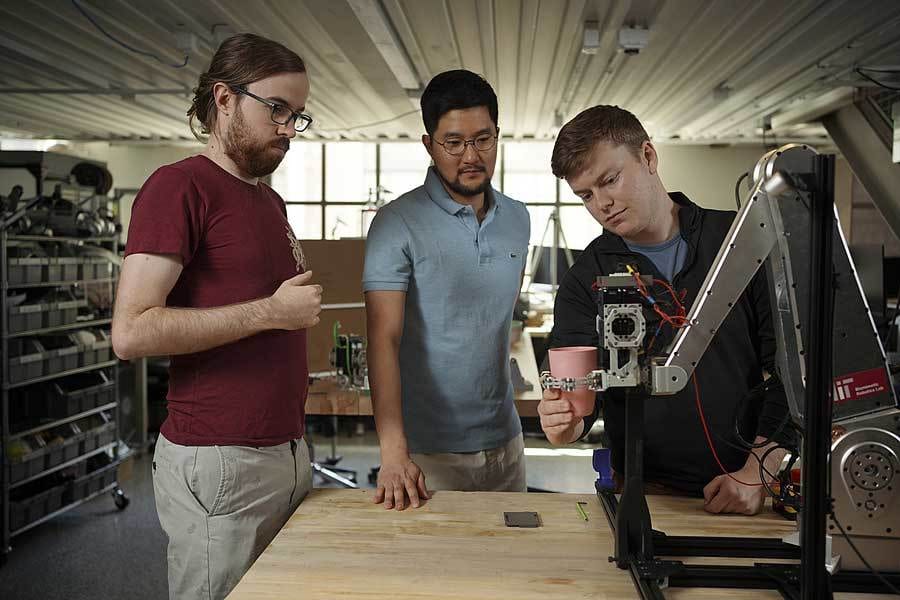
"In environments where people live and work, there’s always going to be uncertainty,” says Andrew SaLoutos, a graduate student in MIT’s Department of Mechanical Engineering. “Someone could put something new on a desk or move something in the break room or add an extra dish to the sink. We’re hoping a robot with reflexes could adapt and work with this kind of uncertainty.”
SaLoutos and his colleagues built a reflexive and reactive platform using fast, responsive actuators. The design includes a high-speed arm and two lightweight, multi-jointed fingers.
In addition to a camera mounted to the base of the arm, the engineers incorporated custom high-bandwidth sensors at the fingertips that instantly record the force and location of any contact, as well as the proximity of the finger to surrounding objects more than 200 times per second.
A high-level planner initially processes visual data of a scene, marking an object’s current location where the gripper should pick the object up, and the location where the robot should place it down. Then, the planner sets a path for the arm to reach out and grasp the object. At this point, the reflexive controller takes over.
If the gripper fails to grab hold of the object, rather than back out and start again as most grippers do, an algorithm instructs the robot to quickly act out any of three grasp maneuvers or reflexes in response to real-time measurements at the fingertips. The three reflexes kick in within the last centimeter of the robot approaching an object and enable the fingers to grab, pinch or drag an object until it has a better hold.
The engineers programmed the reflexes to be carried out without having to involve the high-level planner. Instead, the reflexes are organized at a lower decision-making level, so that they can respond as if by instinct, rather than having to carefully evaluate the situation to plan an optimal fix.
“It’s like how, instead of having the CEO micromanage and plan every single thing in your company, you build a trust system and delegate some tasks to lower-level divisions,” says Sangbae Kim, Ph.D., a professor of mechanical engineering and director of the Biomimetic Robotics Laboratory at MIT. “It may not be optimal, but it helps the company react much more quickly. In many cases, waiting for the optimal solution makes the situation much worse or irrecoverable.”
The MIT engineers are working to include more complex reflexes and grasp maneuvers in the system, with a view toward building a general pick-and-place robot capable of adapting to cluttered and constantly changing spaces.