MONTH 2023

ASSEMBLY LINES
Self-Fixturing Technology Could Boost Friction Stir Welding
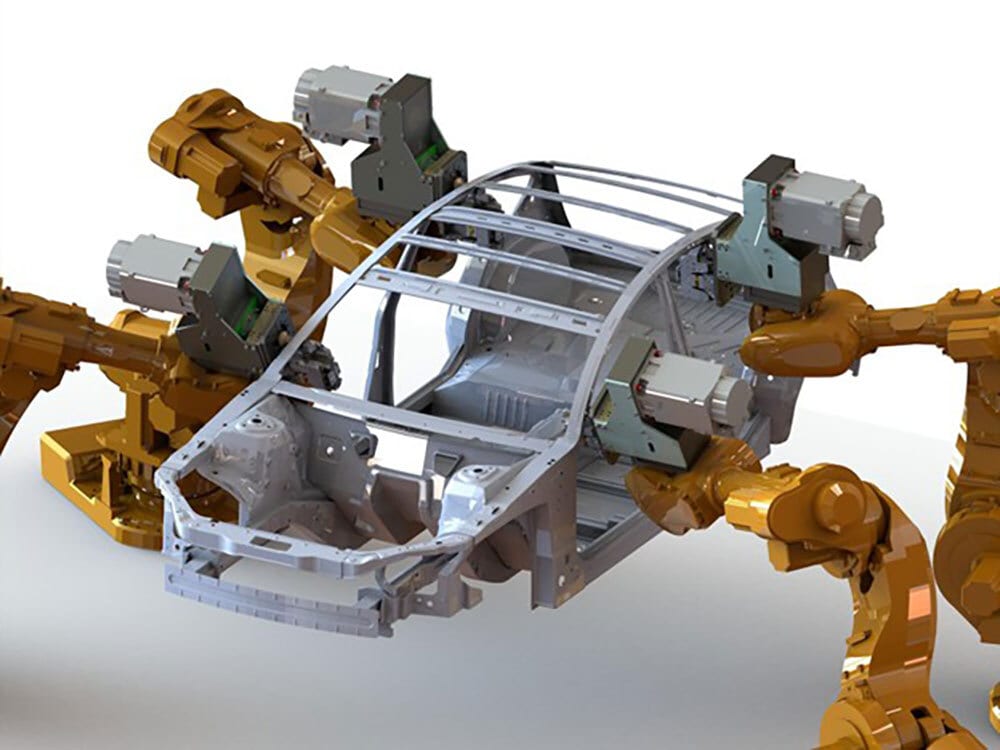
RICHLAND, WA—Engineers at the Pacific Northwest National Laboratory (PNNL) have developed a self-fixturing process for friction stir welding. It uses a robotic arm attachment that includes both the friction stir tool and a miniature backing plate.
The goal of the R&D project is to design a more maneuverable fixturing system that enables manufacturers to mass-produce metal components with lighter materials, stronger welds and lower energy costs.
The new attachment pinches the target material between the friction stir tool and the backing plate, exerting the necessary force and eliminating the need for a separate, custom-shaped anvil.
“If the old approach was an arm holding a pencil, the new approach is an arm holding both a pencil and a clipboard,” says Mitch Blocher, a mechanical engineer at PNNL working on the project.
Self-fixturing friction stir welding could enable new applications on automotive assembly lines. Illustration courtesy Pacific Northwest National Laboratory
According to Blocher, friction stir welding requires only a fraction of the energy required by conventional joining techniques, but isn’t used on many assembly lines today. That’s because it exerts tremendous force (up to 5,000 pounds) and something needs to capture that force.
“Currently, the process requires a rigid, perfectly shaped anvil underneath the material being welded,” explains Blocher. “For many assembly lines, that requirement is tough to meet.”
Blocher believes that PNNL’s breakthrough could free friction stir welding from those constraints and open the door for increased use of the joining process.
“There is some friction stir welding that’s done in vehicle manufacturing,” notes Piyush Upadhyay, Ph.D., senior materials scientist at PNNL. “But, typically, it’s limited to two flat sheets welded on top of a rigid anvil.”
A decade ago, PNNL worked with several companies, including General Motors, to apply friction stir welding in the production of car doors. The process involved welding flat sheets before stamping them into the 3D shape of a car door. However, Upadhyay says that approach doesn’t work for larger, more complex car parts that can’t simply be stamped into shape, such as roof rails and the metal frames that surround doors.
“If you want to friction stir weld anything that isn’t flat, you’re going to need an anvil in the shape of that part,” Upadhyay points out. “If you’re welding a roof rail, you’ll need a roof rail-shaped anvil. For a real-world assembly line, that’s too cumbersome.
“Many components manufactured for vehicles still rely on spot welding and adhesives for joining applications,” says Upadhyay. “Friction stir tools have been attached to robotic arms in the past, but they always required a separate anvil.
“Self-fixturing friction stir welding, however, uses an attachment for a robotic arm that includes both the friction stir tool and a miniature backing plate,” explains Upadhyay. “[But], there’s still the issue of the thousands of pounds of force exerted by the friction stir tool.
“Because self-fixturing friction stir uses a built-in backing plate, rather than an anvil, the system must not only exert, but also withstand, that force,” notes Upadhyay. “There’s just one problem: most assembly lines don’t employ welding robots that are strong enough to handle that.
“Most of the welding in vehicle manufacturing requires very minimal force, since the material is melted in the process,” claims Upadhyay. “Friction stir welding doesn’t melt the material, so pushing into and across the material requires a significant amount of force.”
Upadhyay and his colleagues are in the process of adding another capability to their self-fixturing friction stir tooling: a hydraulic system that powers the attachment and creates a closed loop for the force it generates. Currently, the hydraulic system can capture the force from the tool pressing or tilting. The engineers are now designing new mechanisms to capture additional degrees of movement and developing a system that allows the attachment to pull material into the tool.
“Once this is perfected, there will be no fixturing, no anvil and no force transmitted into the assembly line,” says Blocher. “The only job of the robot will be to hold the friction stir attachment in place and to maintain the correct position.
“[We plan to] package self-fixturing friction stir into a more ergonomic, industry-hardened form so that the technology can be applied on real-world assembly lines,” adds Blocher.
Collaborative Robots May Be Prone to Privacy Problems
WATERLOO, ON—According to a recent study conducted by the University of Waterloo, many collaborative robots suffer from a serious security weakness. A team of engineers discovered that hackers can identify a cobot’s action with a 97 percent accuracy rate.
“Despite their popularity, collaborative robots could be exploited in malicious attacks,” warns Yue Hu, Ph.D., a professor of mechanical and mechatronics engineering who was involved in the research project. “If a hacker notices any command patterns during a procedure, he or she could infer sensitive information, even when commands are encrypted.
“In the robotics community, there’s an increased interest in controlling [machines] remotely by sending commands over a network,” says Hu. “The robot could be anywhere, like a hospital, factory or another country. Many people don’t realize that once these robots are hooked into the network, they are exposed to security risks.”
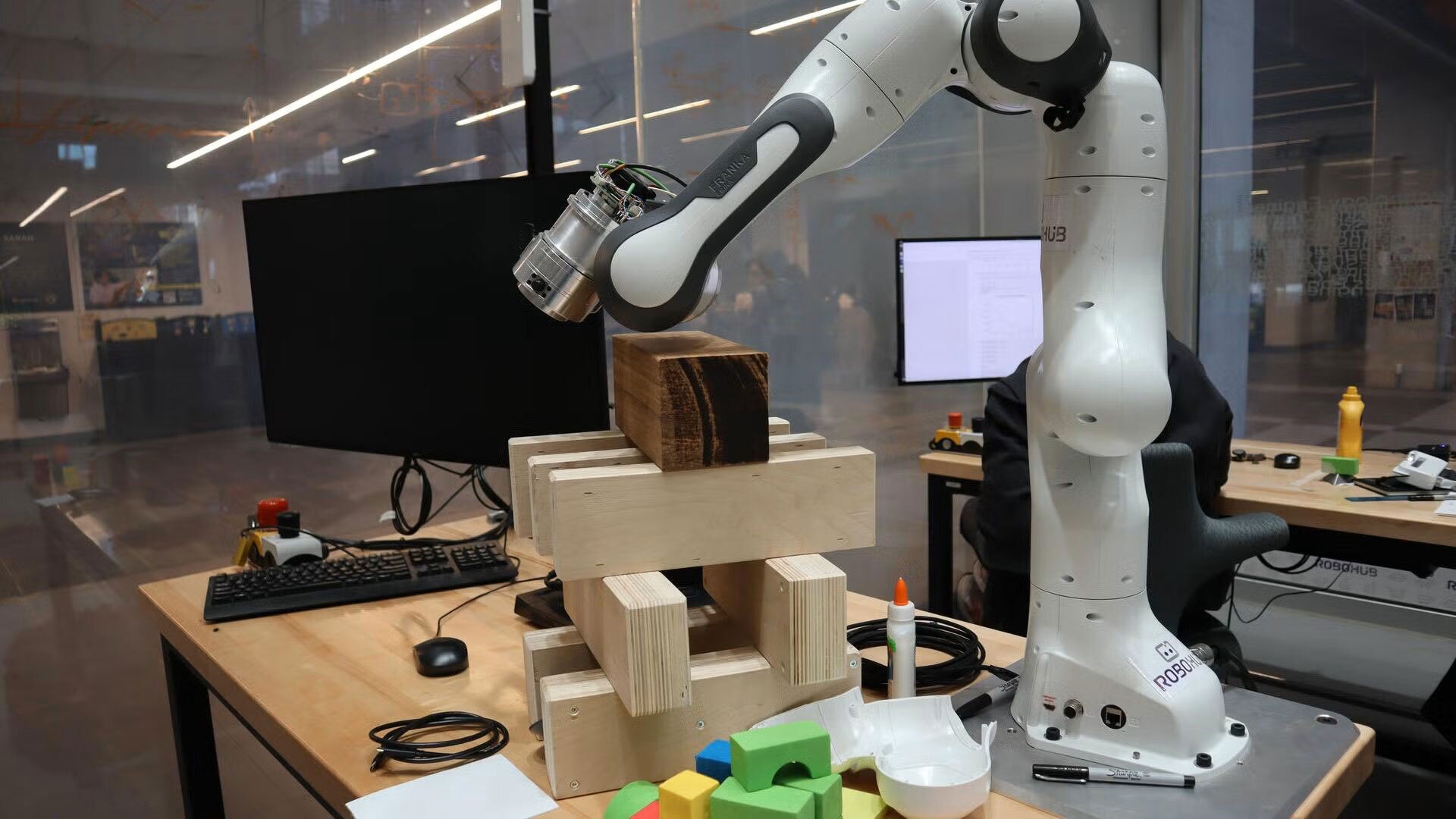
Many robots suffer from a serious security weakness. Photo courtesy University of Waterloo
According to Hu, previous research efforts have focused on privacy concerns in teleoperation robotics, where humans control robots in real-time by using joysticks or virtual reality interfaces. His study focused on script-based robots, where machines perform preprogrammed commands with minimal human intervention.
Hu and his colleagues investigated techniques that could identify a robot’s actions by analyzing its network traffic. They developed a classification technique based on signal processing, which is found in products like noise-cancelling headphones. It analyzes and transforms signals for information extraction or quality improvement.
The engineers conducted experiments by instructing a Kinova Gen3 robotic arm to perform four actions. They collected 200 network traces that were exchanged between the robot and its controller.
By analyzing what type of commands were being sent, they discovered that robot commands can create traffic subpatterns, which can be detected by common signal processing techniques, particularly signal correlation and convolution.
“Certain design choices could prevent leakage and make a system’s network steadier,” claims Hu. “Some of [our] proposals include changing the system’s interface, like its application programming interface timing, or employing a smart traffic shaping algorithm at run-time.”
Additive Manufacturing Helps Boeing Assemble Satellites Faster
EL SEGUNDO, CA—Engineers at Boeing Space Mission Systems are using additive manufacturing to reduce the amount of time that it takes to assemble satellites. Their 3D‑printed solar array substrate compresses composite build times by up to six months. This represents a production improvement of up to 50 percent vs. current cycle times.
The first printed solar arrays will fly Spectrolab solar cells aboard small satellites built by Millennium Space Systems. Both nonintegrated subsidiaries are part of Boeing’s Space Mission Systems organization.
By printing the panel’s structure and built‑in features, Boeing can assemble the array in parallel with cell production. Robot‑assisted assembly and automated inspection at Spectrolab further reduce handoffs, improving speed and consistency.
Boeing is using additive manufacturing to reduce the amount of time that it takes to assemble satellites. Illustration courtesy Boeing
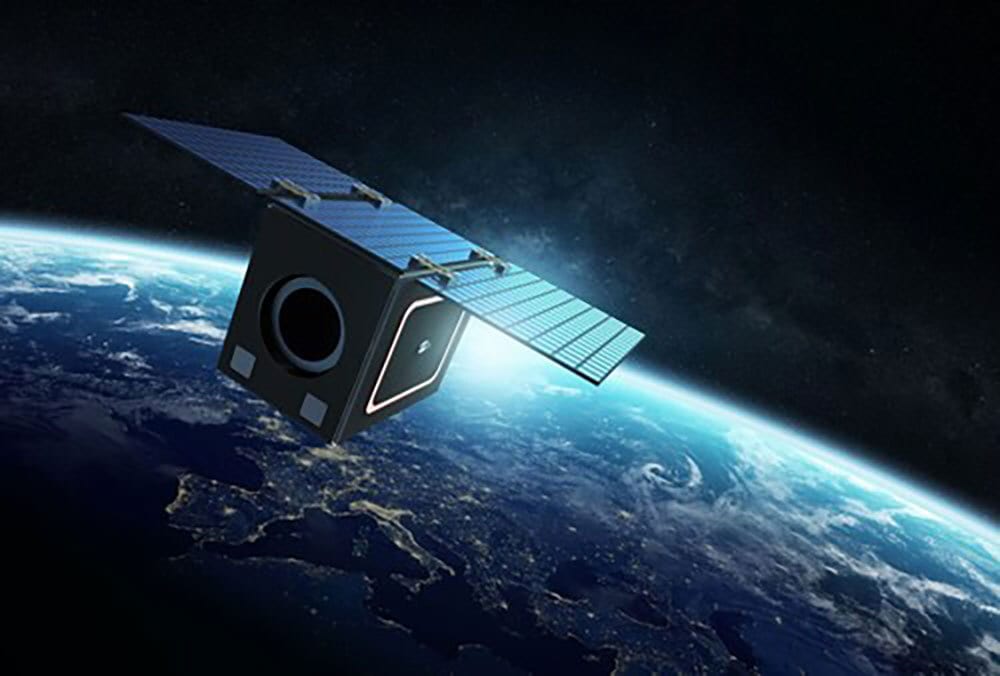
The new array approach is designed to scale from small satellites to larger platforms, including Boeing 702‑class spacecraft, targeting market availability for 2026.
“Power sets the pace of a mission,” says Michelle Parker, vice president of Boeing Space Mission Systems. “We reached across our enterprise to introduce efficiencies and novel technologies to set a more rapid pace.
“By integrating [our] additive manufacturing expertise with Spectrolab’s high‑efficiency solar tech and Millennium’s high‑rate production line, our team is turning production speed into a capability, helping customers field resilient constellations faster,” explains Parker.
Beyond the arrays themselves, Boeing’s new production process enables a parallel build of the complete array, pairing a printed, rigid substrate with flight-proven modular solar technologies.
“By printing features such as [wire] harness paths and attachment points directly into each panel, the design replaces dozens of separate parts, long‑lead tooling and delicate bonding steps with one strong, precise piece that is faster to build and easier to integrate,” notes Parker. “It is built upon the foundation of [our] flight-proven materials and processes.”
“As we scale additive manufacturing across [our company], we’re not just taking time and cost out, we’re putting performance in,” adds Melissa Orme, vice president of materials and structures at Boeing Technology Innovation. “By pairing qualified materials with a common digital thread and high‑rate production, we can lighten structures, craft novel designs and repeat success across programs. [Additive manufacturing] delivers better parts today and the capacity to build many more of them tomorrow.”
Boeing has already incorporated more than 150,000 3D‑printed parts into its aerospace products, yielding significant schedule, cost and performance benefits. This includes more than 1,000 radio-frequency parts on each Wideband Global SATCOM satellite currently in production and multiple small satellite product lines with fully printed structures.
Global Robot Demand Doubles Over Last 10 Years
FRANKFURT—More factories are installing robots to improve productivity, boost quality and address severe labor shortages. According to the International Federation of Robotics (IFR), 542,000 machines were installed worldwide in 2024, more than double the number 10 years ago.
Annual installations topped 500,000 units for the fourth straight year. Asia accounted for 74 percent of new deployments in 2024, compared with 16 percent in Europe and 9 percent in the Americas. “The new World Robotics statistics show 2024 the second highest annual installation count of industrial robots in history—only 2 percent lower than the all-time-high two years ago,” says Takayuki Ito, IFR president. “The transition of many industries into the digital and automated age has been marked by a huge surge in demand. The total number of industrial robots in operational use worldwide was 4,664,000 units in 2024, an increase of 9 percent compared to the previous year.”
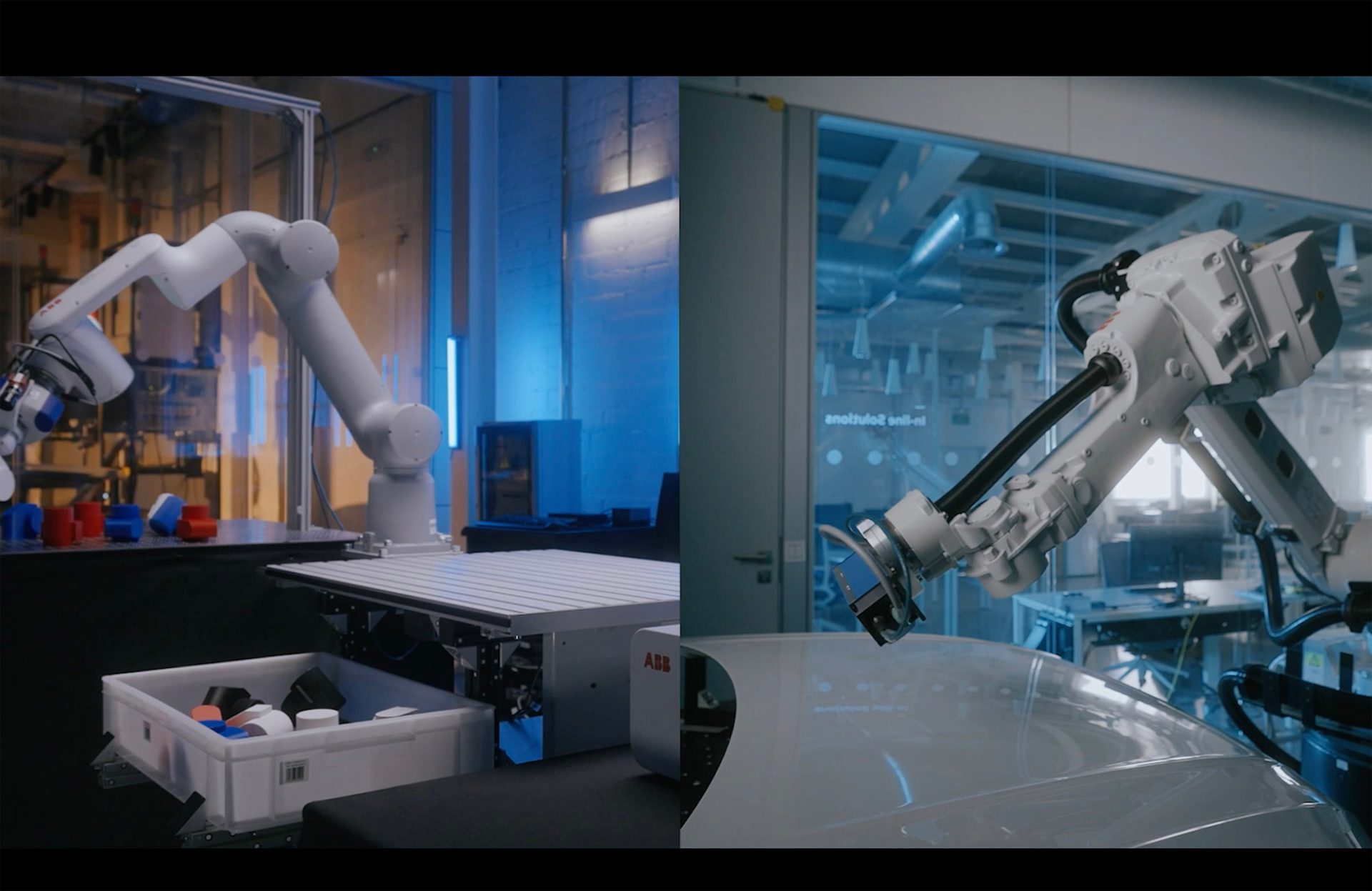
Manufacturers around the world are investing heavily in robotic automation. Photo courtesy ABB Robotics
Robot installations in North America exceeded 50,000 units for the fourth year in a row, with 50,100 units installed in 2024. The United States, the largest regional market, accounted for 68 percent of installations in the Americas in 2024, with 34,200 units.
“The United States imports most of its robots from Japan and Europe, with few domestic suppliers,” explains Ito, who also serves as chief technical advisor at Fanuc Corp. “However, there are numerous domestic system integrators.”
China is by far the world’s largest market, representing 54 percent of global deployments. The latest figures show that 295,000 industrial robots have been installed, which is the highest annual total on record.
“For the first time, Chinese manufacturers have sold more than foreign suppliers in their home country,” says Ito. “Their domestic market share climbed to 57 percent last year, up from about 28 percent over the past decade. China’s operational robot stock exceeded the 2 million mark in 2024, the largest of any country.”
Japan maintained its position as the second largest market for industrial robots, with 44,500 units installed in 2024. The Republic of Korea, the fourth largest robot market in the world, installed 30,600 machines in 2024.
“India continues to grow with a record of 9,100 units installed in 2024, up 7 percent,” Ito points out. “The automotive industry was the strongest driver, with a market share of 45 percent.”
Industrial robot installations in Europe fell 8 percent to 85,000 units in 2024, but it’s still the second largest number recorded in history. The majority (80 percent) of new machines were installed in the European Union, which benefited from the nearshoring trend.
Germany is the largest robot market in Europe and the fifth largest in the world. Other European countries experiencing big demand for robots include Italy, Spain and France.
“The robotics industry is not immune to global macroeconomic conditions, but there is no indication that the overall long-term growth trend will come to an end any time soon,” predicts Ito. “While regional trends vary substantially, the aggregate global trajectory remains positive.
“Globally, robot installations are expected to grow by 6 percent to 575,000 units in 2025,” says Ito. “By 2028, the 700,000 unit mark will be surpassed.”