MONTH 2023

Robotics
Labor shortages are driving new demand for automation.
Options for Screwfeeding
To test the compressor for leaks, engineers equipped a cobot with a sniffer probe. Photo courtesy Mech-Mind Robotics Technologies Co. Ltd.
A collaborative robot, 3D vision, and artificial intelligence make leak testing process more efficient.
Appliance Assembler Automates Leak Testing
John Sprovieri // Chief Editor
In the early days of automation, robots could only undertake simple repetitive tasks, and parts had to be positioned precisely.
Then, with the advent of vision guidance, assemblers found that they could use simpler, less expensive methods to present parts for pickup. Instead of custom-made, precision fixtures, parts can be loosely positioned in pocket tape, a bin or a flat surface, such as a conveyor.
Vision guidance also increases flexibility. Instead of swapping fixtures to run a new part, assemblers can simply reprogram the robot and vision system. Moreover, vision-guided robots can distinguish between parts that differ by size, shape or even color. This allows a robot to handle more than one part or assembly at the same time.
Of course, a vision system can do more than just locate parts. As the system is telling a robot where to retrieve a part, it can also measure the part, inspect it, or read an identification code from its surface.
Now, the addition of artificial intelligence to machine vision is boosting the abilities of robots even more. With AI, robots can undertake demanding tasks, such as assembly, that once could only be carried out by people.
One manufacturer taking full advantage of AI, vision guidance and robotics is Arçelik, a multinational home appliance manufacturer based in Istanbul. The company’s line-up includes white goods (such as refrigerators, freezers, washing machines, dishwashers) and small home appliances (such as vacuum cleaners, coffee makers and blenders). The company operates 15 assembly plants in Turkey, Romania, Russia, China, South Africa and Thailand.
The company assembles air conditioners at its factory in Gebze, Turkey, just southeast of Istanbul. Because air conditioners rely on refrigerant, leak testing is a key part of quality control, particularly for the compressor assembly. To test the compressor, a technician uses a sniffer probe to detect refrigerant escaping from various welded joints. The process is tricky, because it requires the technician to consistently repeat the same precise motions for several hours.
As a result, the company wanted a robot to perform this monotonous task. Automation would increase the consistency of the test process. It would also increase efficiency and throughput, since the robot could work 24/7.
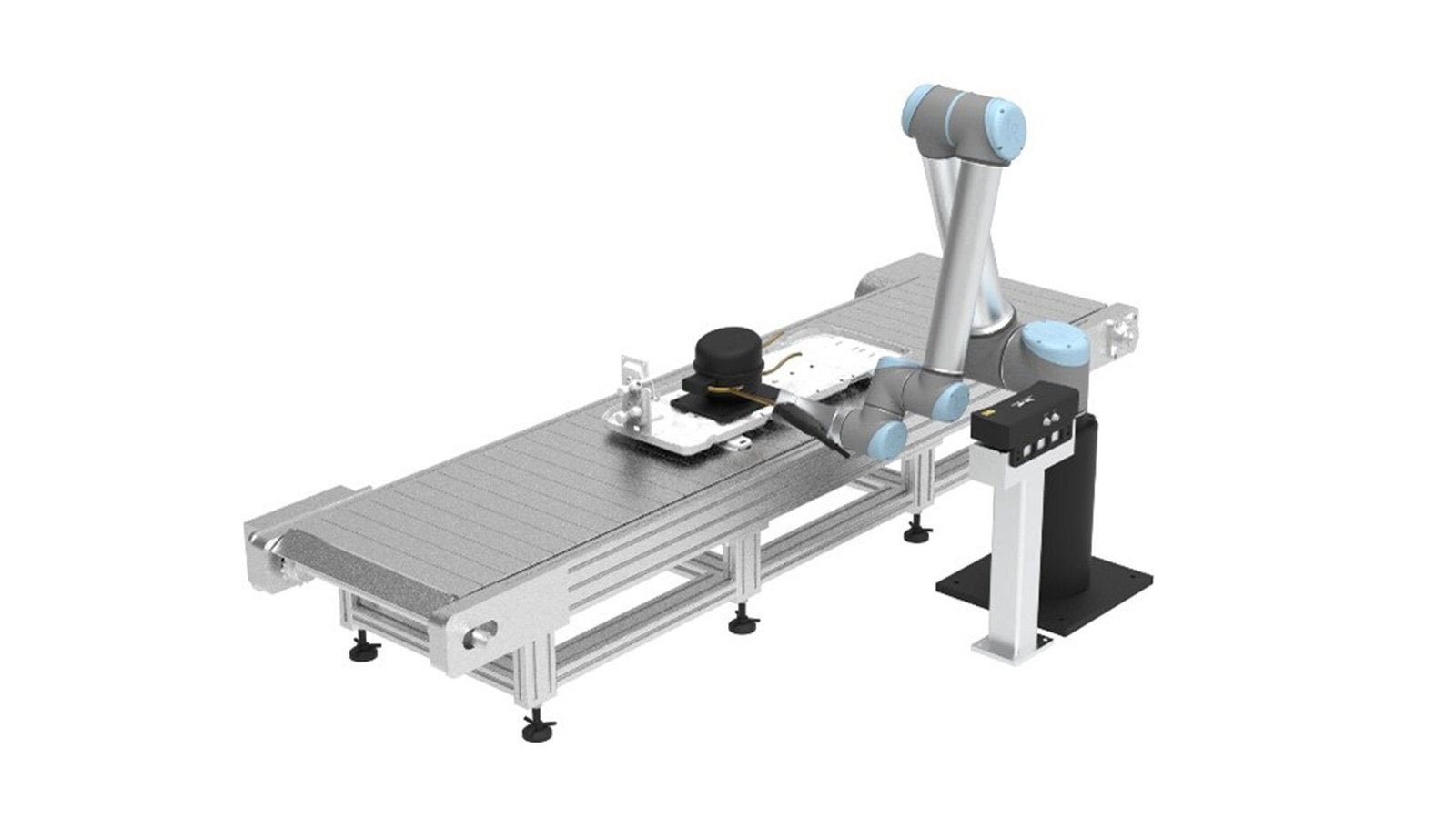
The Mech-Eye camera is in a fixed position across from the workpiece. It takes images of weld joints and maps the surroundings. Photo courtesy Mech-Mind Robotics Technologies Co. Ltd.
Project Challenges
To test the compressor, engineers equipped a UR5E collaborative robot from Universal Robots with a sniffer probe.
Even after automating the task, however, engineers found that the robot was still limited when conducting leak tests. The challenge is that the weld joints in each compressor are random in size, position and orientation. Testing with a sniffer probe requires extreme accuracy, and the area to be inspected contains a tangle of condenser pipes. To precisely and accurately test the compressor, the robot would need to see each weld joint, understand its surroundings, and then plan an optimum path to avoid collisions—just like a human technician.
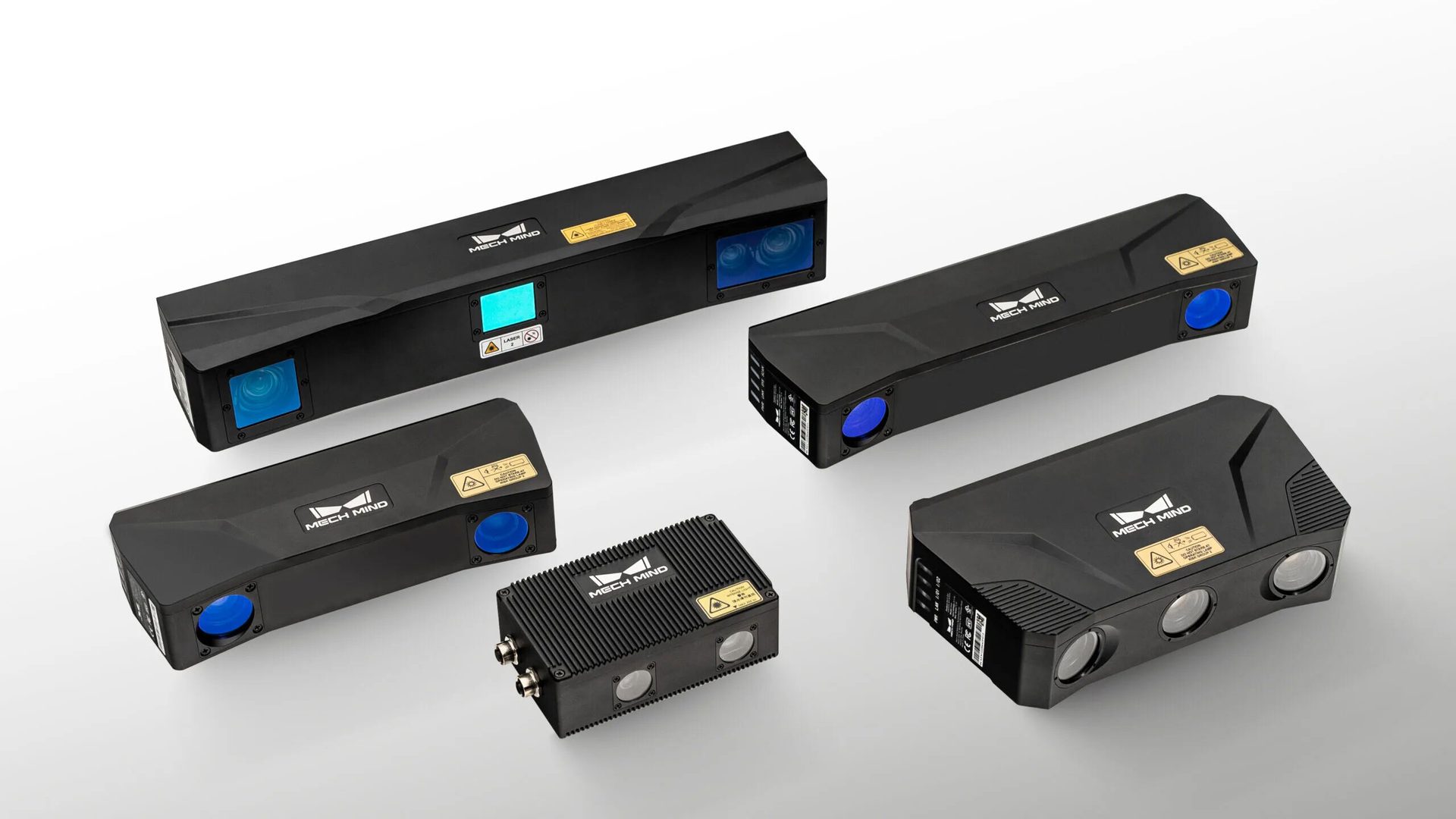
Mech-Eye vision cameras provide high-resolution, detail-rich 3D images for inspection and robot guidance applications. A variety of models are available to satisfy diverse needs, such ambient light resistance or high scanning speed. Photo courtesy Mech-Mind Robotics Technologies Co. Ltd.
To solve the problem, engineers sought help from Mech-Mind Robotics Technologies Co. Ltd., a tech start-up specializing in 3D vision and AI for robots. Founded in 2016, Mech-Mind is based in Munich, Germany, and has offices in the U.S, Japan, South Korea and China. The company’s technology enables systems integrators to manage the most challenging automation tasks, including bin picking, depalletizing, assembly and inspection. Mech-Mind has successfully deployed more than 17,000 3D vision systems worldwide in a variety of industries, including automotive, appliances, and food and beverage manufacturing.
For the compressor testing application, Mech-Mind implemented its Mech-Eye PRO S 3D vision system, along with its Mech-Vision machine vision software, Mech-Viz robot control software, and Mech-DLK deep learning software.
Mech-Mind had to meet several technical requirements:
• The vision system would have to accurately recognize each weld joint, regardless of its position and orientation.
• The vision system would have to differentiate between high- and low-pressure weld joints. Each compressor has one high-pressure weld joint and three low-pressure joints. The high-pressure joint does not have to be inspected; the low-pressure joints do.
• The robot would have to work in a tight space with high agility.
To meet those requirements, Mech-Mind would have to overcome several technical challenges:
• Difficulty in generating high-quality point clouds: Reflections from the background can cause unwanted “noise” in an image, leading to missing data in point clouds.
• Difficulty in accurate recognition: Weld joints come in various sizes, shapes and positions. Recognizing and classifying each weld joint with 100 percent accuracy would be difficult.
• Training speed: The deep-learning software would have to train AI models rapidly to deliver stable and accurate recognition of the various weld joints.

AI and 3D Vision Solve the Problem
Using structured light technology, the PRO S vision system outputs accurate 3D point cloud data, even for randomly located welding points and compressors with dark surfaces, enabling the robot to precisely locate each welding point.
Each weld joint in the object image can be separately identified. Mech-Vision machine vision software delivers accurate recognition results of each welding point and outputs its exact position for the cobot. Mech-DLK deep learning software trains models rapidly to respond to product and object variations and enable fast changeovers.
Mech-Viz robot programming software plans the optimum path for the robot arm to assess each weld joint without colliding with any part of the compressor or any nearby production equipment.
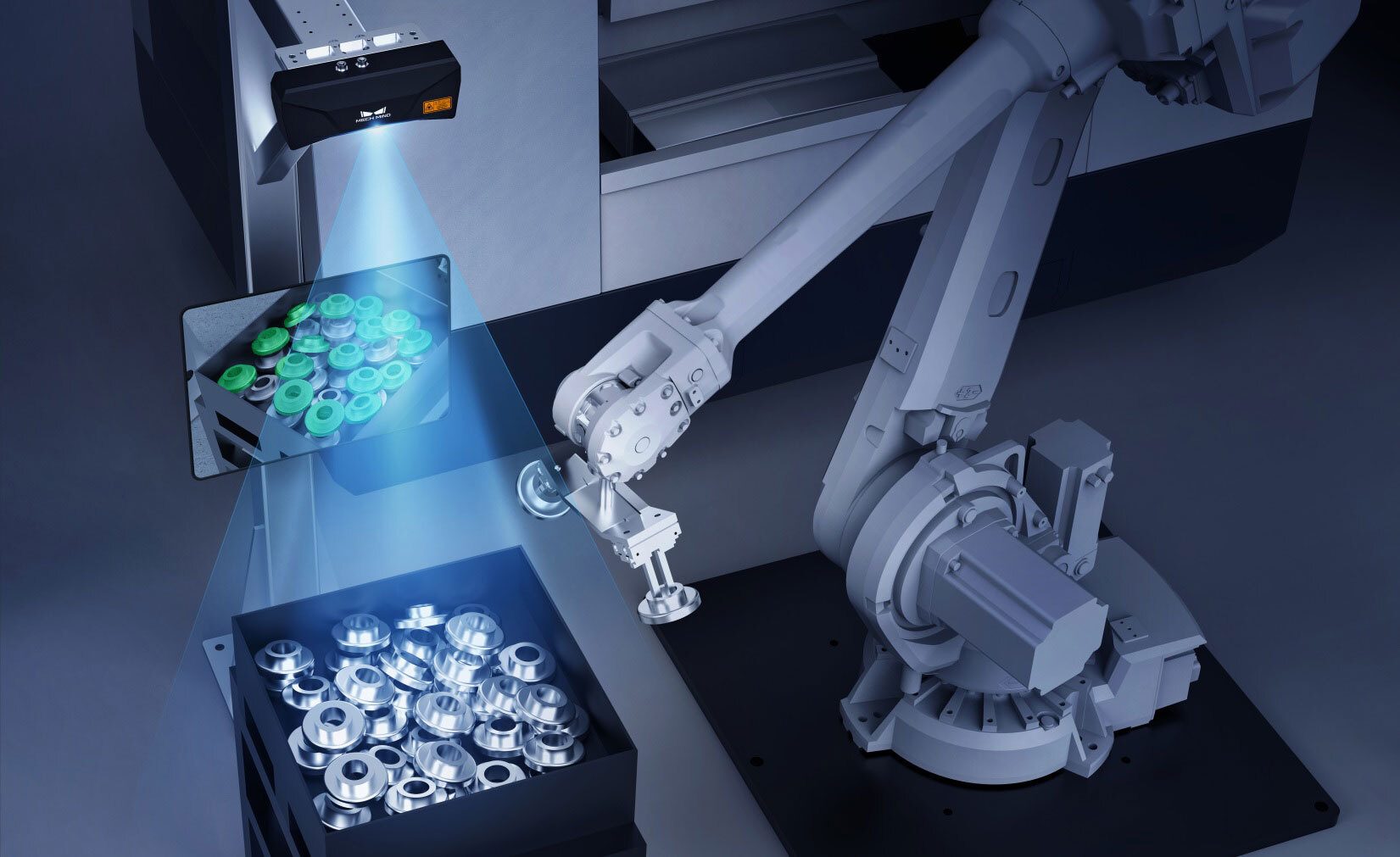
Mech-Eye vision systems can be used for complex robotic applications, such as bin picking. Photo courtesy Mech-Mind Robotics Technologies Co. Ltd.
Mech-Vision filters out the high-pressure weld joint based on the information of the Z-axis and sets a threshold for outputting recognition results. As a result, it can accurately output the location of the low-pressure weld joints. The software gathers data in real-time to manage detection results and review issues, reducing unplanned downtime and improving efficiency.
At the factory in Gebze, the Mech-Eye camera is in a fixed position across from the workpiece. It takes images of weld joints and maps the surroundings. Mech-Vision provides the robot with the location of all the weld joints at one time and guides the robot which spot to check first. This ensures that the robot can test all the joints one after another with only one data capture, optimizing efficiency. The software excludes the high-pressure joint and only includes the low-pressure joints.
Inspection System
The vision system identifies the positions of joints based on 3D point clouds. Then it calculates the distances between the welding points and the compressor center to filter out the high-pressure point.
Mech-Viz plans the optimal path for the robot to test each point while avoiding collisions.
If the sniffer probe detects a leak, the system will trigger an alert, and the faulty product will be sent for repair.
With the vision system and software, the robot can recognize any weld point 100 percent of the time. The cycle time for the vision system—image acquisition and processing for four welding joints, is less than four seconds. All totaled, the cycle time for the entire test process is less than one minute.

ASSEMBLY ONLINE
For more information on vision guidance, visit www.assemblymag.com to read these articles: