MONTH 2023

Aerospace Assembly
Labor shortages are driving new demand for automation.
Options for Screwfeeding
A variety of start-up manufacturers are scrambling to build aircraft for 21st century applications. Illustration courtesy Natilus
Aerospace start-ups are looking for flexibility and automation.
Aircraft Manufacturers Ramp Up
Austin Weber // Senior Editor // webera@bnpmedia.com
A century ago, the Boeing Model 40 was the talk of the aviation world. The single-engine biplane could only carry two passengers and several sacks of mail, but it helped spur modern air travel.
Today, another new era is dawning as a variety of start-up manufacturers scramble to create aircraft designed for 21st century applications. The biggest transformation in the aerospace industry since the dawn of the jet age 75 years ago is being driven by next-generation propulsion systems and other technological advancements.
That innovation is fueling a rush to build innovative assembly lines and factories. Almost a dozen new aircraft assembly plants are under construction or in various planning stages throughout the United States.
That’s because companies are racing to produce a new breed of products for both passenger and freight applications, such as air taxis, blended-wing bodies and supersonic aircraft. Many plan to have their assembly lines up and running by the end of this decade.
One firm that has a birds-eye view of the trend is BRPH, a leading architectural firm that has done a variety of work in the aerospace industry, designing facilities for manufacturers such as Airbus, Boeing, Embraer and Gulfstream. It recently created a factory for Boom Supersonic, a start-up that’s building an aircraft that can fly at twice the speed of today’s fastest passenger jets.
“We are seeing an uptick in terms of new-model aircraft, especially companies planning to build short-range, regional planes,” says Marti Watts, executive director for the manufacturing and industrial business unit at BRPH. “They’re all start-ups looking for cost-effectiveness and efficiency in their new factories.
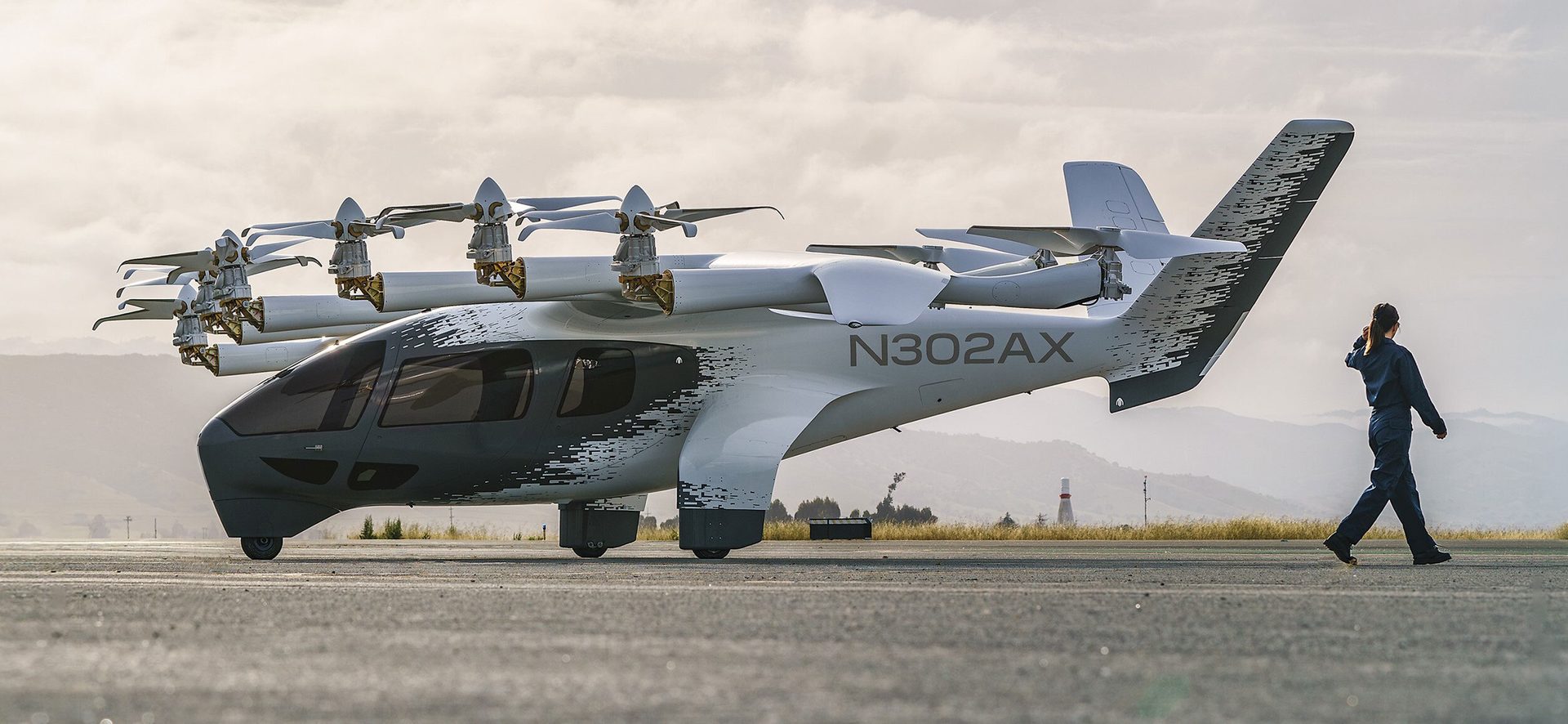
Air taxis are one of the hottest segments of the aerospace industry today. Photo courtesy Archer Aviation Inc.
“A lot of companies are seeking modular designs, because they’re not sure what their growth trajectory will be,” explains Watts. “They want flexibility built into their factories so that they can easily scale up and expand.
“Many companies also want to know how quickly they can get a facility built so they can get their products out the door before the competition,” Watts points out.
“When designing a new facility, we pay careful attention to how people and material need to move in and out,” notes Watts. “To accommodate future expansion, utility distribution on the floor is critical.
“Most start-ups are looking at ways to use moving assembly lines that can be easily adapted and modified as needed,” says Watts. “However, many companies are only looking for final assembly and paint facilities, because they’ll be relying heavily on suppliers for components, such as carbon-fiber composite airframes.
“Each firm has been a little different in terms of how they expect to work their supply chain,” explains Watts. “Some plan to make fuselages and wings in-house, while others will outsource those subassemblies. A few companies also plan to build battery packs in-house, so they’re looking for factory layouts that include high-voltage testing capabilities.”
Accenture is another firm that has been working closely with a variety of nontraditional companies trying to create new types of aircraft.
“Many future production facilities will look more like an auto plant instead of a traditional aircraft factory,” says John Schmidt, leader of the global aerospace and defense practice at Accenture. “That’s because these companies often want to build at higher volumes than the aerospace industry is accustomed to.
“Many start-ups are hiring people from the automotive sector with manufacturing expertise,” claims Schmidt. “But, there’s a lot more scrutiny and regulations to contend with in the aerospace industry.”
Schmidt says many new players are interested in using the latest Industry 4.0 technology in their factories. “Engineers are using digital twins and simulation tools to map out new plants,” he points out. “Material flow inside these facilities will be more automated and streamlined than in traditional aircraft factories.”
Traditionally, aircraft assembly plants have required a lot of physical space, due to the size of fuselages and wings. But, many next-generation designs are more compact, which should make them easier to mass-produce.
“Air taxis, for instance, have dimensions similar to cars or small trucks,” notes Schmidt. “That will make it easier to deploy off-the-shelf automation instead of custom, fixed monuments. New aircraft will also be much lighter and easier to maneuver on assembly lines.”
Many start-ups hope to deploy automated guided vehicles and six-axis robots in their factories. In the past, that has often not been feasible in the aerospace sector due to reach issues and other challenges associated with large, bulky subassemblies.
Some aircraft manufacturers, such as Korea Aerospace Industries Ltd., have even proposed using humanoid robots in the future. Within the next five years, it plans to use the machines to assemble fuselages and wings, in addition to material handling applications.
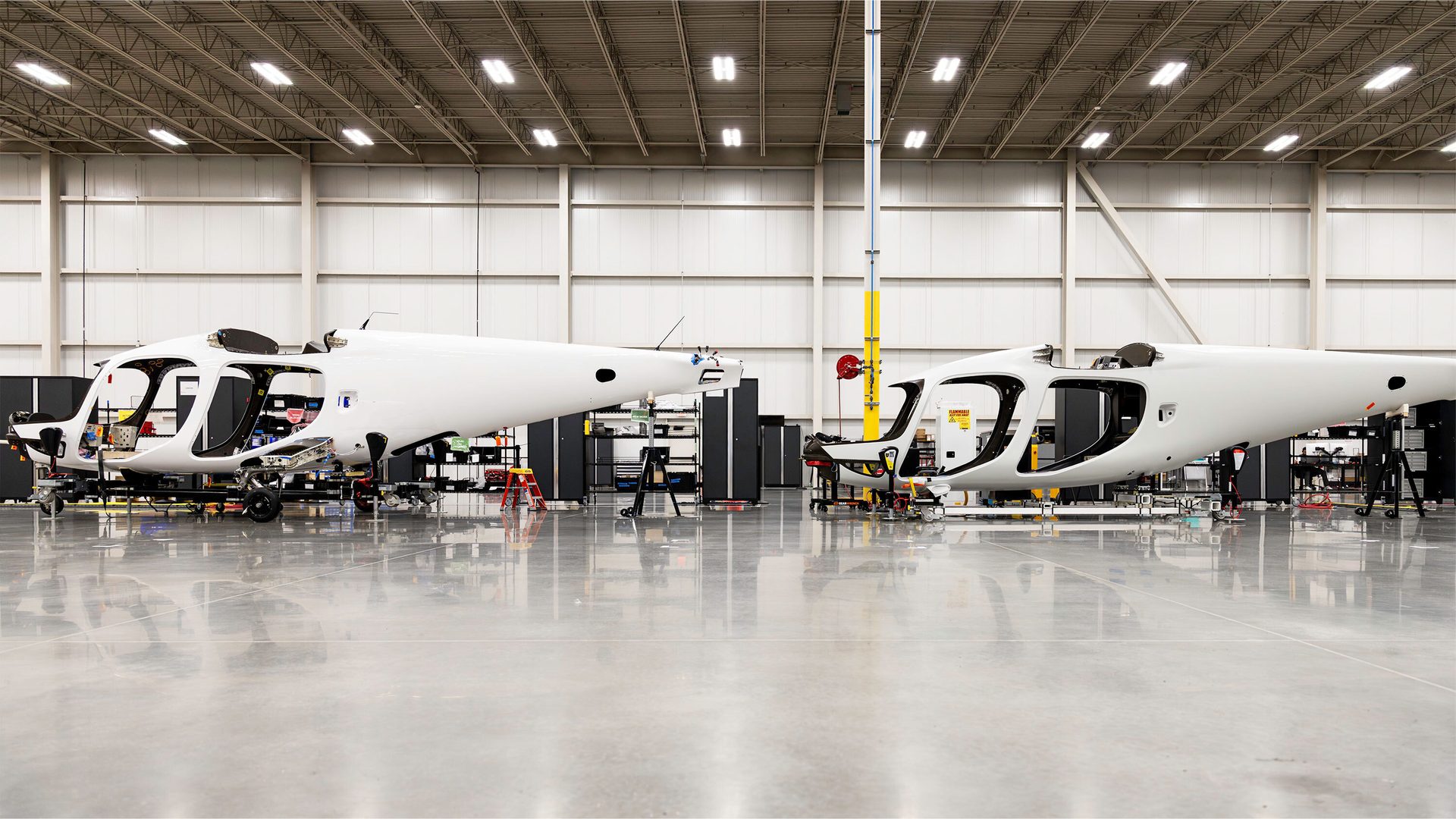
Archer recently acquired a composite manufacturing facility in Southern California. Photo courtesy Archer Aviation Inc.
Air Taxis Take Off
Air taxis are one of the hottest segments of the aerospace industry today. Large manufacturers like Airbus, Boeing and Embraer, in addition to numerous start-ups, are actively developing a new breed of small battery-powered aircraft that can ferry several passengers at a time.
The concept has also attracted investment from major air carriers such as American, Delta and United, in addition to automakers like Honda, Hyundai, Stellantis and Toyota.
Urban air mobility, an aviation industry term for on-demand passenger or cargo-carrying air transportation services, will rely on electric vertical take-off and landing (eVTOL) aircraft flown with or without a pilot. These vehicles promise to reduce urban congestion and provide new ways for people and packages to travel around large cities.
Most of the designs combine features of traditional airplanes and helicopters. They rely on lightweight battery-powered propulsion systems. Multiple electric motors turn fans or propellers that are used for vertical takeoff and horizontal flight.
Research and development efforts that have been ramping up for several years are about to become reality. Companies are developing routes and “vertiports”—landing and recharging areas for eVTOLs—are being planned in aviation hubs such as Chicago.
Manufacturers are eager to move beyond the prototype stage and start commercial production. Some of the leading companies in the U.S. include Archer, Beta and Joby. Each is approaching various production milestones on their quest to provide a safe, sustainable and low-noise alternative to ground transportation in congested cities.
Archer Aviation Inc. has been developing an eVTOL called Midnight. It’s designed to cruise at approximately 2,000 feet and fly quietly over urban areas.
During forward flight, the aircraft’s tilt propellers will spin on axes that are aligned with the oncoming air flow, rather than edge-wise to the flow, as is the case with traditional helicopters, which will further decrease noise levels. And, because the eVTOL will be spinning 12 small propellers rather than one large rotor, it can spin them at significantly lower tip speeds, resulting in much lower noise levels.
Archer’s goal is to transform urban travel, replacing 60-to-90-minute commutes by car with 10-to-20-minute electric air taxi flights that are safe and cost-competitive with traditional ground transportation.
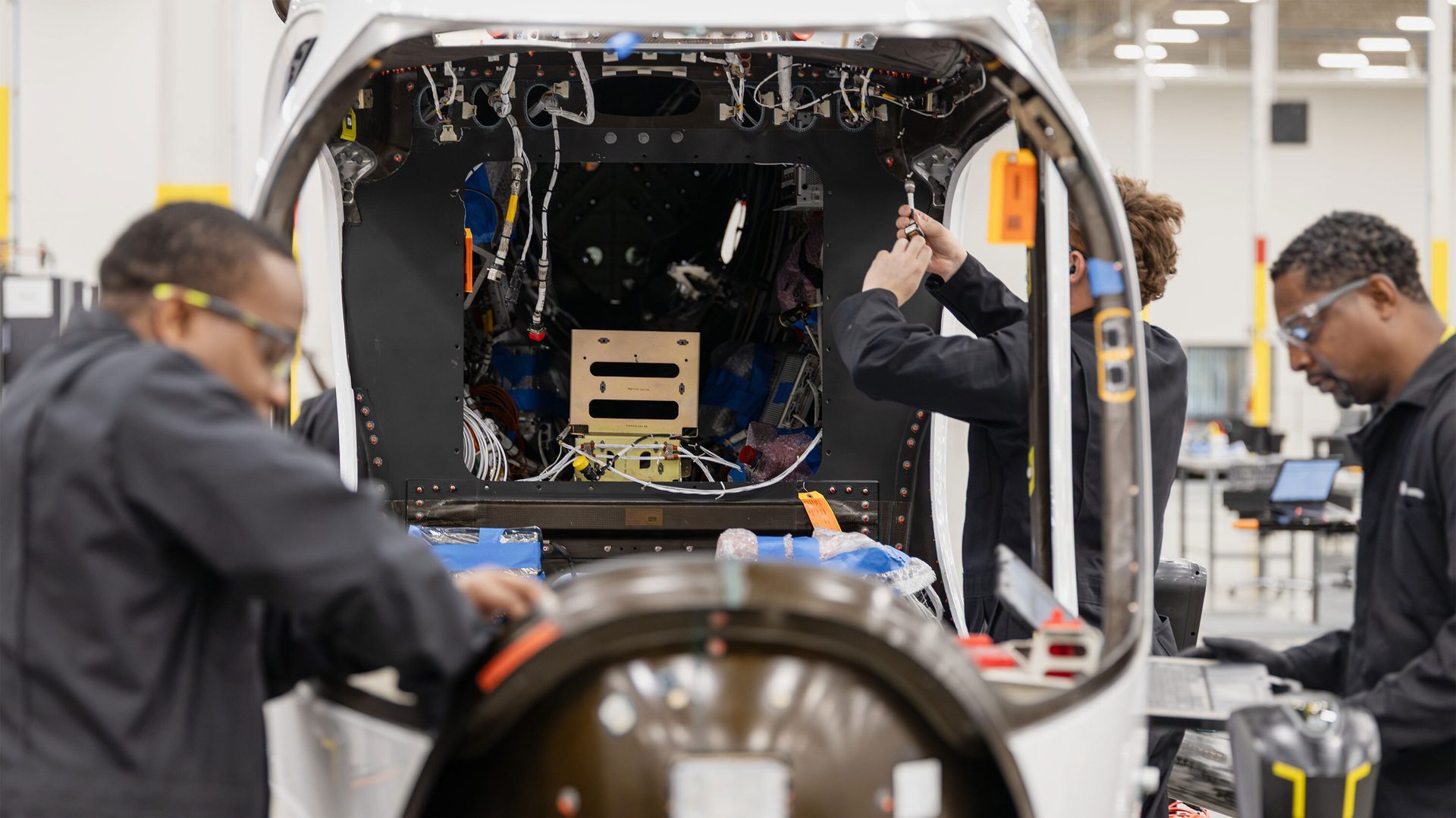
Archer is currently ramping up production of its Midnight air taxi at factories in California and Georgia. Photo courtesy Archer Aviation Inc.
Midnight is a piloted, four-passenger aircraft designed to perform rapid back-to-back flights with minimal charge time between flights. United Airlines will be one of Archer’s first customers, with a route between O’Hare International Airport and downtown Chicago.
Archer is working with Stellantis on a strategic partnership in which the automaker serves as a contract manufacturer to mass-produce the air taxi. Under the agreement, Stellantis is providing advanced assembly technology and manufacturing expertise to achieve a goal of scaling up to 650 aircraft annually by 2030.
Earlier this year, Archer began tooling a 400,000-square-foot facility it refers to as ARC in Covington, GA. It expects to be able to produce two aircraft per month by the end of this year at the facility.
Archer also operates a smaller facility in Santa Clara, CA, where its R&D center is located. The building houses a high-volume battery pack manufacturing line. The “automotive style” line is capable of producing up to 15,000 battery packs per year.
Archer has applied automation in key areas of the battery pack manufacturing process to improve quality, operator safety and data traceability. This includes cell test and load, adhesive dispensing, laser cleaning, laser welding and end-of-line testing.
In addition, Archer recently acquired key composite manufacturing assets and a 60,000-square-foot mnufacturing facility in Huntington Beach, CA, from Mission Critical Composites, a defense contractor.
“These assets allow [us] to bring core composite fabrication capabilities in-house, supporting [our] needs for rapid prototyping and iteration,” says Adam Goldstein, CEO of Archer.
“We are concurrently producing six Midnight aircraft, three of which are in final assembly across our facilities,” explains Goldstein. “We are building these across our ‘golden manufacturing line’ in Silicon Valley and our high-volume facility in Georgia.
“We continue to be focused in the near term on ramping our production capabilities to achieve a rate of 50 aircraft per year across more than 700,000 square feet of manufacturing and test facilities,” adds Goldstein. “We are using the lessons from the final assembly activities at our Silicon Valley [site] to inform the design and ramp of our high-volume manufacturing operations in Georgia.
“We strategically designed our facility in Covington, GA, with the ability for expansion to support long-term output goals,” Goldstein points out.
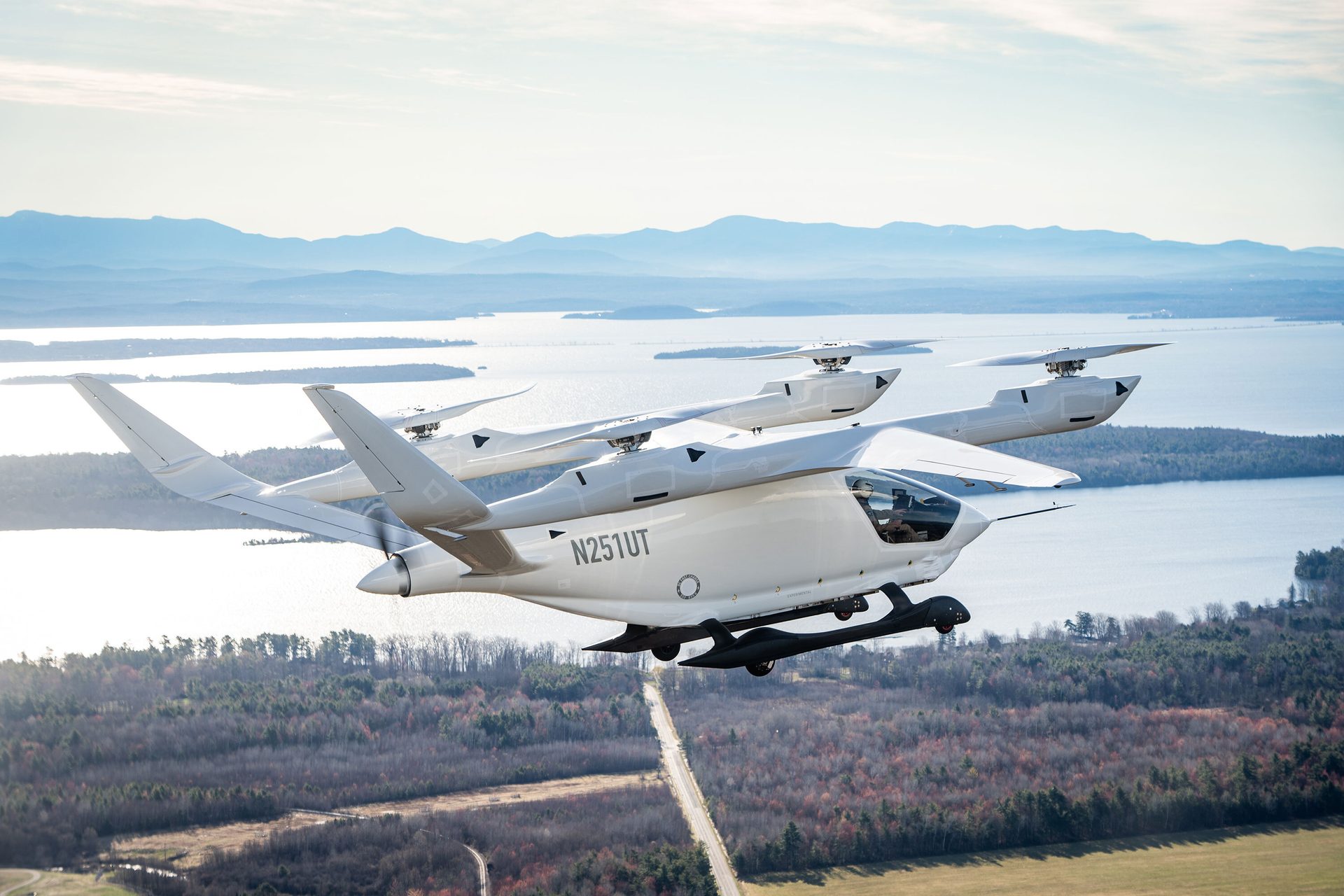
Beta Technologies has been assembling its five-seat battery-powered aircraft in Vermont since 2023. Photo courtesy Beta Technologies Inc.
The Future Is Now
Beta Technologies Inc. opened a 188,000-aquare-foot factory in South Burlington, VT, in 2023 to build the Alia. Customers for the five-seat battery-powered aircraft, which features a 50-foot-wide wing, range from Air New Zealand to UPS. Four 600-volt electric motors power its two-bladed lift propellers.
In addition to building eVTOL and conventional takeoff models of the plane, Beta is assembling battery packs and charging stations at the facility. According to Kyle Clark, CEO, it is “the first full-scale production facility for advanced air mobility (AAM) aircraft in the U.S. [It] is capable of producing up to 300 aircraft per year, once we’ve ramped to full capacity.
“There are also many unique, efficiency and people-first design choices we made in building and bringing this facility online,” claims Clark. “We’re marrying the rigorous quality and intake process required in aerospace with AI and other technology to create a smart function that will help us track every part that enters the building.”
The factory features a massive skylight, windowed hangar doors and specialized lights that help assemblers adjust their circadian rhythms. Sustainability features include a 40-gallon tank for rainwater capture and geothermal wells for heat management.
“Because [we] manufacture so many core enabling technologies in-house, we’ve elected to assemble all production parts and technologies at our factory,” says Clark. “This includes the electric engines and flight controls systems, as well as ground support equipment This [ensures] streamlined parts intake, high quality control and efficient assembly.
“Our production process is based around a pulse line, with several distinct assembly bays where specialized teams collaborate to advance the aircraft system by system down the production line,” explains Clark. “It’s a really efficient way for assembly technicians to perfect their roles within the broader system, and for us to keep the process simple, efficient and organized.
“[This has] allowed us to ramp up quickly and safely, with five airworthy aircraft coming off the line over the past several months,” Clark points out.
“We use a careful blend of automation and manual processes in production,” claims Clark. “Our battery line, for instance, has several automated machines that provide a first and last check of each individual cell.
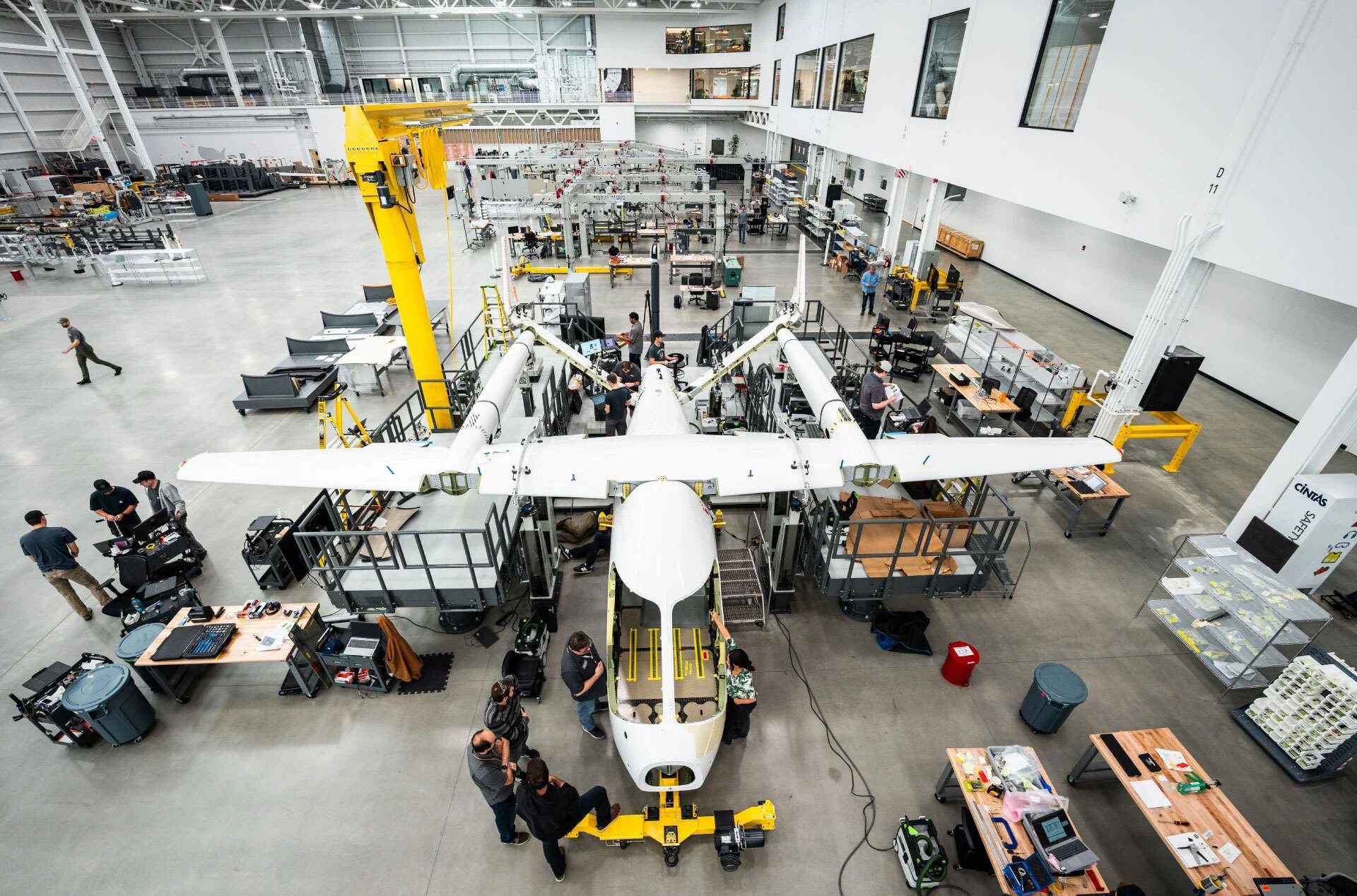
Beta operates a vertically integrated facility that builds batteries, electric engines, flight control systems in-house and ground support equipment in-house. Photo courtesy Beta Technologies Inc.
“The first automated machine examines every single battery, scanning for damage, issues or irregularities before passing it along to our battery assembly technicians, who perform a second manual check, and move the batteries through the configuration process.,” says Clark. “Once the batteries have passed through several checkpoints along the line, they are deposited — as a pack — into another automated machine that bonds the pack together.”
Joby Aviation Inc. is another leading player in the race to build air taxis. Its aircraft is designed to transport a pilot and four passengers at speeds of up to 200 mph, with a maximum range of 100 miles. The start-up plans to operate an aerial ridesharing network through partnerships with Delta Air Lines and Uber.
In addition, Toyota has invested almost $1 billion in the vertically integrated company and has formed a strategic alliance focused on manufacturing.
“Toyota engineers are deeply integrated with the Joby team, providing counsel to support [our] work across design, manufacturing and quality,” says Eric Allison, chief product officer. “Toyota also helps [us] optimize processes, streamline assembly and offer advice related to the development of custom tooling to accelerate production.”
Joby recently completed a major milestone with its first flight between two public airports. During the test, the aircraft successfully integrated with commercial air traffic. The 10-mile flight occurred between Monterey, CA, and Marina, CA, where the company’s R&D facility and pilot production plant are located. Joby also operates a facility in San Carlos, CA, that specializes in developing power train and electronic components.
Earlier this year, Joby expanded the Marina site to 435,000 square feet. Once fully up and running, it will be able to produce up to 24 aircraft a year. The facility will also support FAA production certification, testing, pilot training and maintenance.
According to Allison, vertical integration helps Joby speed development, ensure quality, and streamline testing and certification. “In Marina, we focus on composites fabrication, airframe assembly and overall aircraft final integration,” he points out. “This allows for a level of efficiency that traditional aircraft manufacturers, with more complex supply chains, can’t match.”
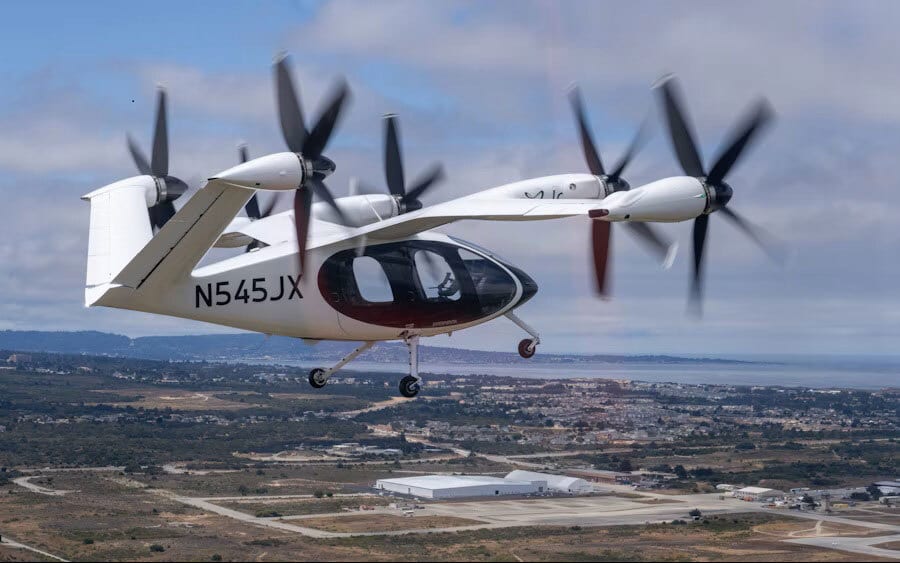
Joby recently completed a major milestone with its first flight between two public airports in California. Photo courtesy Joby Aviation Inc.
Joby is also in the process of ramping up a $500 million factory in Dayton, OH, the home of the Wright brothers and the site of the first airplane factory in the U.S. The company has been retrofitting a former U.S. Postal Service facility with tooling and equipment. Joby Manufacturing Ohio will initially produce small, high-volume components until its air taxi receives FAA certification and is ready for large-scale production.
“Dayton will support our pilot production line and is designed to scale, eventually building up to 500 aircraft a year,” says Didier Papadopoulos, president of aircraft OEM at Joby. “[We are] using our existing California operations in Marina and San Carlos to learn and test new workflows so that, as we scale, we do so as efficiently as possible.
“We are leveraging advanced simulation tools to design our factories,” explains Papadopoulos. “These tools enable us to visualize and optimize the layout, workflow and ergonomics of our manufacturing processes before physical implementation.
“By using these technologies, we can identify potential bottlenecks, streamline operations, and optimize our facilities to improve efficiency and productivity,” claims Papadopoulos.
Wisk Aero LLC is a Boeing subsidiary that is developing an autonomous four-passenger air taxi equipped with 12 tilting propellers powered by electric motors. It is designed for vertical takeoff and landing in dense urban areas.
The company is based in Mountain View, CA, but has been rumored to be interested in setting up a factory in the Phoenix area, where Boeing already has facilities that assemble helicopters and fabricate advanced composites.
However, according to a Wisk spokesperson, “We are not operating in Arizona. For the near future, we will continue production in our Bay Area facilities and share more details about scaled manufacturing when ready.”
Wisk recently embarked on a five-year project with NASA to develop traffic management systems for air taxis and other types of AAM applications. The goal of the R&D initiative is to enable autonomous aircraft to operate safely in congested airspaces.
Honda engineers are also developing an air taxi, but the company has been tight-lipped on its progress. If and when it goes into production, a logical production site would be the Honda Aircraft Co. factory in Greensboro, NC. That’s where the HondaJet has been produced since 2015.
Greensboro has already become a hotbed for aircraft manufacturing, attracting start-ups such as Boom Supersonic and JetZero.
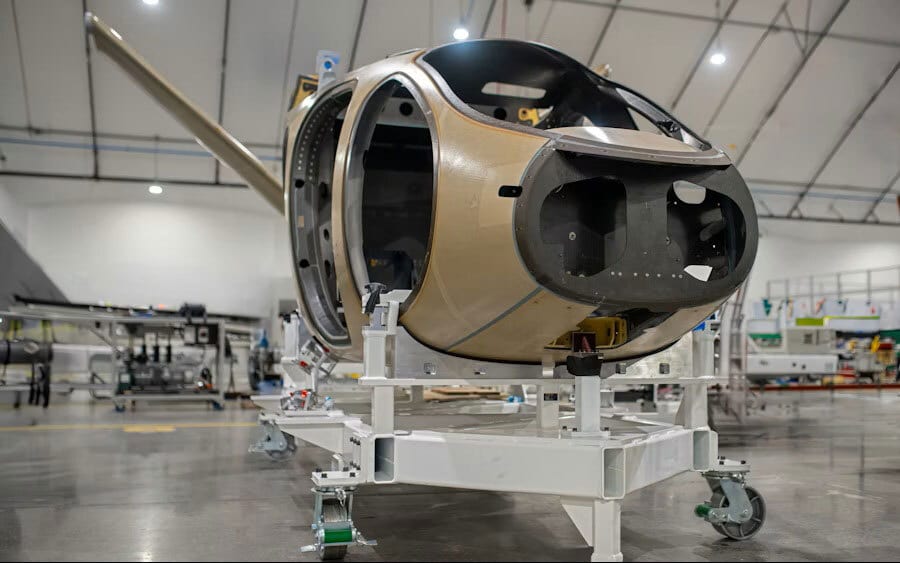
Toyota engineers are helping Joby optimize production processes and streamline assembly lines. Photo courtesy Joby Aviation Inc.
Blended-Wing Bodies
Another next-generation design that intrigues aerospace engineers is the blended-wing-body (BWB), which is radically different than today’s tube-and-wing airplanes. Blending the wing, body and tail into a single, smooth airframe can generate a 30 percent reduction in fuel consumption.
One start-up leading the way is JetZero Inc. Its Z4 is a 250-passenger airplane designed to transform commercial aviation through fuel efficiency and cutting-edge engineering. The company claims that its design will provide an elevated passenger experience due to a special interior and innovative seating arrangements.
Alaska Airlines, Delta Air Lines and United Airlines have invested in JetZero and ordered planes. In addition, the U.S. Air Force has expressed an interest in several military variants.
They’re all attracted to an innovative design that promises 50 percent less fuel burn and lower emissions than traditional jetliners. That’s because the BWB reduces drag and produces lift across the entire wingspan.
“The biggest challenge for airlines is lowering fuel burn and emissions,” claims Tom O’Leary, CEO of JetZero. “Of all the great new technologies in work, the BWB design delivers the biggest impact by far. Airlines will see immediate benefit in cost savings compared to airplanes flying today.”
JetZero recently announced plans to build a state-of-the-art factory in Greensboro, NC. The facility will eventually be capable of producing up to 20 airplanes per month.
JetZero is taking a clean-sheet approach to designing and building the assembly plant. For instance, it has partnered with Siemens to simulate production, using digital and industrial AI tools to maximize efficiency.
“Every plane built will have a digital thread with full traceability to every sourced part and component,” says Dan Da Silva, president and chief operating officer of JetZero. “A digital twin will provide full visibility into manufacturing performance and efficiency to provide accurate real-time data for each particular line number.
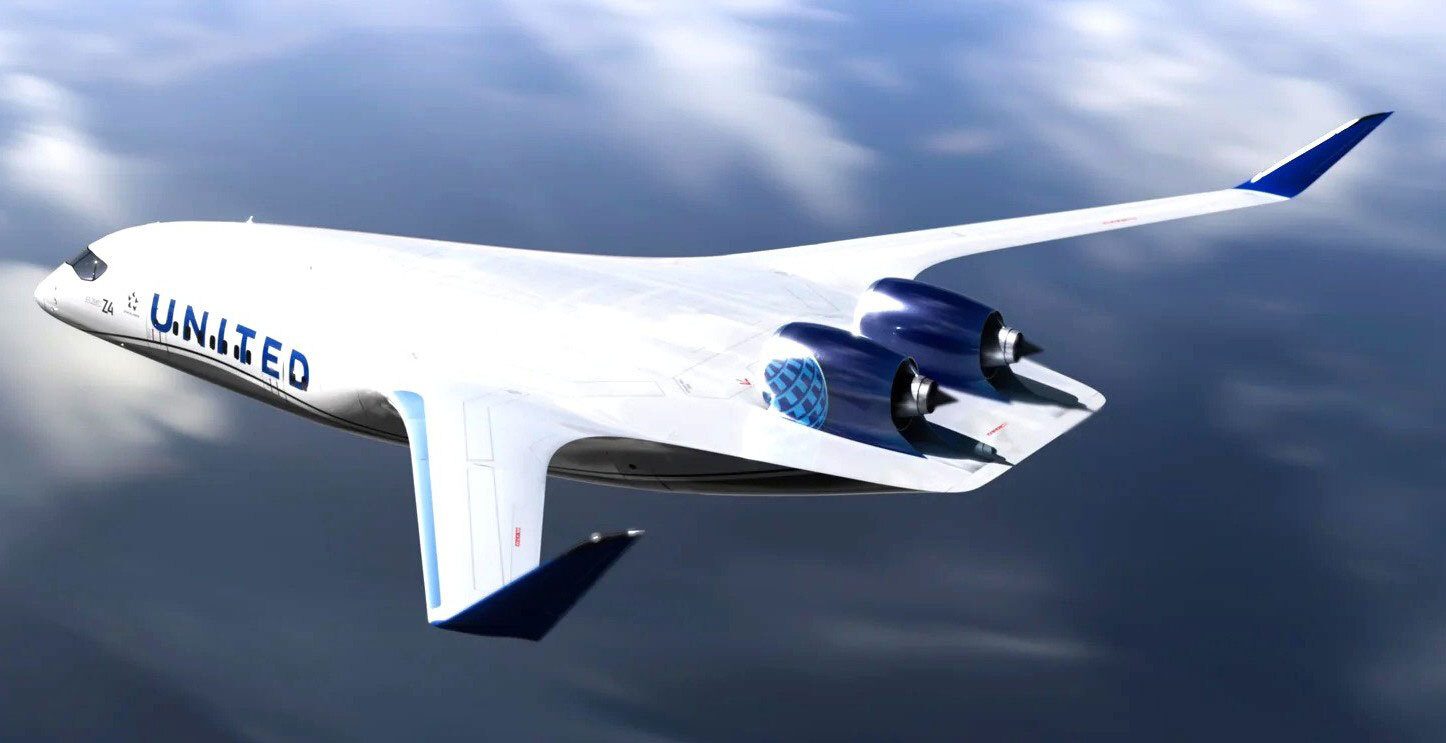
Blending the wing, body and tail into a single, smooth airframe can generate a 30 percent reduction in fuel consumption. Illustration courtesy JetZero Inc.
“[Our facility] will accommodate both structural parts manufacturing and final assembly,” notes Da Silva, a former Boeing engineer. “Unlike a tube-and-wing airplane factory, our Z4 is wider and shorter. The plant layout will reflect this—particularly the final assembly line.
“The Greensboro factory will be built in three phases, minimizing initial costs while growing in size to accommodate increases in production rate,” Da Silva points out. “The facility will be designed for modularity and flexibility.
“Our manufacturing engineering team is currently laying out the processes and equipment that we will use in our factory,” says Da Silva. “[Our production] processes will be tested in a digital environment, allowing us to optimize them before we even start construction on our first building.
“We will most likely utilize a linear line for final assembly and workcells for subassemblies where it makes sense,” notes Da Silva. “The factory will [use] automation to ensure productivity, as well as safety and quality control. [It will feature both] high-tech and high-touch manufacturing.”
Natilus Inc. is another start-up that plans to produce a family of aircraft with a BWB configuration. In addition to passenger versions, the company is developing planes for air freight applications using a patented cargo configuration that allows for higher volume than traditional alternatives, such as the Boeing 747 and 777.
For the same weight of tube-and-wing aircraft, the plane will transport more than twice as much revenue cargo for the same trip, lowering costs by 60 percent and reducing emissions by 50 percent. The planes will use existing ground infrastructure and standard air cargo containers.
Natilus is in the process of building its first aircraft at a facility near San Diego. The Kona is designed for short-haul cargo operations, with a payload capacity of 3.8 metric tons and a range of 900 nautical miles.
“We are currently working to identify a U.S. manufacturing site that can accommodate a production facility for our regional Kona freighter,” says Aleksey Matyushev, CEO of Natilus. “[It also will have] the capacity to build a second, much larger production facility for our 240-passenger plane, the Horizon.”
With the Horizon, Natilus hopes to revolutionize commercial aviation and directly challenge industry leaders like the Airbus A320 and the Boeing 737 Max. The aircraft is designed to be compatible with existing airport gate configurations.
“When selecting a site, we are factoring in the local labor force, power requirements, proximity to suppliers and transportation, and strategic developer partnerships.
“The first facility is expected to be operational in three years to align with the expected culmination of the Kona flight test program and FAA Part 23 certification,” explains Matyushev. “[It] will be 250,000 square feet and will be capable of producing up to 60 aircraft per year. Our phase two facility will be 2.75 million square feet and should be operational in the early 2030s.
“The assembly lines will be laid out in a linear fashion, similar to what automotive and current aviation practices mimic,” says Matyushev. “We have some interesting ideas about novel approaches to manufacturing that can automate certain processes, but we’re keeping those under wraps at the moment. Unfortunately, we do not believe in humanoid robots in aerospace manufacturing just yet.”
Natilus recently announced a partnership with Palantir that should enable it to move faster and more efficiently through the production, procurement and engineering process.
“Palantir’s insights with AI and data collection [will help] reduce the amount of time our engineers spend on workflows,” claims Matyushev. “With visibility into the flow between design, development and the manufacturing floor, we can identify challenges that will help us maintain a better relationship with our supplier base.
“We will incorporate AI-driven data, analytics and modeling to drive real-time decision making and enhance our manufacturing facility,” says Matyushev. “By incorporating cutting-edge technologies, we hope to improve manufacturing efficiencies and employ economies-of-scale.”
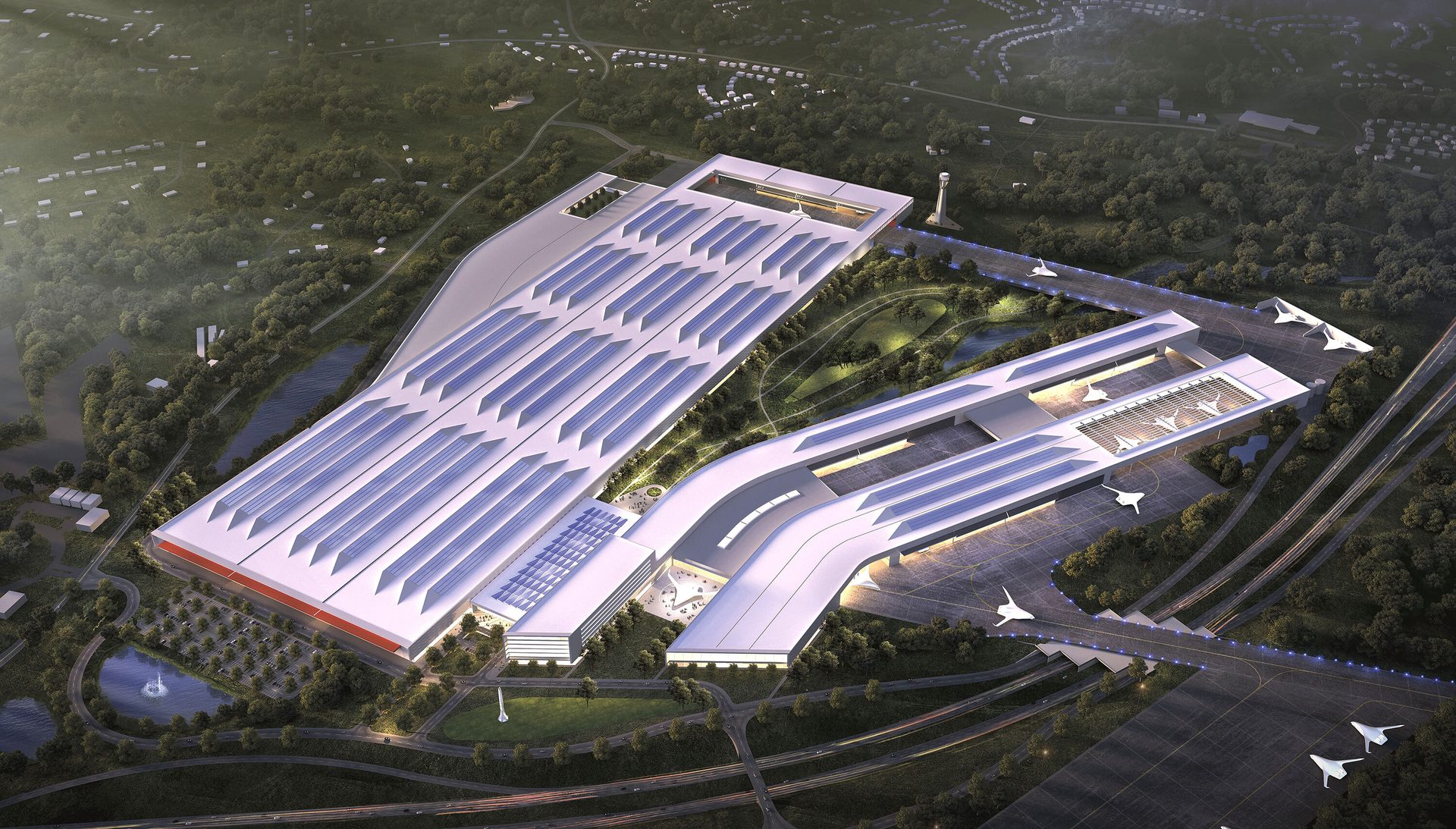
JetZero is in the process of building a factory in Greensboro, NC. Illustration courtesy JetZero Inc.
Supersonic Boom
Because the Concorde last flew in 2003, many people consider supersonic air travel to be a thing of the past. But, several start-ups hope to flip the script with next-generation designs.
Boom Technology Inc. (Boom Supersonic) is leading the charge. The company has already received orders from American Airlines, Japan Airlines and United Airlines for a 199-foot-long plane called the Overture. By the end of this decade, it plans to start producing the aircraft, which will carry 65 to 80 passengers at twice the speed of existing commercial jetliners.
Boom’s 400,000-square-foot Superfactory in Greensboro, NC, which opened in June 2024, will start assembling its first plane sometime next year. The plant has the capacity to produce 33 Overture aircraft per year. The company also plans to add a second assembly line by 2034.
“Currently, we are focused on finalizing the layout for the production floor and workstations to ensure optimal material movement and tool location,” says Blake Scholl, CEO of Boom Supersonic. “The assembly line utilizes a linear floor plan with four stations.
“To ensure safe operation at supersonic speeds, we need to be especially focused on the quality of the aircraft,” Scholl points out. “The tooling and controls we will use to build Overture are the most up-to-date versions of existing technology.
“Our tooling system from Advanced Integration Technology (AIT) is designed to provide us with precise positioning of all the structural sections, control steps into the airstream and gaps in the joints,” claims Scholl. “The drilling machine will allow us to monitor and control hole quality to minimize protrusions of fasteners into the airstream that could cause excess drag.”
AIT will provide an end-to-end system for the Superfactory, creating mobile transport equipment and positioning tools for fuselage assembly, wing assembly, wing-to-fuselage joining and final assembly.
“[We] will leverage automation at the Superfactory to increase efficiency and reduce costs,” says Scholl. “AIT is designing an automated positioning system for us that will replace hard tooling. We will use automation to drill all the holes that join the fuselage sections together.
“All stations will be operated by manually guided vehicles, which [will] greatly reduce the need for overhead cranes and other expensive equipment,” notes Scholl. “[They] will move large sections of fuselage and wing around the shop, and move the engines into place.”
Boom also plans to use a state-of-the-art manufacturing execution system (MES) to ensure product quality.
“[Assemblers] will have easy access to the engineering models on the shop floor and inside the aircraft,” says Scholl. “We’ll be able to provide detailed work instructions and incorporate augmented reality into the build process.
“Automatic data collection from our tools into the MES will allow us to monitor the build as it progresses, as well as analyze data from previous builds to track and correct variations more quickly,” concludes Scholl.
ASSEMBLY ONLINE
For more information on innovative aircraft designs, visit www.assemblymag.com to read these articles: