MONTH 2023

Assembly Presses
Labor shortages are driving new demand for automation.
Options for Screwfeeding
Grundfos pumps can be found in factories making food and beverages, pharmaceuticals and semiconductors. Photo courtesy Grundfos
Pump manufacturer increases efficiency with programmable press.
Servo Hydraulic Press
Saves Energy
Tracy Howard // Operations Manager // AP&T North America Inc. // Monroe, NC
Founded in 1945, Danish company Grundfos is one of the world’s leading manufacturers of pumps. Manufacturing more than 16 million pumps each year, the company is represented in more than 60 countries and employs some 20,000 people.
Grundfos circulator pumps are used for heating, ventilation and air-conditioning systems in homes, office buildings and hotels. In industry, the pumps can be found in factories making food and beverages, pharmaceuticals and semiconductors. Grundfos water pumps are used for irrigation, green houses, municipal water systems, and sewage treatment plants. The company’s pumps are also the power behind fire sprinkler systems in countless buildings.
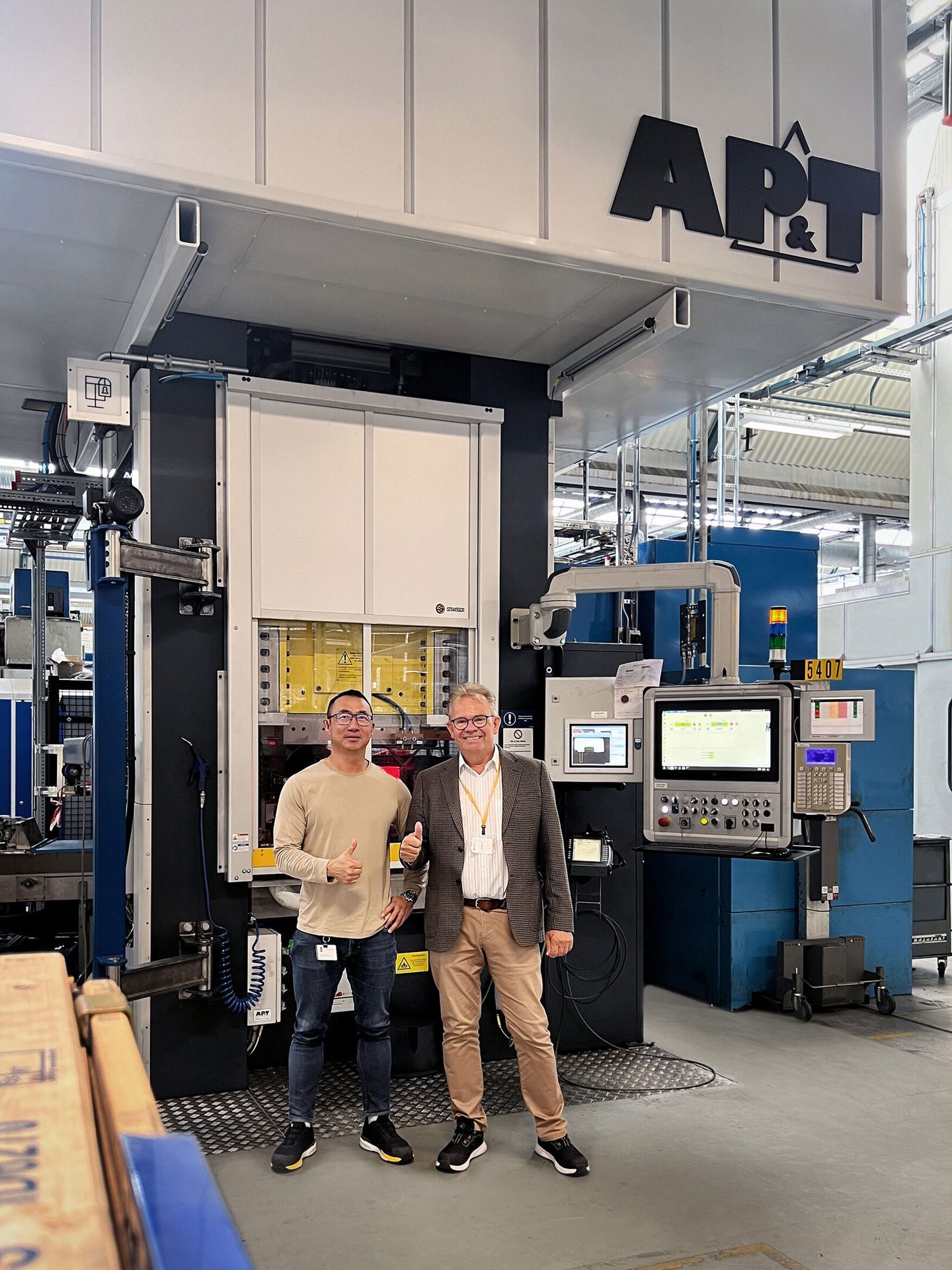
Peter Lund Pedersen from Grundfos (left) and Peter Karlsson from AP&T celebrate the installation of a one-of-a-kind servo press system they developed jointly. The system consumes 85 percent less energy per stroke than the previous press. Photo courtesy AP&T
When Grundfos wanted to modernize how it produced certain metal parts for its pumps, energy efficiency, high repeatability and programmability were among the principal requirements. The company collaborated with press manufacturer AP&T to jointly develop a world-first hydraulic press system that is now operating at Grundfos’ assembly plant in Bjerringbro, Denmark.
“As far as we know, there is nothing like it anywhere else in the world,” says Peter Karlsson, key account and area sales manager at AP&T. “The press is fully programmable, can control the respective motor and pump for each cylinder, and has amazing precision due to its ability to synchronize 4,000 times per second. We could hardly believe the numbers when we first looked at the metrics.”
Grundfos project manager Peter Lund Pedersen describes the initiative as an important strategic step in the company’s sustainability work. “Our goal was to future-proof cold-flow forming with stable and energy-efficient technology,” he says. “We initially considered a control system overhaul, but when we saw the potential energy savings and process benefits of a new servo hydraulic press from AP&T, the decision was easy.”
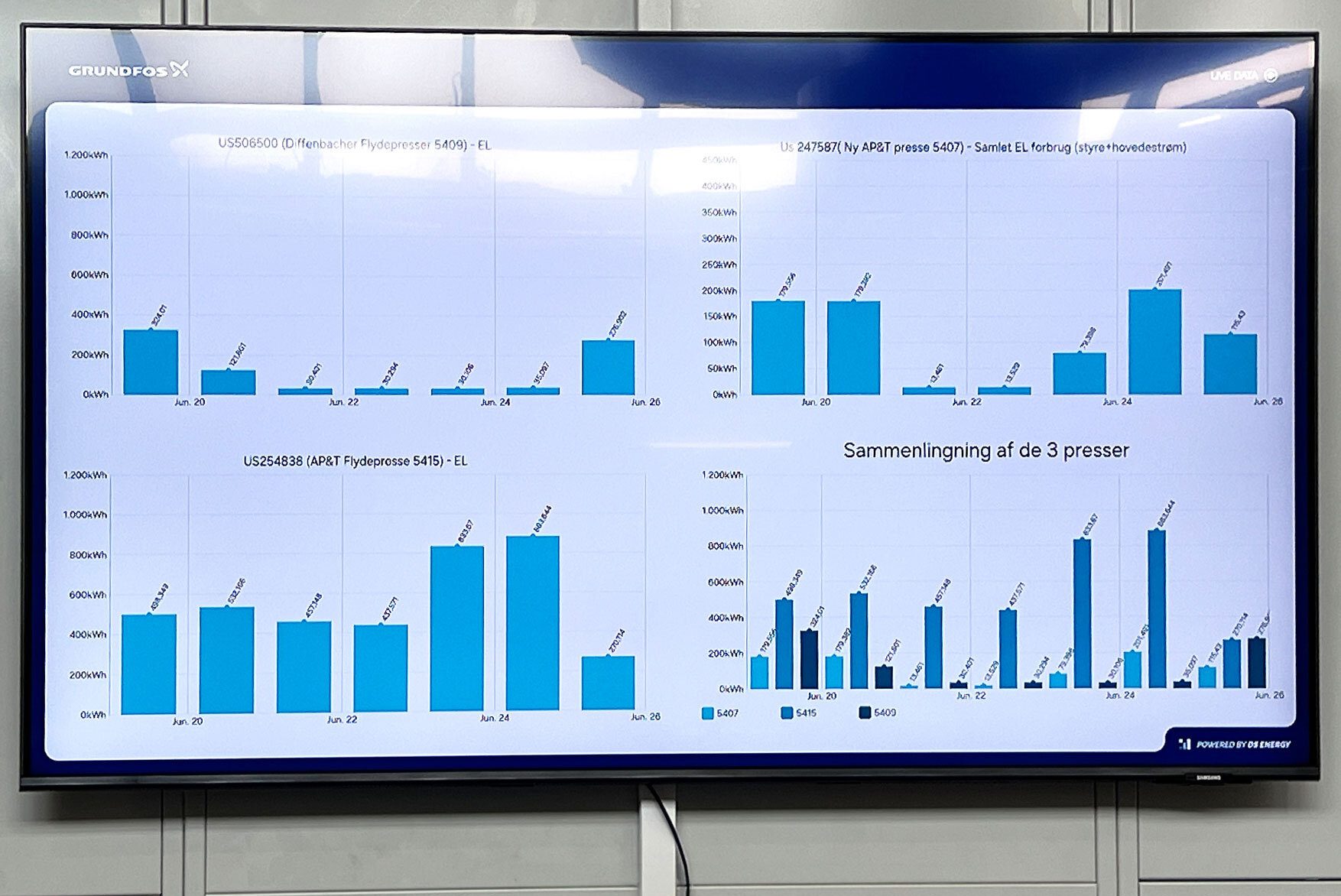
Operators can monitor the energy consumption of the press in real time on a large display screen. Photo courtesy AP&T
50 Years of Experience
Grundfos has been working with AP&T since the 1970s. Their relationship has played a crucial role in developing several technical innovations, some of which are the only ones of their kind.
“Grundfos is a demanding customer, in the best possible way!” says Karlsson. “Over the years, the company’s needs have helped us develop technology that has then found applications in other industries. Our collaboration has been a driving force in our technological development.”
“What makes our partnership so successful is the shared willingness to test new methods and our open dialogue,” adds Pedersen. “We maintain a good and open dialogue and have always had a strong consensus on the development of new production technologies.”
The new servo hydraulic press is integrated into an automated line with two other machines from AP&T. All are connected to a visualization system that shows energy consumption in real time, both machine by machine and for the entire process.
The press consumes significantly less energy than older machines. In fact, it’s 10 times more efficient than the old presses. “It makes it very clear that these are true energy savings on a large scale,” says Karlsson.
An HMI displays the energy data in real time during production. “This visualization has taken on an important function in our work,” explains Pedersen. “We use it to quickly detect deviations and drive improvements. It delivers a strong visual impact, especially compared to the older presses. We have an internal ‘green team’ that actively works to identify energy savings.”
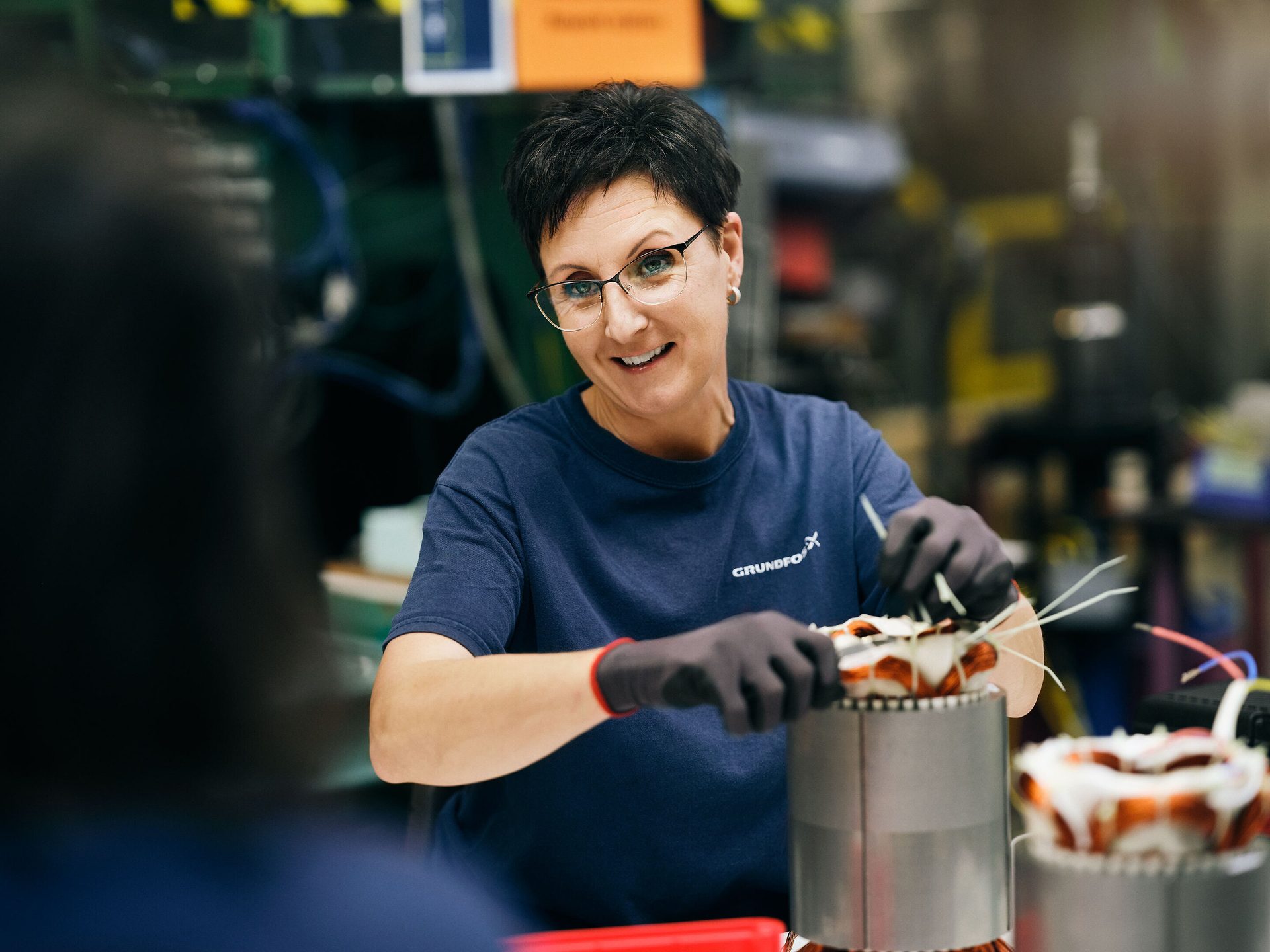
Grundfos makes more than just pumps. It also makes the electric motors that power them. Photo courtesy Grundfos
Inspection System
Programming Freedom
Another key feature of the press is its programmability. Operators can control and adapt pressures, sequences and cycles themselves, without the need for external programming.
“We have never seen such a flexible solution for cold-flow forming anywhere in the world. It saves an enormous amount of time and boosts production capacity,” says Karlsson.
Noise emissions have also been reduced. At only 67 dBA during operation, the press contributes to a quieter and more comfortable working environment. “Minimizing noise is always a goal when we invest in new equipment. The new press has brought a marked improvement to the working environment,” says Pedersen.
Cybersecurity has become increasingly important as digitalization expands. AP&T’s recent ISO 27001 certification has therefore been an important criterion for Grundfos. “We require our suppliers to meet applicable security standards, especially when it comes to IT security. It’s a given today,” says Pedersen.
The servo press is now in operation, and the early results have lived up to expectations in terms of both technical performance and energy efficiency.
“There is always a certain breaking-in period with new technology, but the machine is now up and running in stable production. The precision, noise level and energy consumption are exactly as we hoped,” says Karlsson.

However, Pedersen emphasizes that the real effects will become apparent in the longer term.
“The most obvious result so far is the significant energy savings, especially in comparison to the previous press. We will only be able to assess other results once we have had the press in operation for a longer period. But even now, my clear opinion is that we have absolutely made the right decision, both in terms of choice of press and choice of AP&T as a supplier,” he says.
For more information on presses, visit https://aptgroup.com.