By Austin Weber, Senior Editor// webera@bnpmedia.com
Additive Manufacturing Enables Mass-Produced Drones
INDUSTRY INSIGHT
A new facility near Detroit specializes in heavy-duty metal structures.
Drones are increasingly used for civilian applications. Photo courtesy Stratasys
Drones have dominated the news recently. Everywhere from the war in Ukraine to the Winter Olympics in Italy, unmanned aerial vehicles (UAVs) have attracted a large amount of attention.
Drones are small, lightweight aircraft with a fixed wing or multiple rotors that can be operated remotely or autonomously. While gas engines are used for some applications, the machines typically operate with batteries and electric motors.
The aircraft are widely used by the military for gathering aerial intelligence, reconnaissance and surveillance, in addition to carrying out precision strikes on targets.
Aside from strategic military missions, drones are increasingly used for civilian applications ranging from agricultural monitoring and package delivery to emergency response and filmmaking.
Because of rapid adoption rates and technological advancements, the drone market is projected to grow more than 16 percent annually over the next decade, surpassing $191 billion by 2035.
As drones move from experimental platforms to mission-critical aerospace systems, the real challenge isn’t autonomy or software. It’s mass-production.
To meet unprecedented demand, drone manufacturers are increasingly turning to additive manufacturing to produce airframes, housings and flight-critical components. They’re using the technology to address design, durability and weight constraints that traditional manufacturing struggles to meet quickly at high volumes.
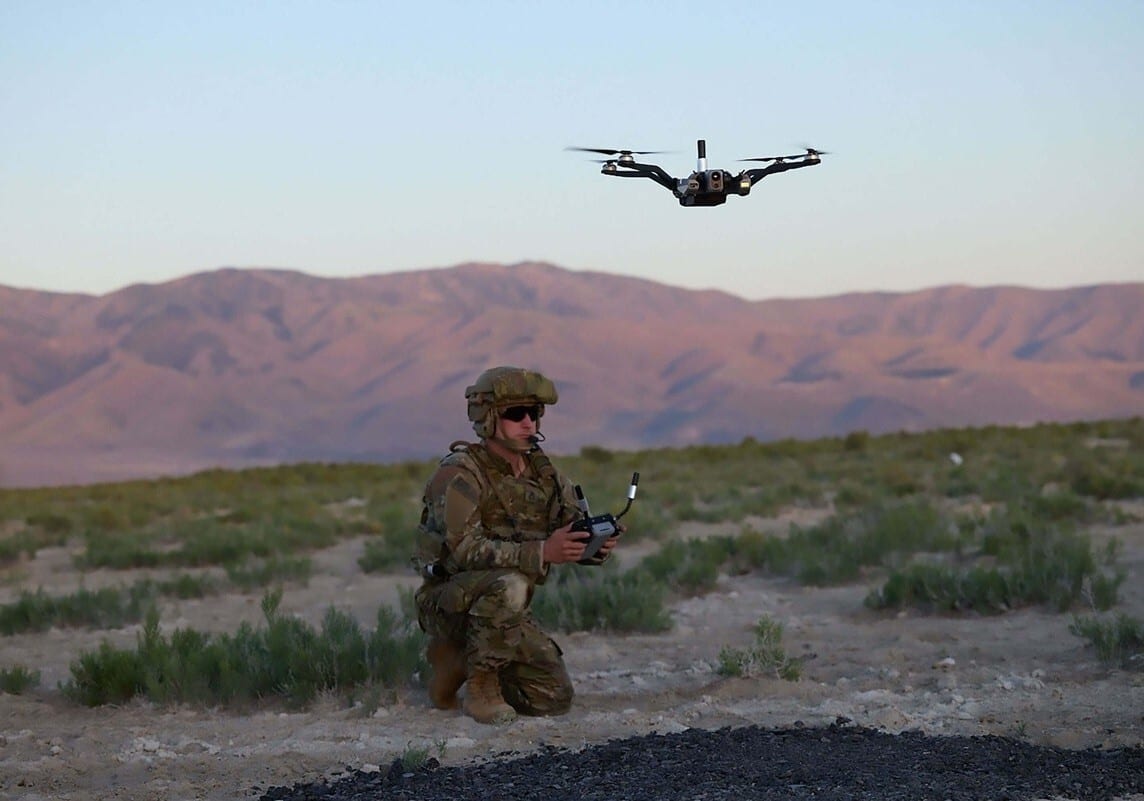
Unmanned aerial vehicles are used by the military for gathering aerial intelligence, reconnaissance and surveillance. Photo courtesy U.S. Army DEVCOM Army Research Laboratory
One of the companies at the leading edge of industrial 3D printing is Stratasys. It specializes in printers, materials and software, in addition to manufacturing services. Stratasys systems include digital light processing (DLP,) fused deposition modeling (FDM), powder bed infusion (SAF) and stereolithography technology.
Last year, Stratasys experienced double-digit annual revenue growth from the aerospace and defense sector, “demonstrating that additive manufacturing is becoming a key capability for sustainment and supply chain resilience,” says Foster Ferguson, vice president of the industrial business unit at Stratasys.
“The U.S. Army uses our SAF technology to scale drone production, and we've partnered with companies like Roush Performance to produce thousands of parts in production volumes,” explains Ferguson. “What sets us apart is the ecosystem, which covers everything from materials to software to as-needed production services.”
Autonomous and Electric Mobility recently asked Ferguson to explain why additive manufacturing will continue to play a key role in the future growth of the drone industry.
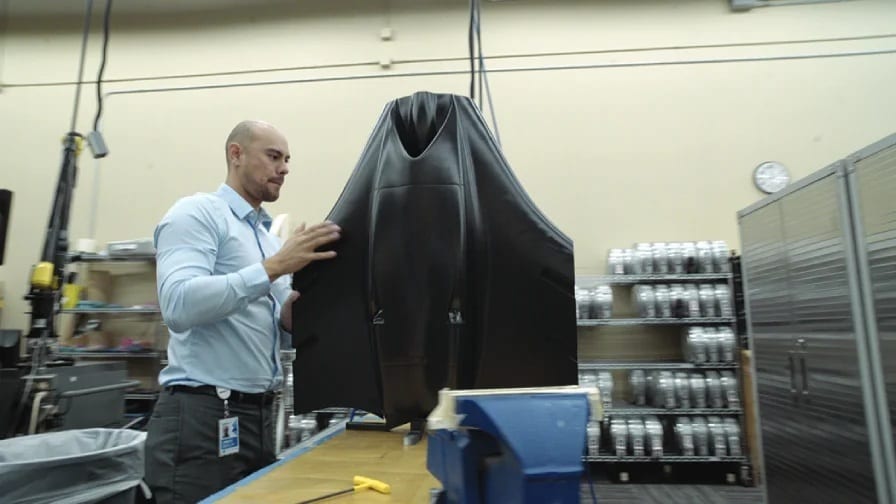
This drone fuselage was produced with additive manufacturing technology. Photo courtesy Stratasys
AEM: How has the commercial drone industry changed in the last few years?
Ferguson: The industry has seen a great expansion due to the massive advances made in drone technology during the Russian-Ukrainian conflict. Our customers supporting this [war] must deliver capabilities that keep up with constant iterations that are being made by the Ukrainian military. These demands for rapid designs transfer over to the commercial industry.
This has helped [companies] evolve from prototyping to production-scale manufacturing, with additive manufacturing playing a central role in this transformation. We've supported companies as they move from one-off experimental builds to deploy mission-critical UAV fleets for defense, infrastructure inspection and logistics. The shift has been dramatic; manufacturers now need scalable production methods that maintain design flexibility without expensive retooling, which is exactly where additive manufacturing technologies excel.
AEM: What is the latest trend in drone technology?
Ferguson: Autonomous flight capabilities and mission-specific adaptability are driving drone innovation, and additive manufacturing enables both. Manufacturers leverage multimaterial printing to embed sensors and electronics directly during production, creating fully integrated systems rather than assembled parts. Advanced materials like ULTEM 9085, Antero 840CN03 and FDM Nylon 12CF allow drone makers to optimize weight, range and durability simultaneously. The ability to print complex, precise internal lattice structures and channels means drones fly longer and carry more payload.
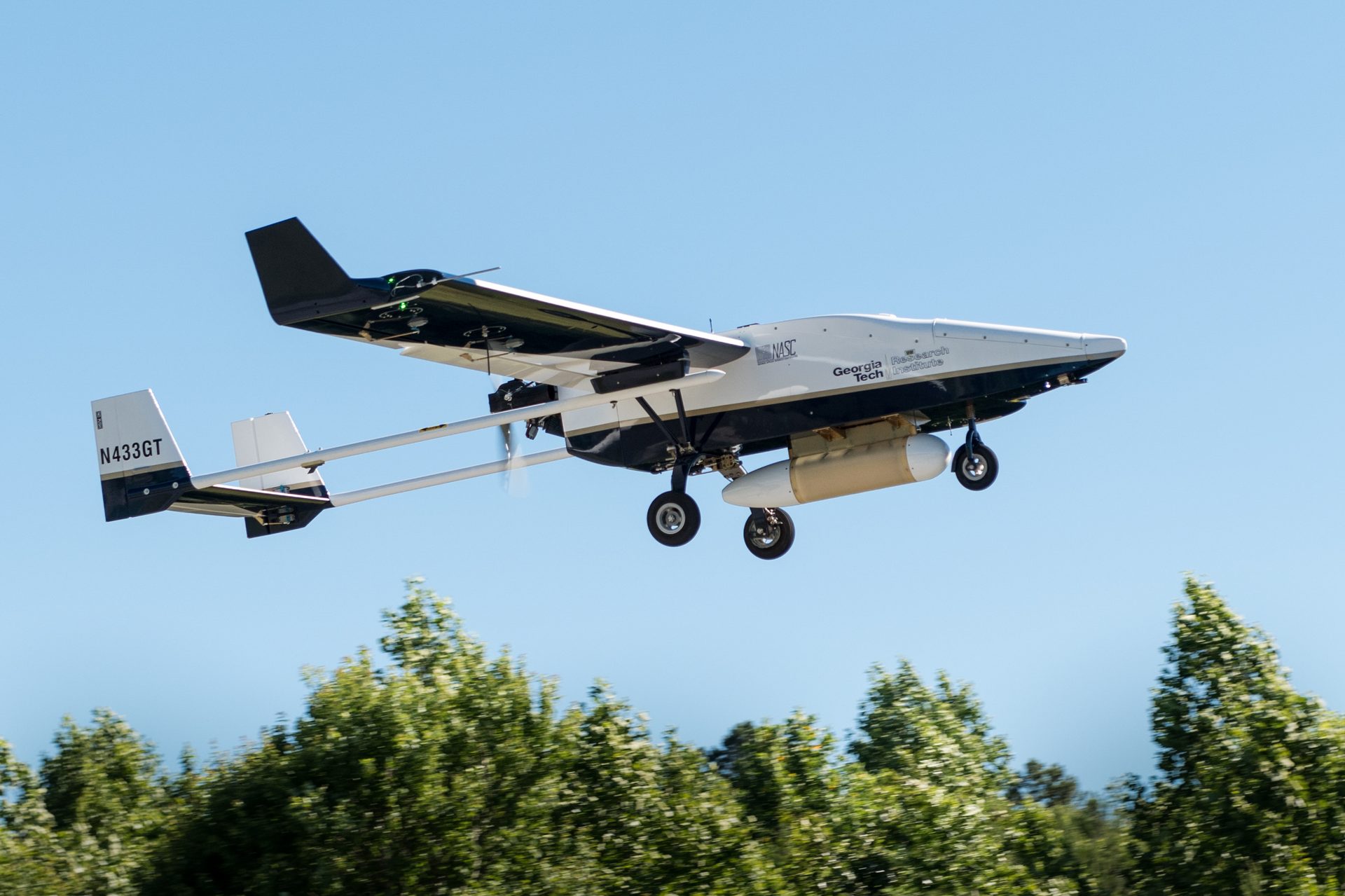
Fixed-wing drones can typically fly faster and longer than multiple-rotor aircraft. Photo courtesy Georgia Institute of Technology
AEM: What type of materials are commercial drones typically made out of today?
Ferguson: UAVs use advanced composites and high-performance thermoplastics that deliver strength at minimal weight. Stratasys has pioneered aerospace-grade materials specifically for UAV applications. They [have been] rigorously qualified with partners like the U.S. Air Force, Boeing and Northrop Grumman specifically for aerospace and defense applications, giving drone manufacturers validated, certified materials with documented properties and clear certification pathways.
AEM: Why are drone manufacturers rethinking production as volumes scale, requirements tighten and supply chains remain fragile?
Ferguson: There are several reasons. First, demand has exploded for drones and drone technology. Second, militaries are becoming increasingly cognizant of supply chain vulnerabilities from a security and fragility standpoint. These supply chain vulnerabilities and scaling challenges are forcing manufacturers to adopt additive manufacturing for localized, on-demand production. [Our] SAF technology has the ability to scale 100,000 drones in a year with low material costs that rival injection molding. [This enables] engineers to rapidly model and iterate drones for changing mission sets and emerging requirements.
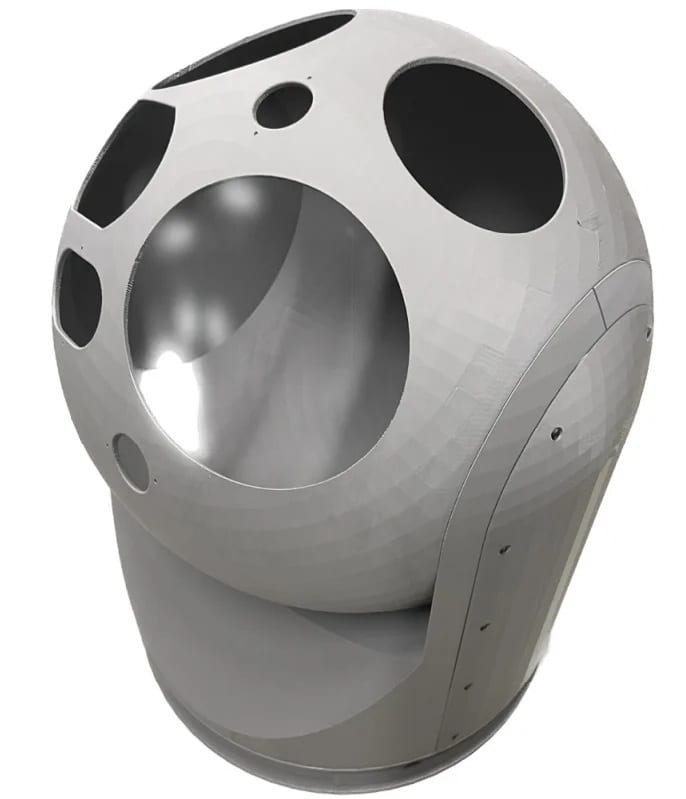
This drone camera housing was printed. Photo courtesy Stratasys
AEM: What type of production equipment are drone manufacturers looking for today?
Ferguson: Manufacturers need industrial-grade systems that deliver consistent quality from prototype to production without retooling. Multi-technology capabilities include large-format FDM printing for airframes, precision DLP technology for complex internal components and SAF systems for high-throughput production runs.
AEM: What are some of the challenges involved in mass-producing drones?
Ferguson: Mass-producing drones demands a balance of weight against strength while meeting strict aerospace certification requirements. Additive manufacturing addresses these challenges directly by reducing component weight while maintaining strength. The ability to consolidate dozens of traditionally assembled components into single printed parts eliminates fasteners, reduces weight and speeds assembly, while repeatable processes provide the full traceability defense and commercial applications require.
AEM: How does additive manufacturing help drone manufacturers move from low-rate initial production to scalable manufacturing without retooling their factories?
Ferguson: Additive manufacturing eliminates the fundamental barrier to scaling: production tooling. The same system that produces the prototype can also produce the end-use part. Design iterations happen in software that can take minutes to change and hours to implement, not expensive molds that take months to produce and ship. Whether a company needs 10 drones or 10,000, they’re using the same production process. This means manufacturers can respond immediately to urgent defense or commercial demands and customize each unit for specific mission profiles. They can replicate production capabilities at multiple locations or even deploy mobile manufacturing units without replicating tooling infrastructure.
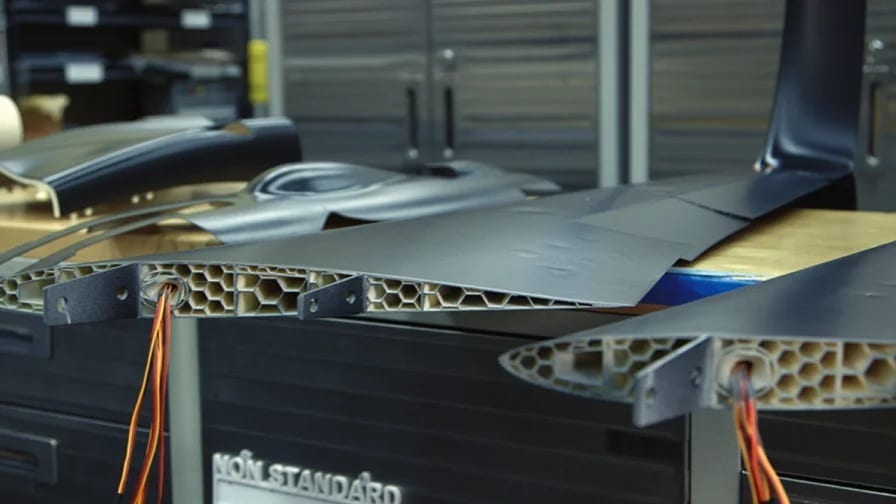
Additive manufacturing technology was used to produce this drone wing, which features a honeycomb structure to reduce weight. Photo courtesy Stratasys
AEM: How does additive manufacturing help drone manufacturers mass-produce lighter, stronger and more integrated drone structures to improve range and payload efficiency?
Ferguson: Software enables engineers to create new designs, determine part strength and test final output for inconsistencies. For example, internal lattice structures can provide strength exactly where it’s needed while minimizing weight everywhere else. We're printing complete fuselage sections as single parts, rather than the legacy approach involving dozens of assembled components that require fasteners and pose potential failure points.
Multimaterial printing allows precise material placement, rigid structures for load bearing, flexible materials for vibration dampening and conductive materials for integrated electronics, all in one build. With faster printing heads, larger build platforms and post-processing machining, where necessary, you have a final product all on one floor. Additive manufacturing can produce drones that fly longer, carry more payload and perform better, while being produced more quickly and cost-consciously than traditional methods.
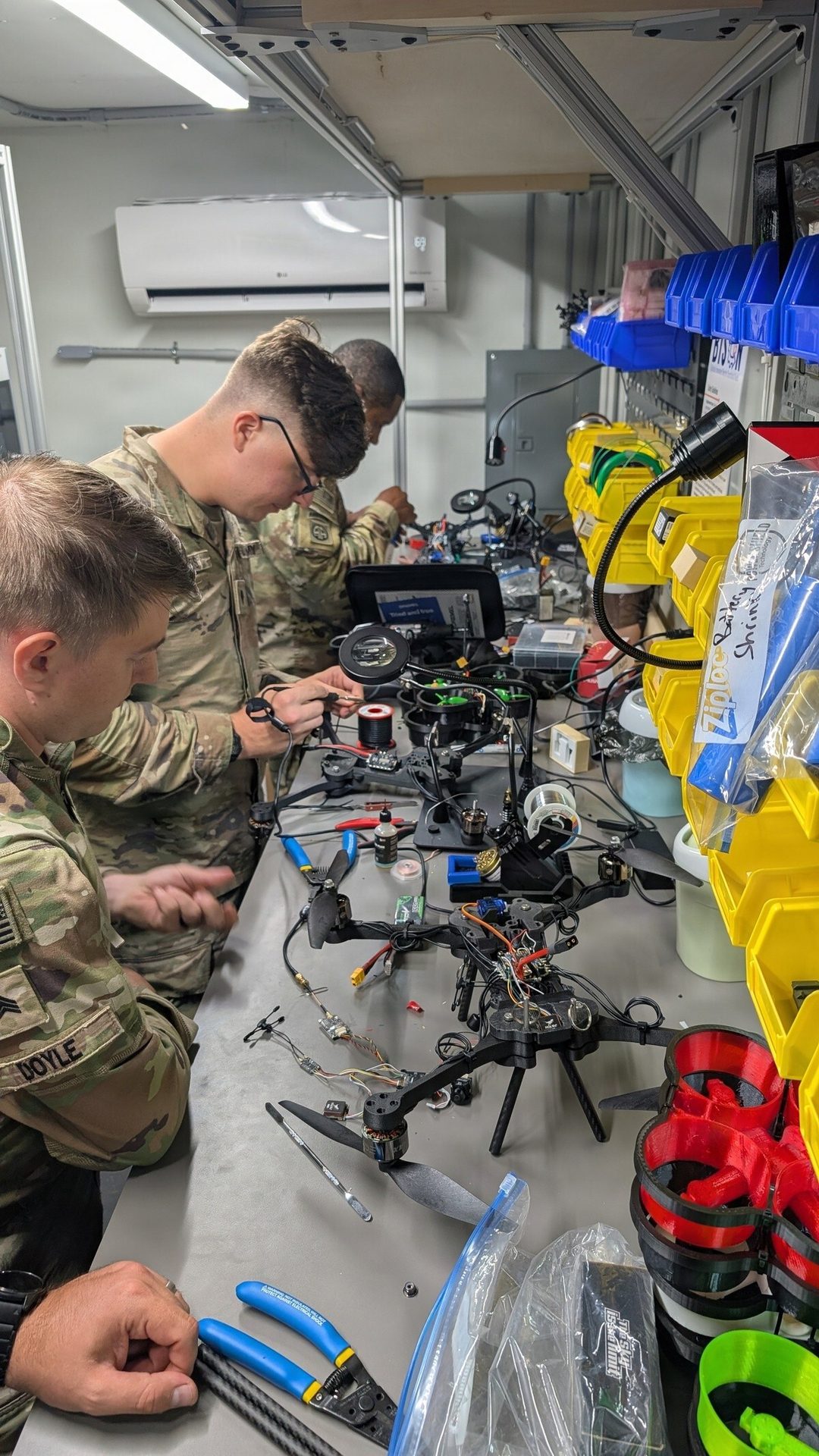
The military uses additive manufacturing technology to scale drone production. Photo courtesy U.S. Army DEVCOM Army Research Laboratory
AEM: What type of drone components are typically made with additive manufacturing technology?
Ferguson: Virtually every drone component benefits from additive manufacturing. Manufacturers can produce complete airframes and fuselages as single parts, composite rotor blades optimized for efficiency, lightweight battery housings with integrated mounting features, and custom sensor enclosures for cameras, lidar and thermal imaging. Internal structural components, mounting brackets for mission-specific payloads, antenna housings, and even the jigs and fixtures used to assemble drones, are increasingly 3D printed.
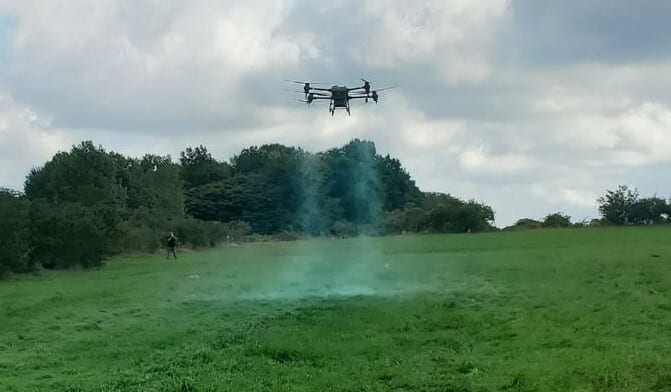
Drones are widely used for agricultural applications ranging from crop surveillance to spraying. Photo courtesy Michigan State University
AEM: What type of additive manufacturing equipment is typically used by drone manufacturers? Has Stratasys developed any equipment specifically for drone production?
Ferguson: Drone manufacturers leverage a variety of Stratasys technologies, including Fortus F3300 and F900, Fortus 450mc, H350 SAF, P3 DLP and Fortus FDC material delivery. While we haven't built a drone-specific machine, we've developed and validated materials specifically for aerospace applications that are perfect for UAV production. Our holistic approach combines validated materials with documented certification pathways, GrabCAD software for traceability, Stratasys Direct Manufacturing services and deep aerospace expertise, giving drone manufacturers everything needed to move confidently no matter their production stage or design need.
MAy 2026 | ASSEMBLYMAG.com