MEDICAL REVIEW

CONTACT
Austin

Lightweight battery-powered aircraft are ready for take-off.
Standardized Assembly Cells Save Time
John Sprovieri // Chief Editor
With the F-MAP, a seated assembler loads parts in and out of the cell, which can be equipped with a single processing tool, such as a servo press. Photo courtesy PIA Automation
MEDICAL PRODUCTS
Introducing a new medical device can take a long time. Aside from conducting clinical trials and earning FDA approval, device makers must also establish that their production processes conform to current good manufacturing practices (cGMP). These guidelines detail the minimum requirements that manufacturers must meet to ensure that their products are consistently high in quality, from batch to batch.
The last thing device makers need, then, is a delay in ramping up production. To reduce engineering time and get their products to market faster, many device makers are turning to standardized automated assembly platforms.
One of the newest such platforms is the Meditec series from PIA Automation. The line includes cells for manual, semiautomatic and fully automatic assembly.
The most basic unit is the Meditec F-MAP, a standalone, single-process workstation. With the F-MAP, a seated assembler loads parts in and out of the cell, which can be equipped with a single processing tool, such as a servo press, an automatic dispensing system, or a laser marker. The cell includes an HMI and arms for holding work instructions or part racks.
IC80 Inline Chassis Features
- Open frame designs allows access all around
- Tensioned with chordal compensating cam to reduce vibration
- Link pins use needle roller bearings for increased longevity
- Multiple drive options
Performance
- Zero-backlash in all directions
- High load capacity
- Long-term accuracy
- Fast and flexible indexing
Sankyo Automation
937-498-4901
Superior precision positioning products
The work area measures 1,000 by 1,500 millimeters, and the table height is 980 millimeters. A light curtain provides access to the work area and ensures operator safety. Machine controls are integrated into the cell.
For fast changeover, the cell is equipped with PIA’s Clictec technology, which enables standardized, modular fixtures to be exchanged quickly and easily with just one click.
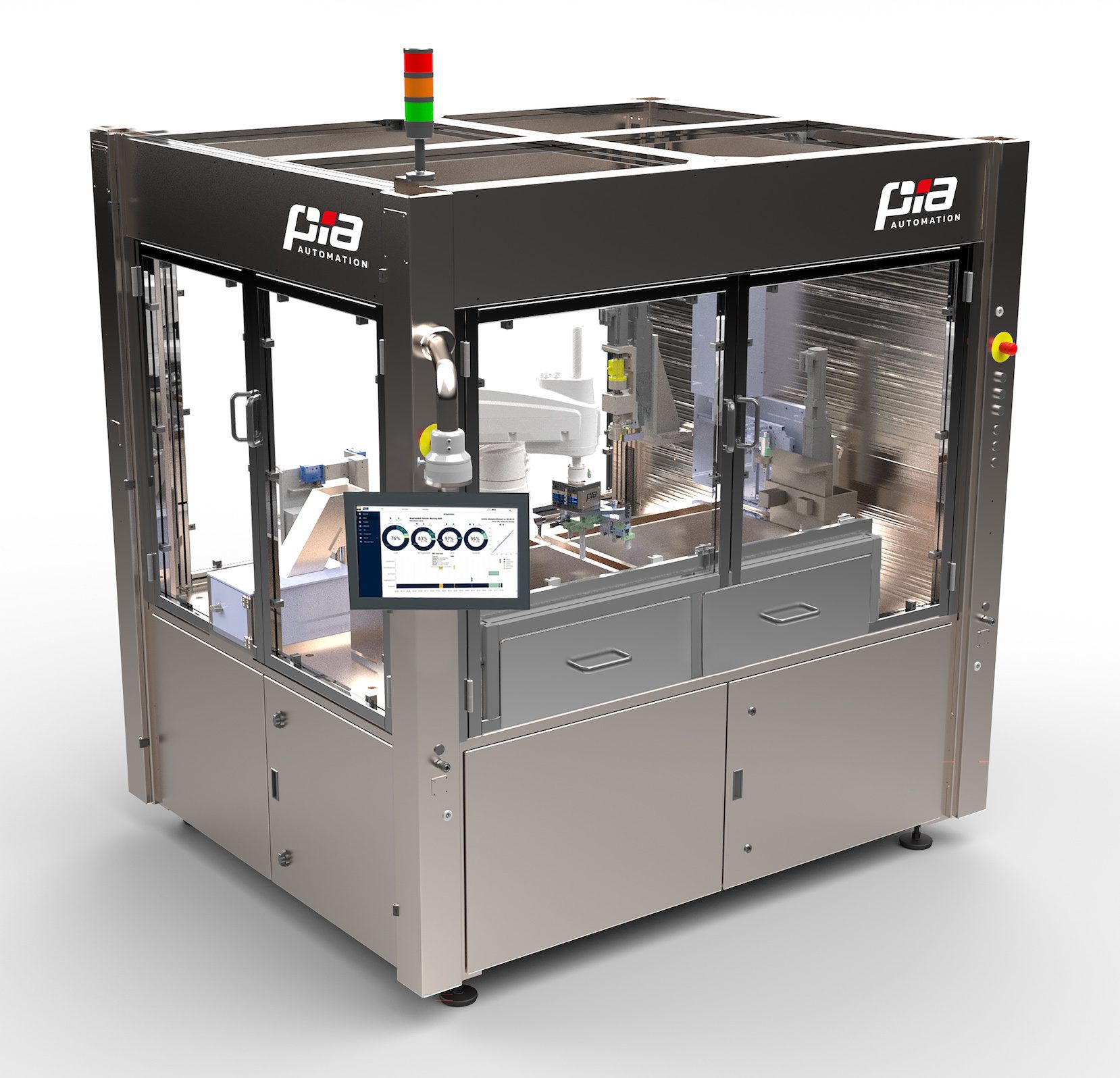
The Meditec V‑RAC is a flexible, compact robotic assembly system for drug delivery devices. Photo courtesy PIA Automation
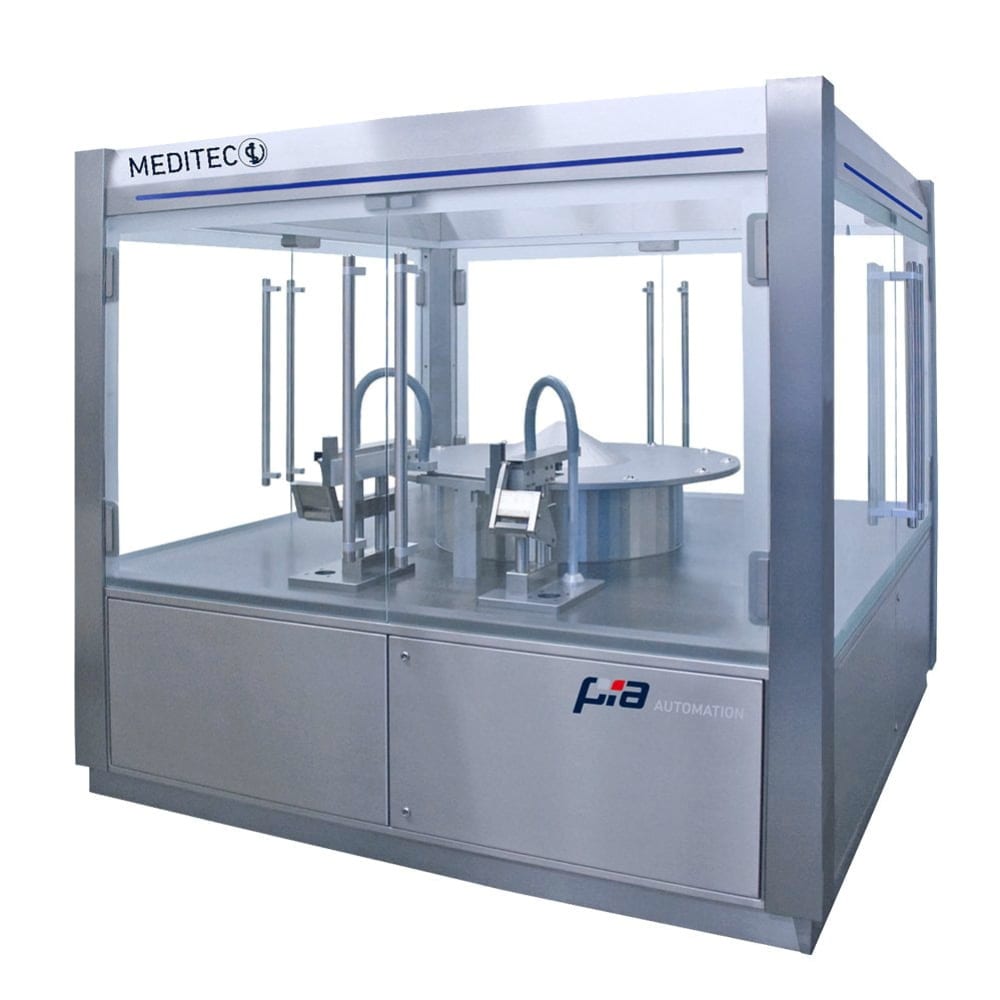
This rotary indexing system can run up to 60 cycles per minute. Photo courtesy PIA Automation
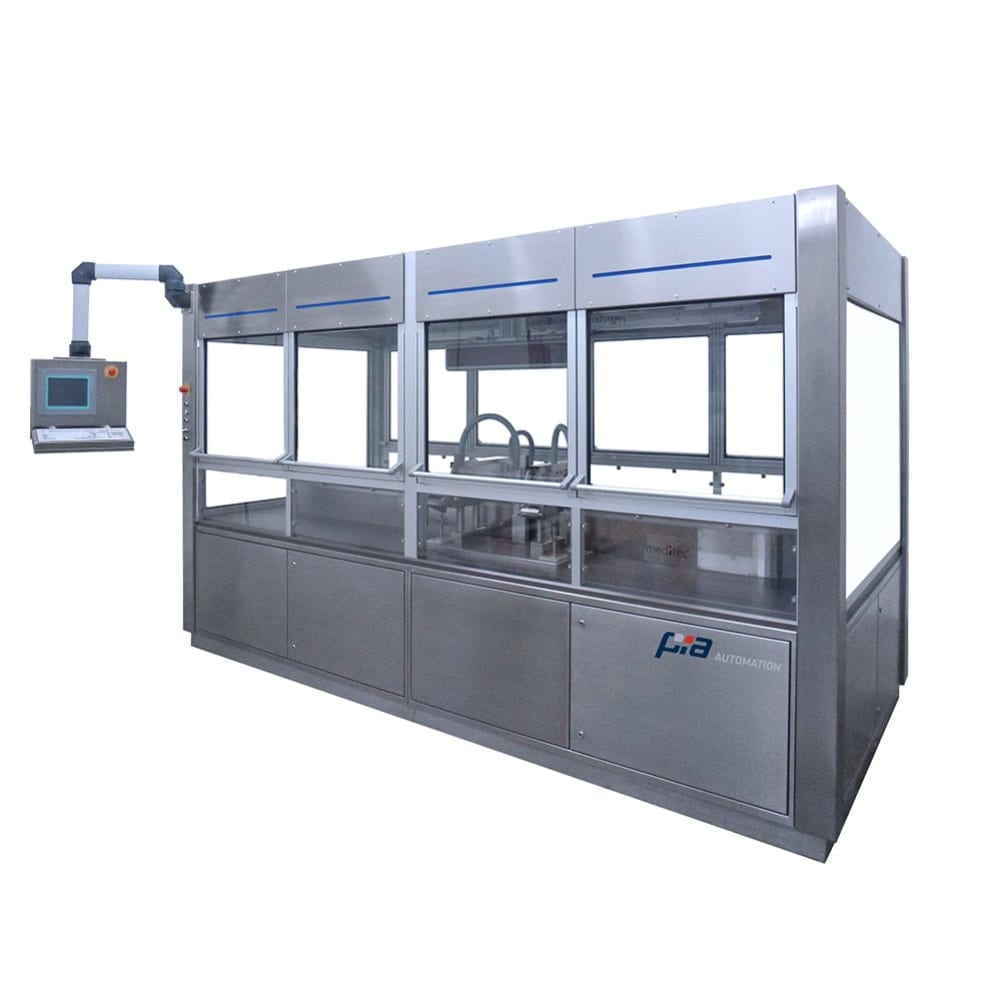
This linear transfer system can run up to 200 cycles per minute. Photo courtesy PIA Automation
For higher volume production, there’s the Meditec V‑RAC, a flexible, compact and efficient assembly system for GLP 1 pens, autoinjectors, safety syringes and other drug delivery devices. It is designed for preclinical and clinical production, as well as the manufacture of small and medium batch sizes. It is ideal for companies that require high-quality, GMP-compliant assembly processes, but also want maximum flexibility and short start-up times.
Measuring 1.8 meters long, 2.1 meters wide and 2 meters tall, the Meditec V‑RAC is equipped with a Siemens control system and Stäubli SCARA robot. Parts are loaded and unloaded manually, but the robot does all the handling within the cell.
Compatible with class ISO 7 clean room standards, the cell can be equipped with a variety of assembly processes, including pressing, dispensing, labeling and vision inspection. The cell can also be equipped with digital add-ons for smart factory integration.
It can produce up to eight parts per minute. Faulty assemblies are automatically ejected.
For fully automated assembly, the Meditec series offers two options.
A rotary indexing system can run up to 60 cycles per minute. The indexing drive unit is located beneath the base plate, and the system includes space for up to eight feeding tracks.
Compatible with class ISO 6 clean room standards, the compact system can accommodate parts up to 80 millimeters long.
A linear transfer system can run up to 200 cycles per minute. Assemblies are transported from station to station on pallets to accommodate variable processing times.
Compatible with class ISO 6 clean room standards, the system can accommodate parts 60 millimeters wide and 160 millimeters long.

“A company with Ford’s scale can really influence the supply chain and business practices across our entire industry,” adds Sue Slaughter, purchasing director at Ford Motor Co. “It is so important that we not only think about how [we] can use our purchasing power to fuel our business needs, but also to advance sustainability.”
Because the automotive supply chain is extremely complex, the Guiding Principles contain expectations about business ethics, working conditions, human rights, health and safety, environmental leadership and supply chain due diligence for suppliers at all tiers. All suppliers are expected to uphold these standards and enforce them throughout their supply chain.
The Guiding Principles are based on fundamental elements of social, environmental and governance responsibility that are consistent with applicable laws and international standards created by organizations such as the United Nations.
Topics covered under the revised guidelines include the following:
Business ethics, including counterfeit parts and data protection.
Environmental issues, such as air quality, carbon neutrality, chemical management, circularity and water management.
Health and safety issues, such as personal protective equipment and workspace.
Human rights and working conditions, such as benefits, wages and working hours.
Responsible supply chain management, such as ethical sourcing of raw materials.
The BMW Group has implemented several projects in its packaging logistics unit to help the environment and conserve resources. The goal of the initiative is to work closely with suppliers to reduce carbon emissions and adhere to the principles of a circular economy.
BMW’s European assembly plants are using more recycled material in their packaging. For newly awarded contracts, the proportion of recycled material in reusable packaging for logistics purposes will almost double this year from around 20 percent to over 35 percent.
Using alternative sustainable materials, reducing single-use packaging, introducing lightweight packaging in certain areas and reducing transport volumes will also help cut carbon emissions.
BMW is monitoring the impact of individual measures via a CO2 calculator for packaging. The automaker’s overall aim is to reduce CO2 emissions in the supply chain by 20 percent per vehicle compared to 2019.
“Our re:think, re:duce, re:use, re:cycle approach is being implemented consistently in packaging logistics,” says Michael Nikolaides, head of production network and logistics at BMW Group. “We’re using innovative strategies to consistently reduce the volume of resources we use, thus reducing our carbon footprint.
“We are also doing our part to get the BMW iFACTORY up and running, with a particular focus on the ‘green’ side of things…with an emphasis on flexibility and efficiency, sustainability and digitalization,” explains Nikolaides. “It provides an answer to the challenges involved in the transformation to e-mobility and [leverages] the latest technologies to create a production process that uses minimal resources.”
According to Nikolaides, BMW is using more recycled material, such as expanded polypropylene (EPP) packaging. “Our newly developed EPP packaging already contains 25 percent recycled material,” he points out. “EPP is used in special containers, as its shape can be adapted to the components being packaged, allowing them to be transported safely.
“Around 360,000 of these containers are needed each year,” claims Nikolaides. “Using 25 percent recycled material allows us to save almost 280 tons of CO2 annually. There are plans to increase this proportion of recycled material even further, with the first pilot schemes with 100 percent recycled material currently underway. If these tests are successful, this configuration will become standard for new contracts from 2024.
“An additional 680 tons of carbon emissions savings can be made every year by using covers and so-called small load carriers with 50 percent recycled contents,” says Nikolaides. “As things stand, these measures are focused within the European markets due to the current waste management situation and available recycling infrastructure. But, we are working toward expanding to our locations in China, Mexico and the United States.”
BMW also plans to use folding large load carriers in place of traditional pallet cages made of steel. The plastic alternatives will be made from over 90 percent recycled material. They work in a similar way to the collapsible shopping crates that most people are familiar with.
When they’re empty, the carriers can be folded up, making them easier to transport. Nikolaides claims that using 15,000 of these new containers will reduce CO2 by around 3,000 tons per year.
“When it comes to packaging, the sky’s the limit,” says Nikolaides. “We’re launching pilot projects using bio-based materials to replace oil-based substances such as polyethylene and polypropylene.
“We are also investigating whether and in what ways we can use materials from recycled household appliances in our packaging,” explains Nikolaides. “In the long term, our aim is to use alternatives to raw materials across the board.”
BMW Initiative Targets Sustainable Packaging
BMW is using sustainable packaging in its assembly plants. Photo courtesy BMW Group
ASSEMBLY ONLINE
For more information on medical device assembly, visit www.assemblymag.com to read these articles: