
MONTH 2023
Test and Inspection
Labor shortages are driving new demand for automation.
Options for Screwfeeding
Because eight parts are tested simultaneously, line speed is achieved for a cycle time of 12 to 15 seconds. Photo courtesy Inficon
New technology enabled a biotech company to triple production and save more than $1 million.
Micro-Scale Leak Testing of
Medical Devices
Jacques Hoffmann // President // InterTech Development Co. // Skokie, IL
Thankfully, most of us don’t easily recall the terrifying statistics that ruled our pandemic days before the COVID-19 vaccine became widely available. According to the Journal of the American Medical Association, more than 2.5 million deaths were averted when the vaccines became widely available. That equates to one death averted per 5,400 vaccine doses administered.
Before these vaccines and at the time of the March 2020 shutdown, the sole effective tool to help contain the epidemic was accurate testing. Rapid testing methods, such as polymerase chain reaction (PCR), gave public health officials a way to gauge how to deploy scarce resources and to make quarantines a standard operating procedure to help keep the disease from spreading.
Remembering this mindset helps give a window into the pressures that the engineers and scientists labored under as they tried to scale up production of PCR-based rapid testing systems for the COVID-19 virus.
In PCR testing, very small amounts of genetic material are copied and amplified. The technique is used to diagnose more than just COVID-19. It is used in a variety of immunodiagnostic and molecular assay tests.
Given the highly infectious nature of the COVID pathogen, tests for the virus had to be quick, reliable and safe. The test components and transfer devices had to be leak-proof—both to give accurate test results and to prevent infection of the clinicians performing the tests.
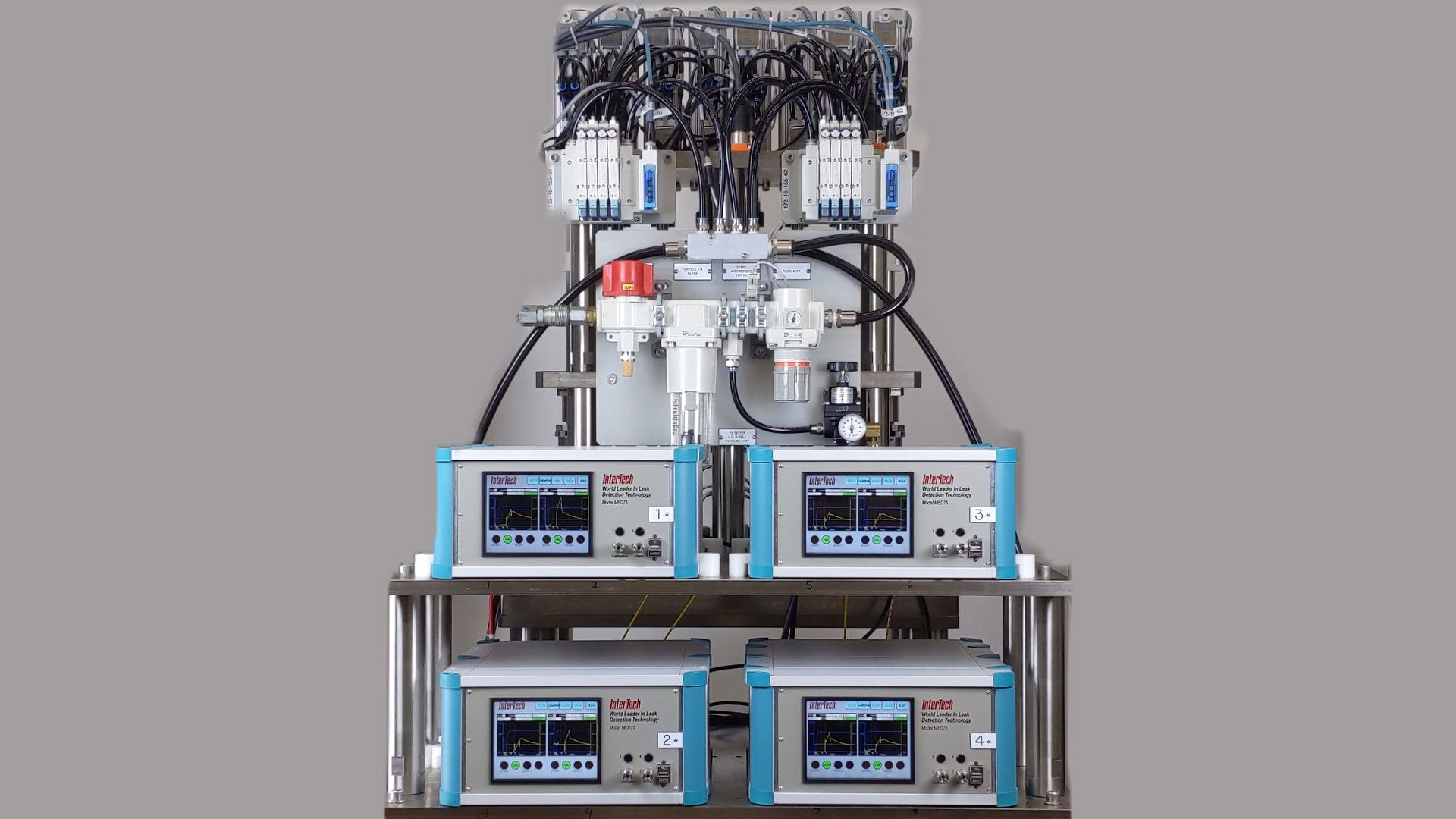
Sixteen InterTech test heads replaced 192 pressure decay test heads. Photo courtesy InterTech Development Co.
Leak Testing on a Small Scale
For these reasons, it was no small matter when the biotechnology company that developed the PCR test for COVID turned to InterTech’s MicroScale leak test systems. Less-than-fast and less-than-accurate leak testers were a major drag on the biotech company’s production output and gauge repeatability and reproducibility (GR&R).
GR&R is a statistical analysis tool used to quantify measurement error by assessing how much variation comes from the measuring instrument (repeatability) vs. different operators (reproducibility). The goal is to ensure the system reliably distinguishes good parts from bad and maintains product quality.
Through an industry reference, the biotech company eventually enlisted InterTech’s help to engineer an alternative to the pressure decay leak testers that the company had been using.
After implementing InterTech’s technology, the biotech company tripled production and saved more than $1 million. Sixteen InterTech test heads replaced 192 pressure decay test heads. The capital investment to create the new lines for testing was reduced by a factor of 12. Work in process was significantly reduced by optimizing floor space.
Most importantly, the stringency of the leak tests was never compromised. For example, the company originally tested the COVID-19 diagnostic sample transfer devices to a limit of 0.008 sccm at 682 to 710 millibars without GR&R capability. The new InterTech test system tested the devices to the same limit, but with a GR&R of less than 20 percent—at a rate of 16 parts every 2.8 seconds or 150 parts per hour.
Superior Technology
These turnkey microleak testing systems can be used for both in-line testing and audit testing. At the core of each system is InterTech’s patented mass-flow test sensors, superior pressure decay test sensor designs, and unique test fixtures.
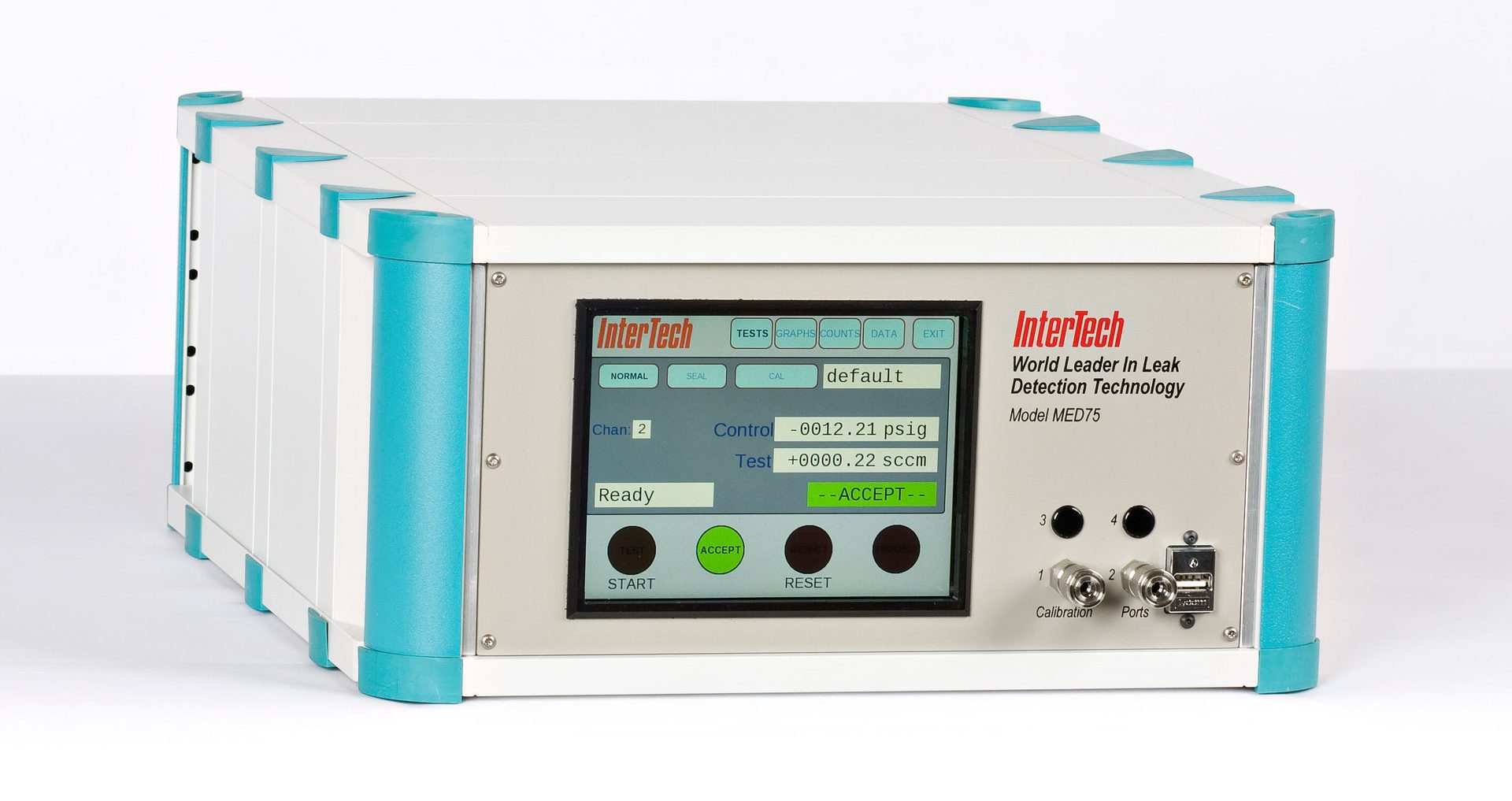
This instrument can leak test 16 parts every 2.8 seconds or 150 parts per hour. Photo courtesy InterTech Development Co.
InterTech’s MicroScale leak test technology effectively eliminated the testing errors (both false positives and false negatives) inherent in the pressure testing methods that the company had previously used. Faster throughput was achieved by replacing inefficient test instruments with InterTech MED75 MicroScale leak testers, which feature dual, independent test channels.
The instruments can reliably find holes as small as 0.5 micron in diameter.
Ethernet-IP capability allows seamless integration of test data with all the company’s quality assurance systems. This remote access to test data also led to significant savings in maintenance and product changeover times.
A robust product quality traceability system was assured by implementing a deterministic analytical test technology life cycle. The InterTech leak test systems are compatible with all ASTM standards, including ASTM F2338 and ASTM F3287, as well as being 21 CFR Part 11 compliant.
ASSEMBLY ONLINE
For more information on leak testing, visit www.assemblymag.com to read these articles: