
Plastic and Metal Welding
Labor shortages are driving new demand for automation.
Options for Screwfeeding
This automated positioning system enables one set of parts to be loaded and unloaded while a six-axis robot welds a second set of parts. Photo courtesy CLOOS North America
Robots enable skilled welders to handle more technically demanding tasks.
Volvo Automates Welding
John Sprovieri // Chief Editor
Volvo Construction Equipment in Shippensburg, PA, and CLOOS North America in suburban Chicago go way back.
As a heavy equipment manufacturer, Volvo produces large metal assemblies requiring high welding deposition rates and robotic systems capable of optimal positioning. CLOOS has been supplying welding technology for more than 70 years.
Volvo’s first CLOOS machine, a robotic system that could automatically adjust to weld compactor drums of different lengths and diameters, was purchased in 1998. To put that in perspective, Google was founded in the same year.
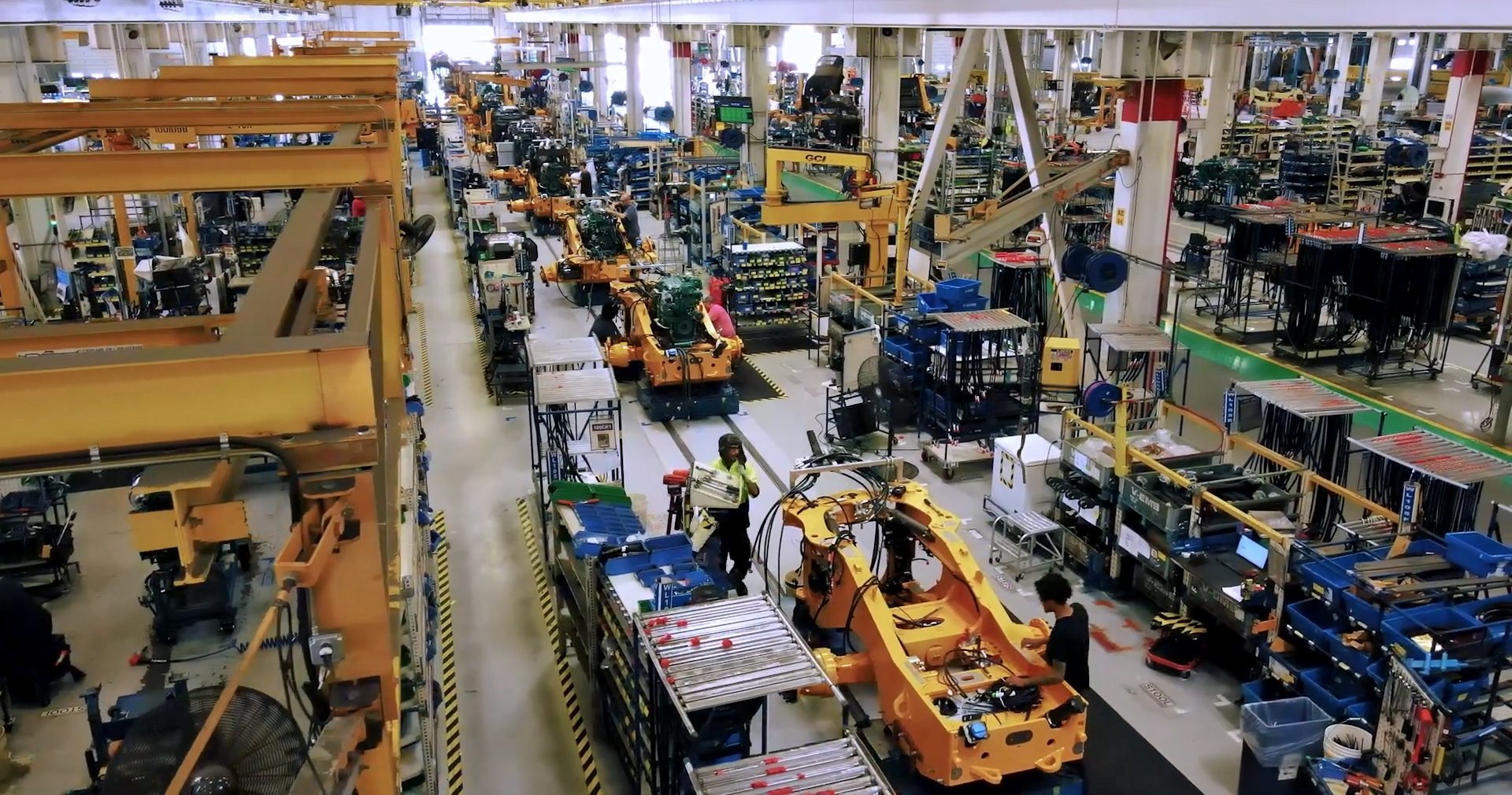
Volvo’s assembly plant in Shippensburg, PA, manufactures wheel loaders, compactors and other construction equipment. Photo courtesy CLOOS North America
“With each size we had to do a new setup,” recalls Karen Geesaman, head of manufacturing engineering and maintenance at Volvo. “And with the system from CLOOS, the robot was able to adjust to each size and diameter of drum without us having to touch it. That was super helpful, reduced our setup times, increased quality, and reduced manual weld time.”
The success of that first system kicked off a strong bond between the two manufacturers. Today, Volvo has 12 CLOOS systems in operation at its assembly plant.
“We’ve been working together for decades,” says Nate Alleman, Volvo’s head of wheel loader end-to-end flow. “Because of our relationship with that team, we’ve switched over all of our robots completely to CLOOS.”
The Challenge
Volvo developed a deep familiarity with automation during the past 37 years, and that’s changing how the company thinks about addressing assembly challenges.
“There are times when we’re discussing some problem, and we’ll joke, ‘Well, if we could only solve this,’” Alleman says. “And then we stop and think, ‘What if we could actually solve that?’”
Time after time, Volvo has reached out to CLOOS to work together on new solutions to its thorniest problems.
Most recently, Volvo noticed that its skilled workers were spending more time on non-value-added tasks—moving material, hooking it up to a crane, and setting it in a fixture—instead of doing what they do best: complex welds. It was draining time and energy that could have been better spent on more important work.
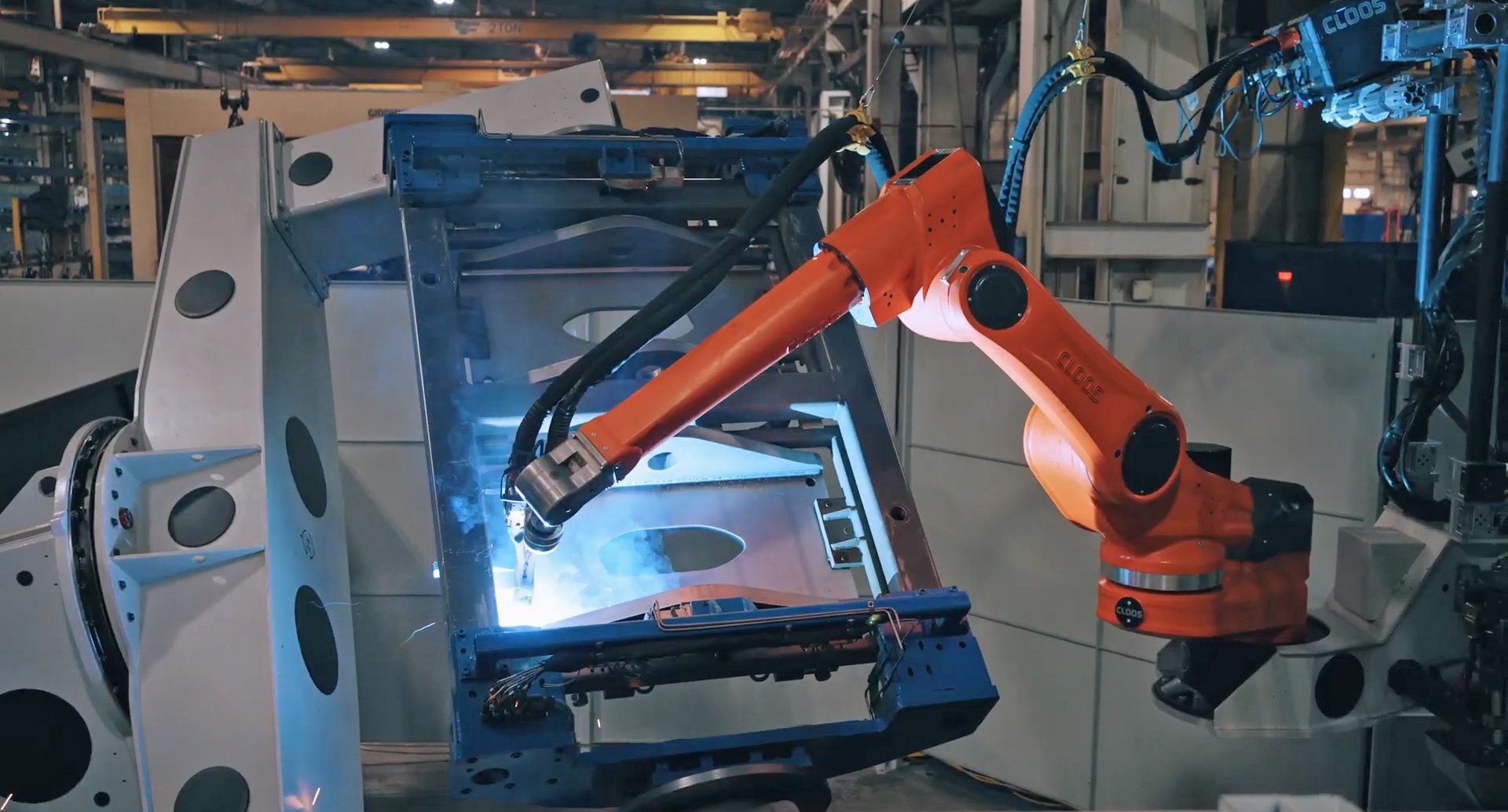
Automating large weldments has freed up skilled welders to tackle more technically demanding jobs. Photo courtesy CLOOS North America
The Solution
Working with Volvo and another supplier specializing in autonomous vehicles, CLOOS created a state-of-the-art robotic welding system in which different technologies work in concert.
An autonomous mobile robot (AMR) independently collects material from a welder’s cell, transports it across the production floor, and loads it into another automated cell. That cell has an automated positioning system—almost resembling a rotisserie or tuning fork—that both supports and articulates the material. That enhanced articulation provides two axes of positioning, enabling access to all six sides of the weld.
The “tuning fork” system sits on a swiveling mechanism. Once the part is loaded into the fixture, the whole assembly rotates to an enclosed cell where a welding robot finishes the job.
That rotation reveals a second fork, this one holding another component that’s just been completed. While the new material is being welded on the other side, the AMR takes the finished component, moves it down the line, and returns to its original position to start the whole process over again.
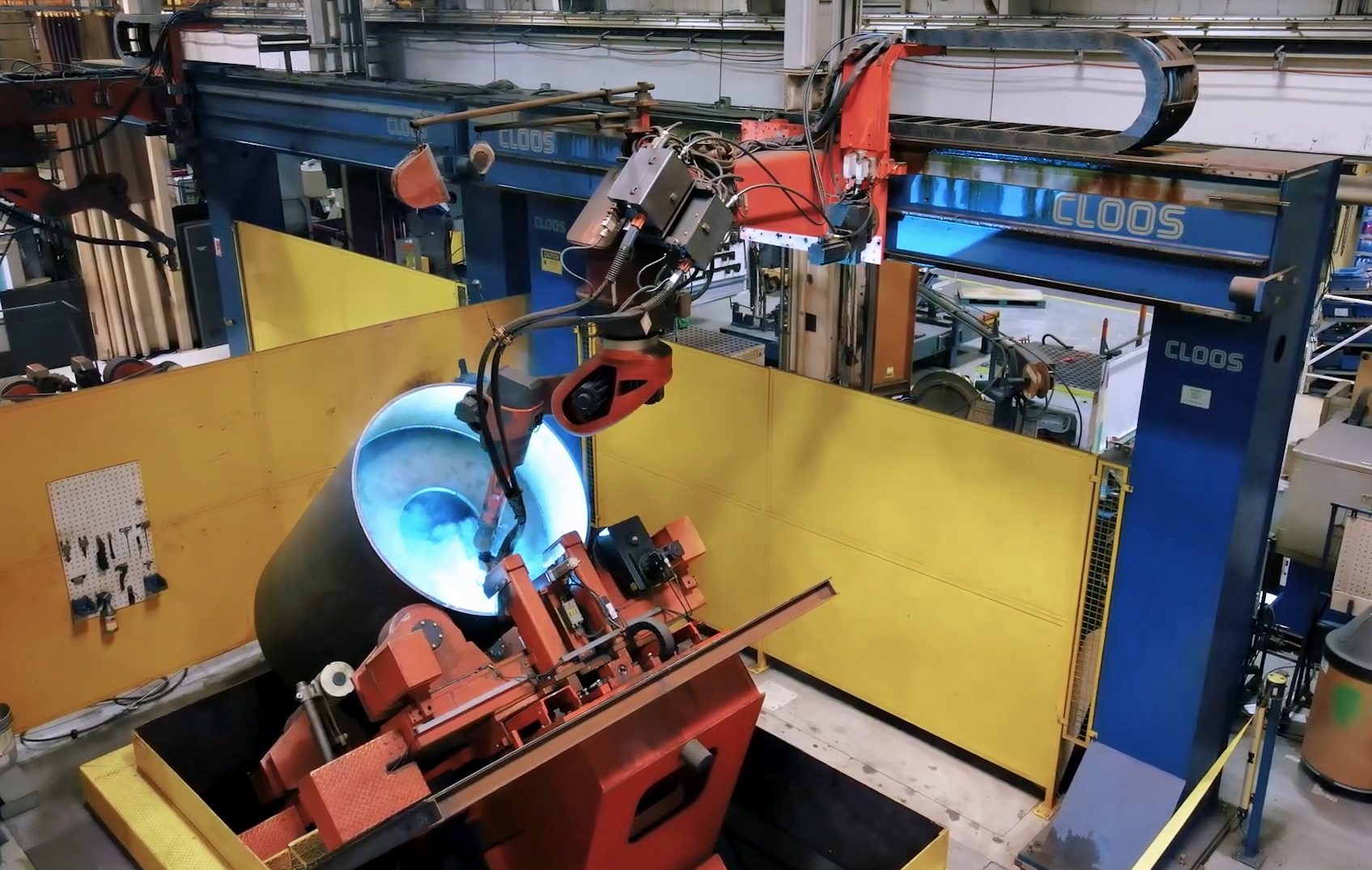
This robotic system automatically adjusts to weld compactor drums of different lengths and diameters. Photo courtesy CLOOS North America
The automated system has dramatically reduced cycle times, allowing Volvo to meet growing production demands without compromising quality. The automated process has improved ergonomics and requires less manual intervention, freeing up skilled welders for more critical tasks.
“We’re probably at least a third faster in this operation than we were before,” Alleman says. “We’re getting better welds, better reach and locations, so that we have less manual welds afterwards. We’re taking out that non-value-added work…and keeping those welders on the welding task. This gets us one step further in being the best plant we can be.”
“Adding the CLOOS system into our fabrication department was a big help,” says Justin Brindle, production team lead at Volvo. “With the AMR to load and unload, we are able to walk away and not have to watch it. And, the weld speed with the CLOOS robot is so much better than what we’ve had in the past. It’s actually welding faster than we can build parts.
“With the old system, we couldn’t run lights out,” he continues. “With the new system, we are able to run lights out. Within the first week of us using the new system, I could tell a huge difference with the weld speed and the quality of the welds coming from this new system.”
The collaboration between CLOOS and Volvo highlights that solving automation problems isn’t just about robots—it’s about relationships.
“We’ve had a good relationship over all those years. We have great respect for CLOOS,
for their products, the reliability of their service—everything. Anything we work with them on, we always have great outcomes,” says Troy Renninger, a weld engineer at Volvo.
For more information on robotic welding, click here. To see a video of the system in action, click here.